Editorial self-study SET for 2027; not an official SASMO 2027 examination. Known source years remain in individual attributions. Time: 90 minutes. Platform scoring starts at 0: Q1–15 are worth 2 points each; Q16–25 are worth 4 points each; wrong and blank answers score 0; maximum 70. Official SASMO scoring instead starts at 15, deducts 1 for an incorrect Section A answer and has a maximum of 85. Verified means editorially checked; assumptions, source errors and mathematical uncertainty are disclosed where relevant.
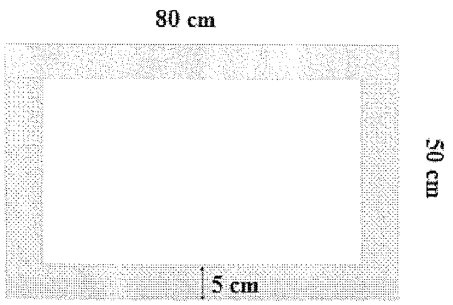
A television is 80 cm long and 50 cm wide. Its border is 5 cm thick on every side. What is the area of the screen, in square centimeters?
Lily, Macy and Ronald are old classmates. At a recent gathering they discuss their occupations: one is a teacher, one a doctor and one a lawyer. Ronald is older than the teacher. Macy is younger than the lawyer. The lawyer is younger than Lily. What is Lily’s occupation?
Sally writes “Singapore and Asian Schools Math Olympiad”. She starts on Monday and writes one letter each day. On which day of the week does she finish? Spaces are not letters.
Alex writes SASMOSASMOSASMO… repeatedly. (a) What is the 36th letter? (b) How many times does S appear among the first 50 letters? Give the letter; count.
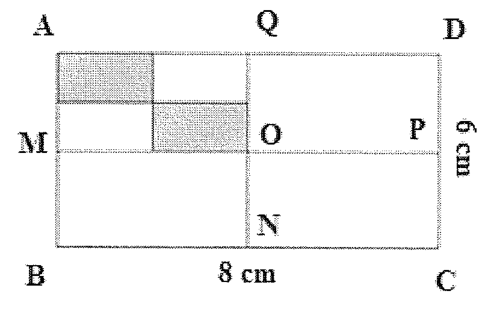
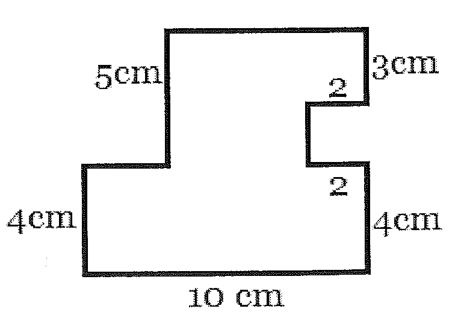
Rectangle ABCD is 8 cm long and 6 cm wide. Find the total area of the two shaded rectangles, in square centimeters, using the subdivision in the diagram.
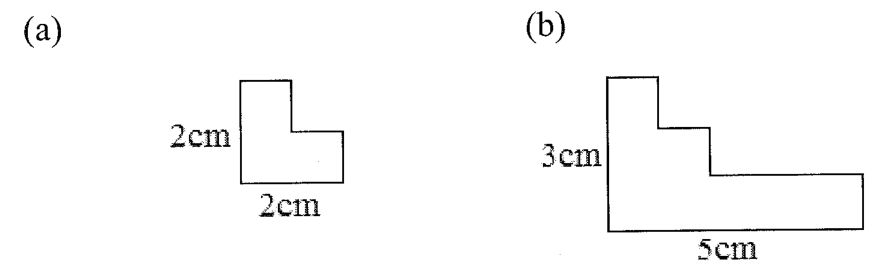
For this exercise assume M,P,Q,N are the side midpoints, O is the center, and the upper-left quarter is split into four equal rectangles. These equalities are suggested by the drawing but not marked in the source.
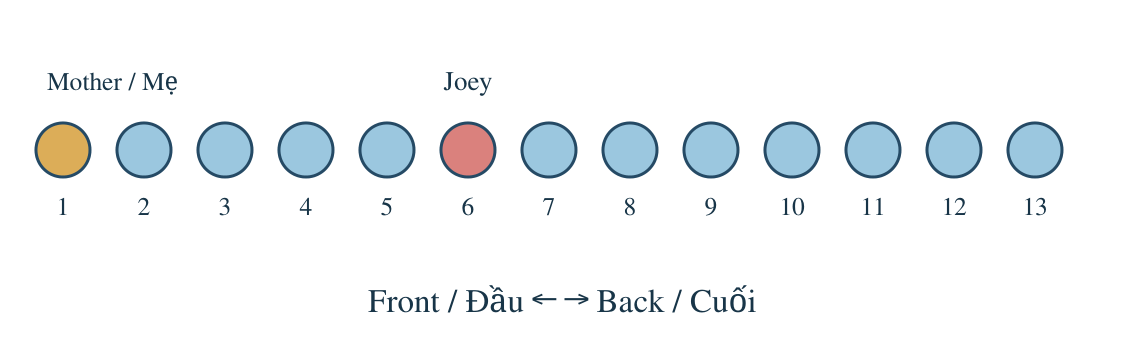
Ducklings walk in a queue following their mother. Joey is 6th from the front and 8th from the back, counting the mother in the queue. Some ducklings leave, making Joey the middle duck in the queue. What is the fewest ducklings that must leave?
“Middle” refers to the whole queue, including the mother. Only other ducklings leave; Joey and the mother stay.
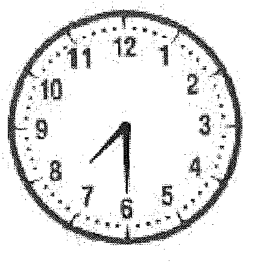
The clock shows 7:30 a.m. The hour hand is between 7 and 8 and the minute hand points to 6. Which number will the minute hand point to 50 minutes later?
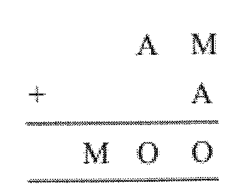
Different letters represent different digits in the column addition AM+A=MOO. Find the three-digit sum MOO. Letters in a row denote decimal numbers, not multiplication.
Leading digits A and M cannot be zero. Repeated letters have the same value.
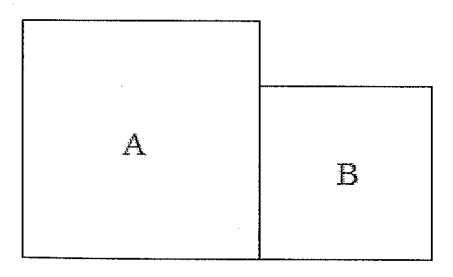
Two squares A and B are adjacent, aligned along their bottom edges as shown. The difference of their areas is 85 square centimeters. The source asks for the perimeter of the combined figure. Can one unique perimeter be determined from these data? Enter yes or no.
The source gives no extra relation between the side lengths, and its answer key is not supported by the stated data. Treat the sketch as not to scale; decide whether the requested perimeter is uniquely determined.
Amy, Bob and Cindy have favorite fruits among orange, apple and pear. Amy says, “I don’t eat orange.” Bob says, “I don’t eat apple or orange.” Find each favorite fruit. Give Amy; Bob; Cindy.
Use the source’s intended one-to-one assignment: each child has one favorite, all three favorites differ, and the statements exclude the named fruits from their favorites.
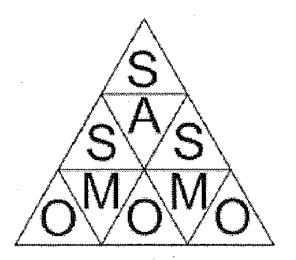
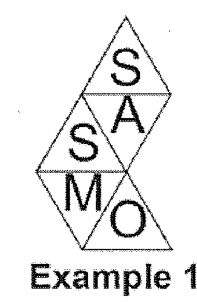
How many ways can the word SASMO be cut from the triangular paper? The five letters must stay in one piece, as in Example 1.
Count distinct selections of five triangular cells forming an edge-connected letter path S→A→S→M→O, as in the example. Touching only at a corner is not enough.