Editorial self-study SET for 2027; not an official SASMO 2027 examination. Known source years remain in individual attributions. Time: 90 minutes. Platform scoring starts at 0: Q1–15 are worth 2 points each; Q16–25 are worth 4 points each; wrong and blank answers score 0; maximum 70. Official SASMO scoring instead starts at 15, deducts 1 for an incorrect Section A answer and has a maximum of 85. Verified means editorially checked; assumptions, source errors and mathematical uncertainty are disclosed where relevant.
Andy has 3 pieces of paper. He tears each into 5 smaller pieces. He then takes some of the resulting pieces and tears each into 3 smaller pieces, continuing this process. Can he finish with 49 pieces?
Three children have a total age of 30 years. The oldest is twice as old as the second child. The youngest is 10 years younger than the oldest. How old is the oldest?
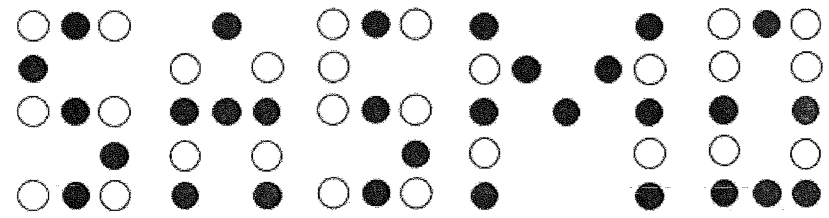
Equal-sized black and white circles spell SASMO as shown. The total area of the black circles is 50 cm ². What is the total area of the white circles, in cm ²?
The source Vietnamese sentence accidentally refers to all circles, but its English statement and answer key use the black circles. Here 50 cm ² explicitly refers only to the black circles.
Children stand equally spaced in a circle and are numbered consecutively around it. The fifth child is opposite the thirteenth. How many children are there?
As intended by “opposite” in this counting question, children occupy equally spaced positions numbered in order around the circle.
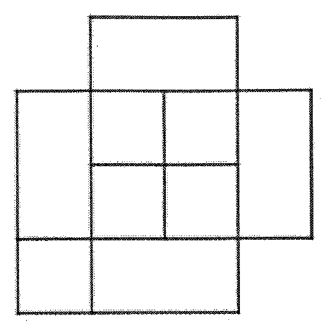
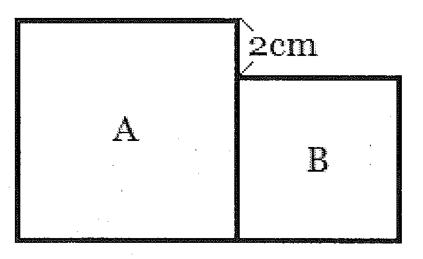
The figure is made of squares A and B. Square A has perimeter 28 cm. Its top is 2 cm above the top of B, and their bottoms are aligned. What is the perimeter of the whole figure, in cm?
Billy reads 5 pages on day 1, 10 pages on day 2, 15 pages on day 3, and continues increasing the daily amount by 5. He finishes the comic on day 8, reading the full scheduled amount that day. How many pages does the comic have?
Use the source’s intended convention that Billy reads 40 pages on day 8, rather than stopping after a smaller remainder. Otherwise the exact total is not determined.
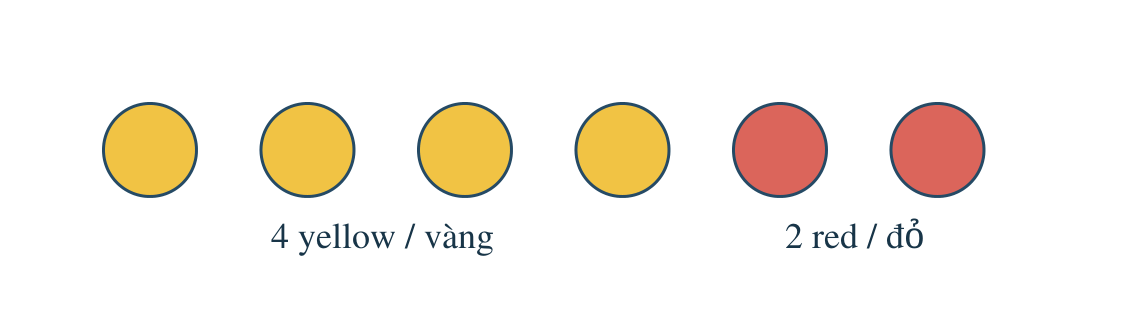
A basket contains 4 yellow apples and 2 red apples. Without looking, what is the smallest number of apples you must take to be certain of having 2 apples of the same color?
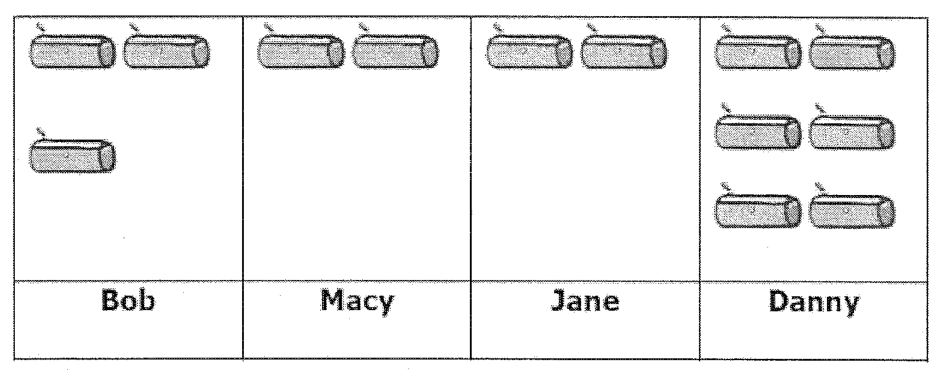
Bob, Macy, Jane and Danny have the pictured pencil cases. Every case holds the same number of pencils. Danny has 18 more pencils than Bob. How many pencils do the four children have altogether?
Hansel wants two dice in different colors. Available colors are red, blue, green, yellow, pink and white. How many different pairs of colors can he choose? The order of choosing does not matter.
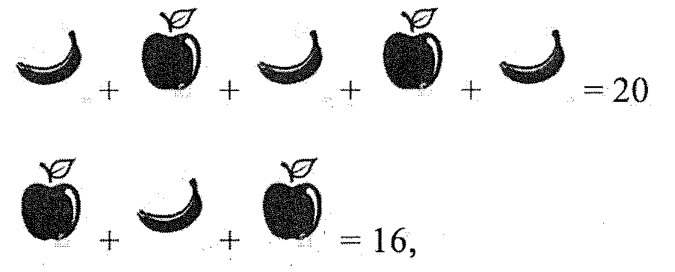
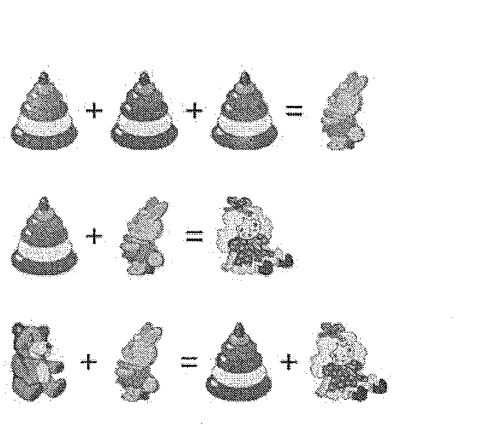
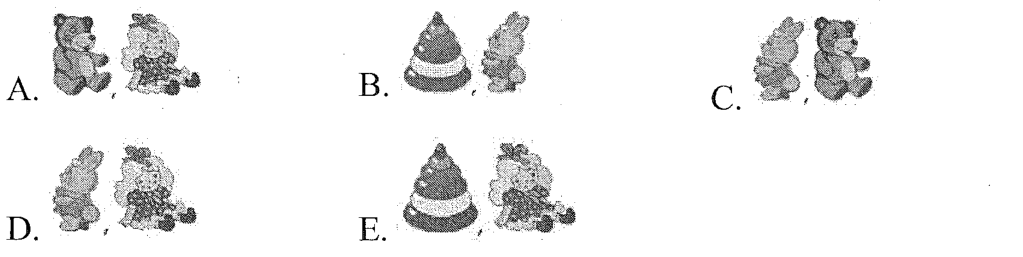
Nelly buys four kinds of toys whose positive prices satisfy the pictured equalities. Which pair shows the cheapest toy first and the most expensive toy second?
Given $2\ast3=49$, $3\ast2=94$ and $4\ast3=169$, find $3\ast8$ using the intended rule: square each input, then write the two results next to one another in their original order.
A finite list of examples alone permits other artificial rules. This edition explicitly uses the source’s square-and-concatenate rule before answering.