Editorial self-study SET for 2027; not an official SASMO 2027 examination. Known source years remain in individual attributions. Time: 90 minutes. Platform scoring starts at 0: Q1–15 are worth 2 points each; Q16–25 are worth 4 points each; wrong and blank answers score 0; maximum 70. Official SASMO scoring instead starts at 15, deducts 1 for an incorrect Section A answer and has a maximum of 85. Verified means editorially checked; assumptions, source errors and mathematical uncertainty are disclosed where relevant.
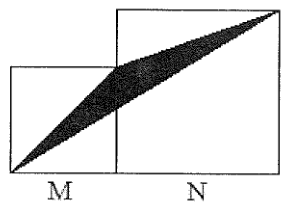
M and N are adjacent squares with side lengths 4 cm and 6 cm, respectively, standing on the same baseline as shown. Find the area of the shaded triangle in square centimetres.
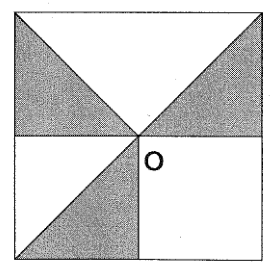
The square has area 40 cm². O is its centre. What is the area of the shaded region? The horizontal line through O joins the midpoints of the sides, and the lower vertical segment joins O to the midpoint of the bottom side.
Arrange 30 squares in a row and colour them black and white following the pattern. How many more black squares than white squares are there?
The English source says “triangles”, but the picture, Vietnamese statement and worked solution use squares. Count squares, continuing the repeating block black, white, black, white, black, black.
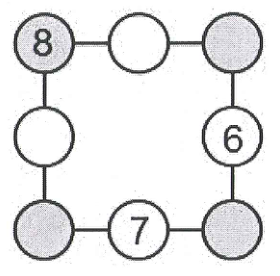
John has written 6, 7 and 8 in three circles. He writes each of 1, 2, 3, 4 and 5 exactly once in the remaining circles so that the sum along each side of the square is 13. What is the sum of the numbers in the shaded circles?
Fill all seven blank cells so that the sum of any three consecutive cells is 235. Enter the seven missing numbers from left to right, separated by commas.
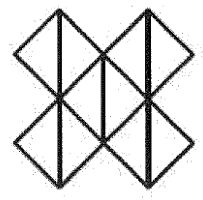
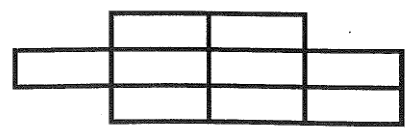
For this edition, interpret the drawing as a regular grid: the top row occupies columns 2–3, the middle row columns 1–4, and the bottom row columns 2–4. Count all rectangles, including squares; the drawn lines, not the printed answer key, determine the answer.
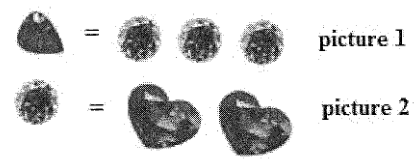
In the country of Jewellery, three sapphires can be traded for one ruby (picture 1), and one sapphire for two hearts (picture 2). How many hearts are worth two rubies?
A rectangle is 6 cm long and 4 cm wide. Its length is increased by 2 cm. What should the new width be so that its area stays the same? Give your answer in centimetres.
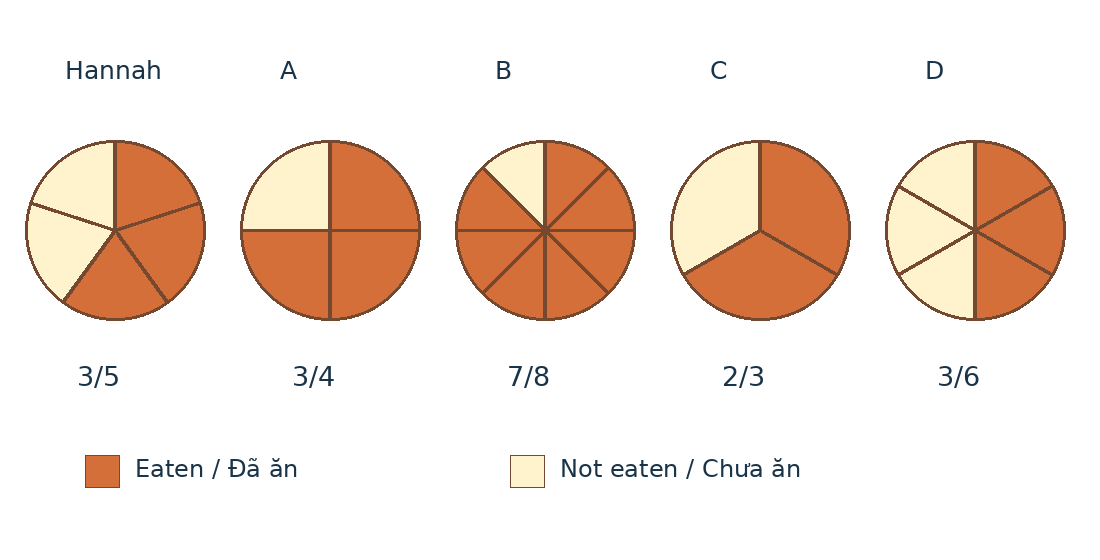
Hannah buys five whole pizzas: one for herself and one for each of four students. She cuts hers into 5 equal slices and eats 3. Student A cuts a pizza into 4 equal slices and eats 3; B cuts one into 8 and eats 7; C cuts one into 3 and eats 2; D cuts one into 6 and eats 3. Who eats less pizza than Hannah?
Assume the five whole pizzas are the same size, as required by the source fraction comparison.
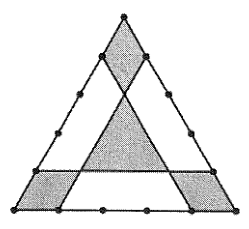
A triangle has area 50 cm². Each side is divided into five equal parts and some pairs of division points are joined as shown. What is the total area of the shaded regions, in square centimetres?
Use the equal-division diagram as drawn: each side has five equal parts, and the interior segments follow the corresponding parallel triangular grid.
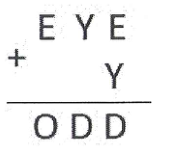
One day Randy is bored and writes all whole numbers from 49 through 97, including both endpoints. How many times does he write the digit 8? Give the number of occurrences. The worked-example source also offers these choices: A. 4; B. 8; C. 11; D. 13; E. None of the above.
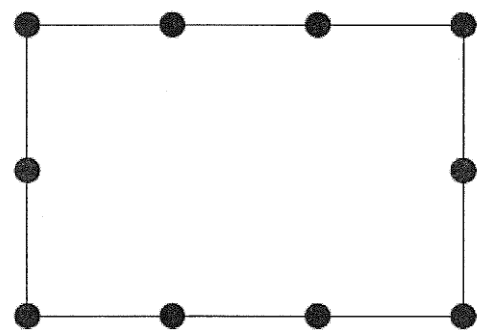
Tom makes the shown rectangle with 10 gumdrops and 10 toothpicks. He then makes another rectangle using 32 gumdrops. Each long side has twice as many gumdrops as each short side. How many gumdrops are on one short side of the new rectangle? Include the two corner gumdrops when counting a side.