Editorial self-study SET for 2027; not an official SASMO 2027 examination. Known source years remain in individual attributions. Time: 90 minutes. Platform scoring starts at 0: Q1–15 are worth 2 points each; Q16–25 are worth 4 points each; wrong and blank answers score 0; maximum 70. Official SASMO scoring instead starts at 15, deducts 1 for an incorrect Section A answer and has a maximum of 85. Verified means editorially checked; assumptions, source errors and mathematical uncertainty are disclosed where relevant.
Billy, Fred and Jenny meet for dinner. Their jobs are dentist, teacher and accountant, one each. Fred is older than the accountant. Billy is a different age from the teacher. The teacher is younger than Jenny. What is each person’s job? Enter the codes for Billy; Fred; Jenny: D = dentist, T = teacher, A = accountant.
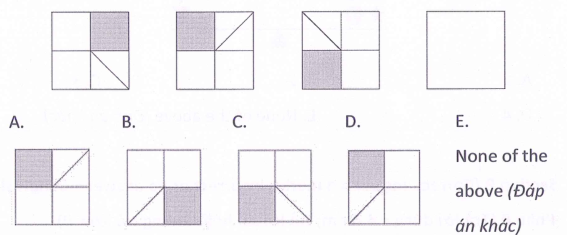
Find the next number in 8, 10, 6, 12, 4, 14, 2, … . One source asks for a number; another gives A. 0, B. 10, C. 16, D. 18, E. None of the above. Enter the number; option letter.
Use the intended pattern of two alternating arithmetic sequences. The source keys disagree; the solution explains the discrepancy.
(a) Donald, Ann, Dan and Bob raced. Ann was neither fastest nor slowest. Bob was faster than Donald. Dan was slower than Ann. Who was fastest?
(b) In the SASMO 2016 source variant, Dora, Lucas, Richard and Jonathan raced. Lucas was neither fastest nor slowest. Jonathan was faster than Dora. Richard was slower than Lucas. Who was fastest?
Enter the names for (a); (b), separated by a semicolon.
Answer all three parts: (a) How many one-digit numbers are there? (b) How many two-digit numbers are there? (c) How many numbers are there from 37 to 311? Count nonnegative whole numbers, including 0 as a one-digit number, and include both endpoints in (c). Enter (a); (b); (c).
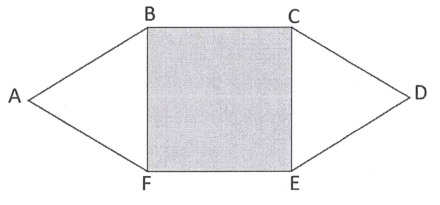
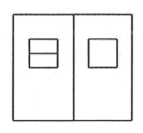
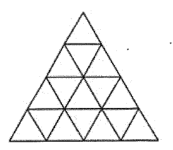
How many different rectangles, including squares, are in the diagram? Count rectangles of every size whose complete sides are drawn.
The source answer key is inconsistent with the instruction to count all rectangles. Follow the printed diagram and include the outer frame and both large halves.
Bob wants to buy two balls of different colors. The shop offers orange, yellow, white, red and green. How many different pairs of colors can he choose?
In a family, each boy has three sisters and each girl has three brothers. How many children are there? A source variant is open-response; another offers A. 3, B. 6, C. 7, D. 8, E. None of the above. Enter the number of children; option letter.