Editorial self-study SET for 2027; not an official SASMO 2027 examination. Known source years remain in individual attributions. Time: 90 minutes. Platform scoring starts at 0: Q1–15 are worth 2 points each; Q16–25 are worth 4 points each; wrong and blank answers score 0; maximum 70. Official SASMO scoring instead starts at 15, deducts 1 for an incorrect Section A answer and has a maximum of 85. Verified means editorially checked; assumptions, source errors and mathematical uncertainty are disclosed where relevant.
Nancy took part in the 12-mile Hunger Walk, starting at 3:00 p.m. and finishing at 5:00 p.m. How many hours did Nancy walk? Enter the number of hours.
Uncle John lives on a farm with his wife and two sons. They raise 10 cows and 20 chickens. How many legs are there altogether, counting the people and animals described?
Three apples and five oranges weigh 270 g. Three apples and seven oranges weigh 342 g. What is the weight of one orange, in grams? Fruit of the same kind has the same weight.
Jack, Henry and Chloe come from Canada, Vietnam and France, one person from each country, but not in that order. Henry was not born in Vietnam or France. Chloe is younger than the person from France. Find each person’s native country. Enter the country codes for Jack; Henry; Chloe, using CA = Canada, VN = Vietnam, FR = France.
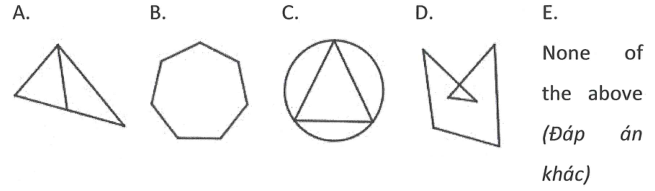
Drawing in “one stroke” means drawing a figure without lifting the pen and without retracing a line. Which of the figures below cannot be drawn in one stroke? Choose A, B, C, D or E.
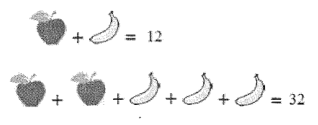
The identical fruit symbols stand for the same numbers. Given the two equations in the figure, what number does an apple stand for?
The same problem appears as Question 5 of SASMO 2016 Primary 2, with these choices: A. 2; B. 4; C. 6; D. 8; E. 10. This self-study question keeps the open-response form: enter the number represented by the apple, not a choice letter.
Forty apples are shared equally among six children, giving each child as many whole apples as possible. How many does each child get, and how many are left over?
What is the smallest positive whole number that is divisible by both 6 and 7 and contains exactly two odd digits?
The source’s English phrase “has two odd numbers” is interpreted as “contains two odd digits”, following its Vietnamese wording and answer key; it does not mean a two-digit odd number.
Find the next number in the sequence 21, 24, 19, 26, 17, … .
Use the simple repeating rule suggested by the sequence. A finite list alone can support other invented rules; this question asks for the intended elementary pattern.
Tyler tells Kyle: “When I was your age, you were only 5 years old. By the time you reach my present age, I will be 44 years old.” Find their present ages. Enter Kyle’s age; Tyler’s age, in years.
A toy shop has 43 yo-yos in its first box and 23 in its second box. In one week it sells the same number from each box. The first box then contains five times as many yo-yos as the second. How many yo-yos remain in the shop altogether?
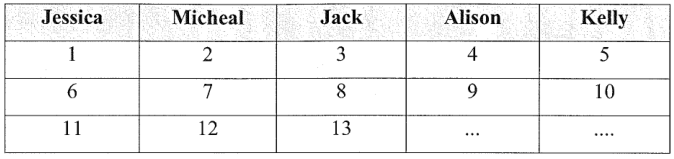
Forty-eight picture cards are distributed among five children in the repeating order shown in the table. Who receives (a) the 28th card and (b) the last card? Enter the two names in order, separated by a semicolon.
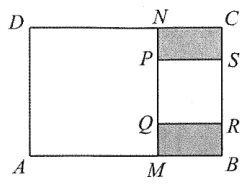
Squares AMND and PQRS lie inside rectangle ABCD as shown. Their areas are 16 cm² and 4 cm² respectively. What is the total area of the shaded regions, in cm²?