Editorial self-study SET for 2027; not an official SASMO 2027 examination. Known source years remain in individual attributions. Time: 90 minutes. Platform scoring starts at 0: Q1–15 are worth 2 points each; Q16–25 are worth 4 points each; wrong and blank answers score 0; maximum 70. Official SASMO scoring instead starts at 15, deducts 1 for an incorrect Section A answer and has a maximum of 85. Verified means editorially checked; assumptions, source errors and mathematical uncertainty are disclosed where relevant.
Jane repeatedly writes the five words “Mental, Wood, Water, Fire, Soil” in that order. Starting with the first word, she colours successive words green, red, yellow, then repeats these colours. What is the 202nd word and its colour?
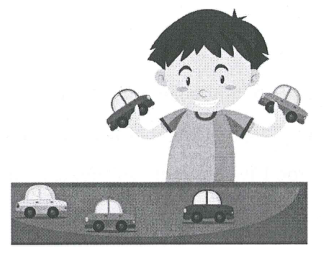
Jeremy has a box of identical toy cars that differ only in colour: 5 red, 9 blue and 4 white. Without looking, what is the smallest number of cars he must take to be certain of getting 3 of the same colour?
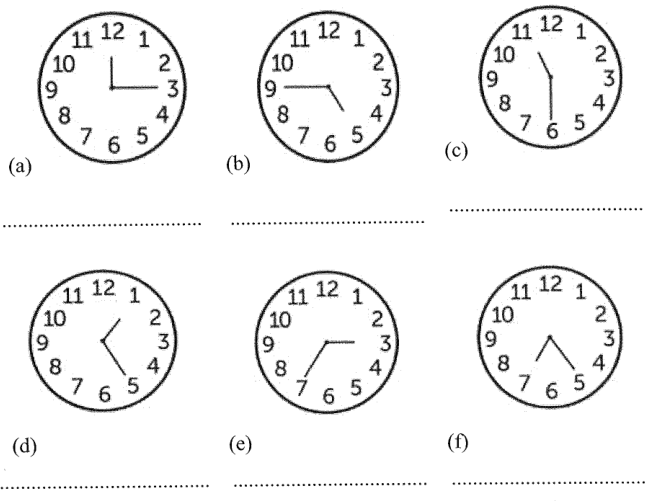
What time does each clock show? Read (a)–(f). Enter six times in h:mm format, separated by semicolons.
Treat the hour hands as approximate; when a hand is near the next hour, read the hour before it until the minute hand reaches 12. No a.m./p.m. is specified.
Nick wants to bake a cake with exactly 1 flavour and 1 topping. He can choose from 3 flavours and 3 toppings. How many different kinds of cake can he make?
A square and a rectangle have equal perimeters. Each side of the square is 6 cm. The rectangle is twice as long as it is wide. Find its area in square centimetres.
Ace, Ben and Cindy share 30 grapes. Ace gives 10 grapes to Ben, then Ben gives 8 grapes to Cindy, leaving all three with equal numbers. How many more grapes did Ace have than Cindy at first?
David takes 30 seconds to climb from the first floor to the third floor. How many seconds does he take to climb from the third floor to the sixth floor?
Assume each floor interval takes the same time and David does not stop.
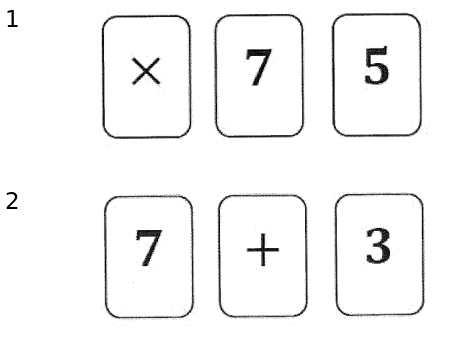
A magician puts 3 cards on the table. Each has a mathematical symbol on one side and a number on the other. Initially the visible faces are ×, 7, 5. He flips some (possibly all) cards and rearranges them; the visible faces are now 7, +, 3. What number is on the other side of the + card?