Scoring for this platform: initial 0; Q1–15 correct +2, Q16–25 correct +4; wrong or blank 0; maximum 70. Official SASMO rules (reference only): initial 15; Section A correct +2, wrong −1, blank 0; Section B correct +4, wrong or blank 0; maximum 85.
A machine converts any positive integer into a two-digit code as follows:
1. The first digit is its remainder on division by 9.
2. The second digit is its remainder on division by 17.
3. If the remainder on division by 17 exceeds 9, the second digit is instead 9.
For example, 20 is converted to 23. What is the smallest number converted to 13?
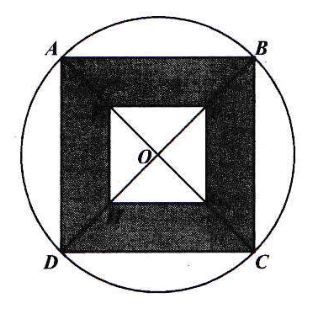
In the diagram, square $ABCD$ is inscribed in a circle. Its diagonals intersect at $O$. Points $E,F,G,H$ are the midpoints of $AO,BO,CO,DO$, respectively. What fraction of the area of the circle is the shaded area?
An integer is called beprisque if its two neighboring integers are a perfect square and a prime number. For example, 8 is beprisque. How many beprisque integers less than 100 are there?
Interpretation: Perfect squares include 0 = 0². Prime numbers are positive integers greater than 1.
A train traveling at 144 km/h crosses a bridge in 40 seconds and a man standing on the bridge in 24 seconds. What is the length of the bridge, in metres?
Interpretation: The speed is constant; the stated times are for the whole train to pass the bridge and the stationary person.
Answer format: enter the integer answer without units. Leading zeros are optional; the original paper uses four-digit boxes.
An operation $\triangle$ is defined by the following pattern: $$3\triangle3=2+3+4,\qquad5\triangle2=4+5,$$ $$9\triangle6=8+9+10+11+12+13.$$ If $164\triangle x=2022$, find $x$.
Interpretation: Use the intended consecutive-sum rule: a △ b is the sum of b consecutive integers starting at a−1; b is a positive integer. The examples alone do not specify every possible abstract operation.
Answer format: enter the integer answer without units. Leading zeros are optional; the original paper uses four-digit boxes.