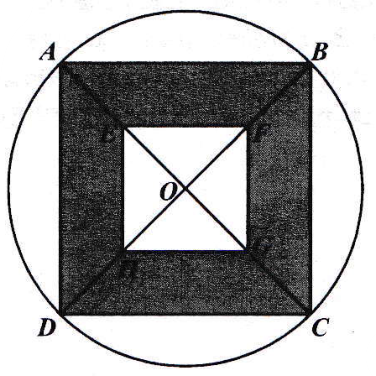
In the diagram, square $ABCD$ is inscribed in a circle. Its diagonals meet at $O$. Points $E,F,G,H$ are the midpoints of $AO,BO,CO,DO$, respectively. What fraction of the circle’s area is shaded?
Interpretation: The shaded region is inside ABCD and outside EFGH. The four inner vertices are the named midpoints.
A game begins with four piles containing 20, 22, 25 and 27 marbles. On each turn a player takes 3 marbles from the largest pile and gives one to each of the other three piles. How many marbles are in the smallest pile after the 2022nd turn?
Towns A and B are 1.26 km apart. At 9:00 a.m., Aaron starts cycling from A to B at 72 metres per minute, while Jeremy starts from B to A at 108 metres per minute. At 9:04 a.m., Kyle starts from A to B at 144 metres per minute. What is the distance, in metres, between Kyle and Jeremy when Aaron first meets one of them?
Interpretation: All three travel along the same route at their stated constant speeds. “Meets” means after Aaron starts; Kyle’s later departure is not an encounter at 9:00.
Answer format: an integer without units. Leading zeros are optional; the source uses four digit boxes.
In a classroom, each student shook hands with 4 girls and 6 boys. The number of handshakes between students of the same gender was 7 more than the number between students of opposite genders. How many boys were in the classroom?
Interpretation: No student shakes their own hand, and any pair shakes hands at most once; “4 girls and 6 boys” refers to other students.
Answer format: an integer without units. Leading zeros are optional; the source uses four digit boxes.
The 2022nd term of the sequence below is $m/n$ in lowest terms, with $\operatorname{HCF}(m,n)=1$. Find $n-m$. $$\frac12,\frac13,\frac14,\frac24,\frac15,\frac25,\frac16,\frac26,\frac36,\frac17,\frac27,\frac37,\ldots$$
Interpretation: Continue by increasing denominator d = 2, 3, 4, …; for each d list numerators 1 through floor(d/2) in order. Repeated equal fractions remain separate terms, and term 1 is 1/2.
Answer format: an integer without units. Leading zeros are optional; the source uses four digit boxes.