Platform scoring: start at 0; Q1–15 earn 2 each, Q16–25 earn 4 each; wrong or blank earns 0; maximum 70. Official SASMO: start at 15; wrong Section A answer −1; maximum 85. Time: 90 minutes, from the official-format reference rather than these source pages.
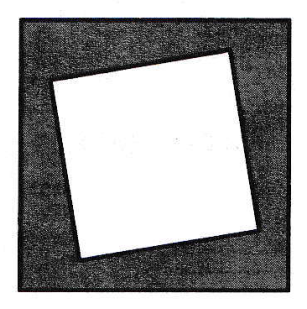
In the diagram, a small square lies inside a large square. The shaded area is 48 cm². If the perimeter of the small square is 44 cm, find the perimeter, in cm, of the large square.
In an election for class president, 92 votes are cast for five candidates. Each student votes for exactly one candidate. The candidate with the highest number of votes wins. What is the smallest number of votes the winner can receive?
Assume there is one outright winner, with strictly more votes than each other candidate.
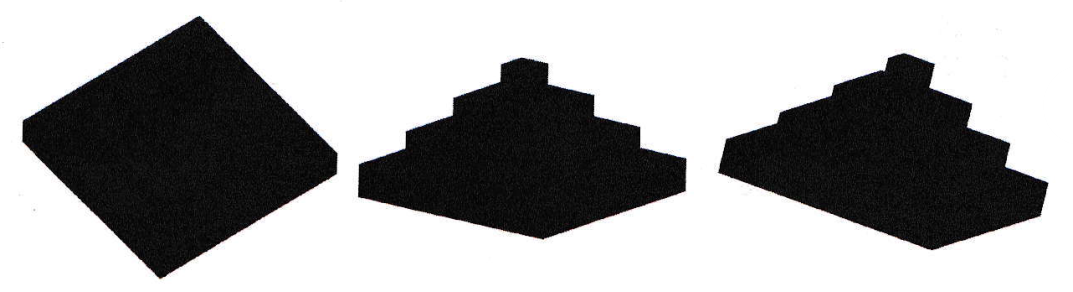
Mason built a pyramid using identical cubes. The pyramid is shown from different angles. He paints the whole pyramid green. How many cubes have exactly 2 faces painted green?
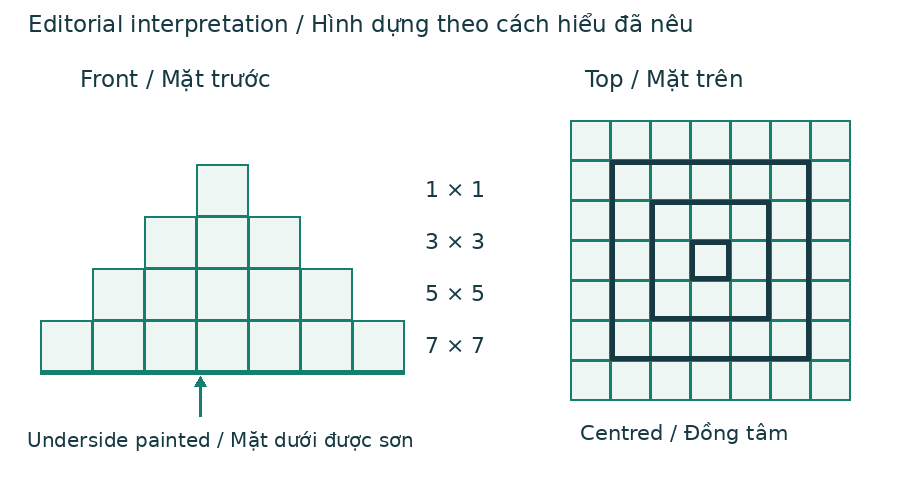
Scan clarification: the internal cube lines are obscured in the original. Use four centred solid square layers, from bottom to top $7\times7$, $5\times5$, $3\times3$, $1\times1$. All exterior faces, including the underside, are painted; touching faces are not painted. This is the interpretation used by the source solution.
Editorial schematic of the stated interpretation (not a new source figure).
A bag contains oranges and bananas. If 140 bananas are given away, the percentage of fruit that is bananas decreases from 60% to 40%. How many oranges are in the bag?
One hundred marbles can be shared equally among some students. If 8 more students share the same 100 marbles, each student can still receive an equal number. How many marbles can each student receive originally?
Each share must be a positive whole number of marbles.
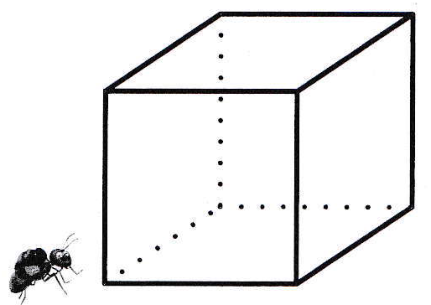
An ant starts at a vertex of a cube and walks only along its edges. It cannot use an edge more than once. Each edge is 9 cm long. What is the greatest distance, in cm, it can walk before it cannot continue?
Vertices may be visited again; only repeating an edge is forbidden.
The first common term of these two sequences is 54. What is their next common term?
$$18,27,36,45,54,\ldots$$
$$22,30,38,46,54,\ldots$$
Continue each sequence with its constant difference.
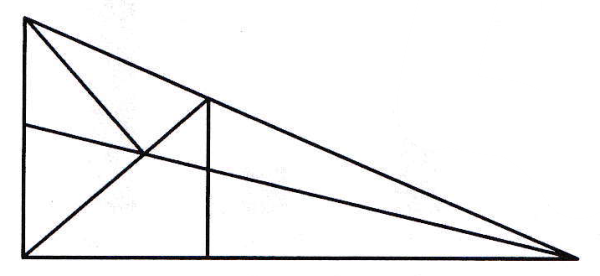
Count triangles of every size whose three sides are completely drawn. The extra labelled version in the explanation uses the same line arrangement.
Answer entry: enter the whole number only, without units. The paper uses four shaded digits with leading zeros; ordinary integer entry is accepted here.
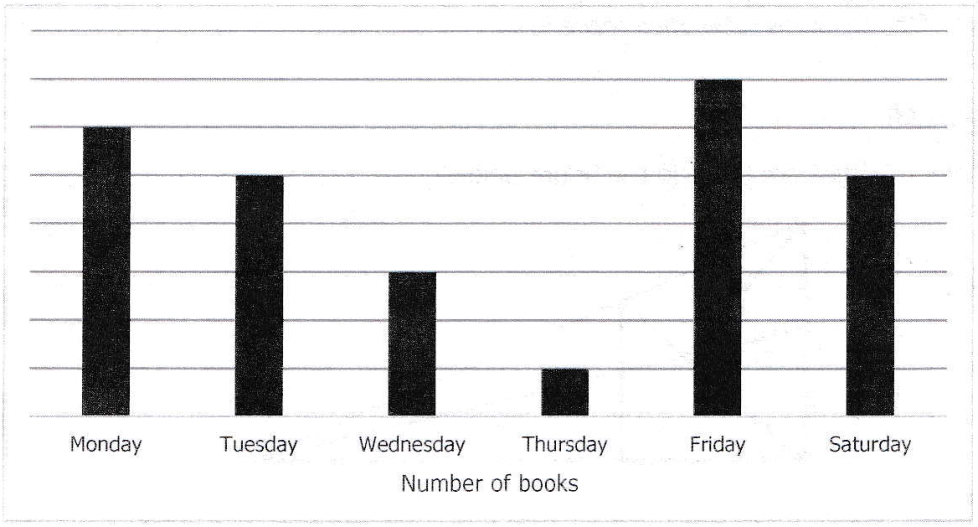
The graph shows the numbers of books Mr Goh sold in the first 6 days of a week. All horizontal lines are equally spaced. The ratio of books sold on Monday to Sunday is $2:5$. The average number sold over the whole week is 252. How many books did he sell on Sunday?
Read the bottom horizontal line as zero. The original graph's day labels run Monday through Saturday from left to right.
Answer entry: enter the whole number only, without units. The paper uses four shaded digits with leading zeros; ordinary integer entry is accepted here.
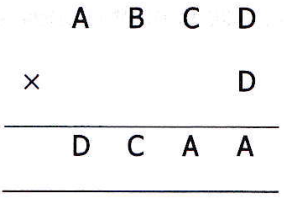
In this cryptarithm, different letters represent different digits. What is the value of the four-digit number ABCD?
$$\begin{array}{rrrrr} &A&B&C&D\\ \times&&&&D\\ \hline &D&C&A&A\end{array}$$
A and D are nonzero because both displayed numbers have four digits.
Answer entry: enter the whole number only, without units. The paper uses four shaded digits with leading zeros; ordinary integer entry is accepted here.
A school library has 124 Science and Maths textbooks altogether. If $5/8$ of the Science textbooks and $4/7$ of the Maths textbooks are loaned out, 48 textbooks remain altogether. How many Maths textbooks does the library have?
Answer entry: enter the whole number only, without units. The paper uses four shaded digits with leading zeros; ordinary integer entry is accepted here.
Sam, Mark and Lucy went shopping. Sam spent $4/9$ of their total spending. Mark and Lucy spent the rest in the ratio $8:7$. Sam and Lucy spent 475 dollars altogether. Find the average amount, in dollars, spent by each child.
Answer entry: enter the whole number only, without units. The paper uses four shaded digits with leading zeros; ordinary integer entry is accepted here.