Scoring for this platform: initial 0; Q1–15 correct +2, Q16–25 correct +4; wrong or blank 0; maximum 70. Official SASMO rules (reference only): initial 15; Section A correct +2, wrong −1, blank 0; Section B correct +4, wrong or blank 0; maximum 85.
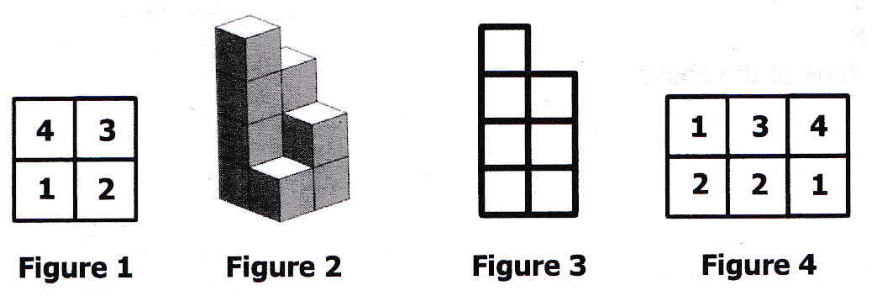
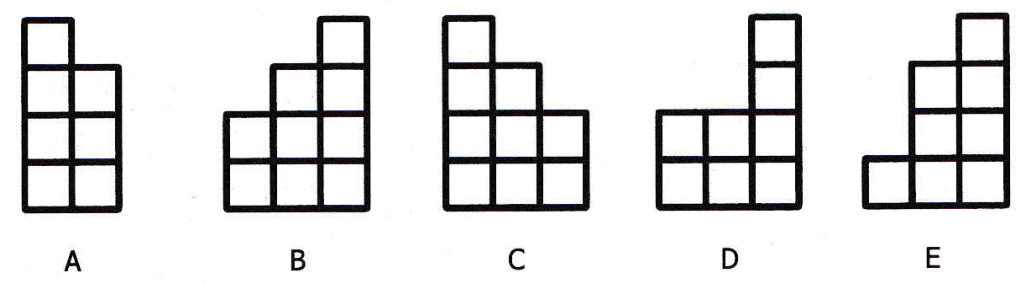
Figure 1 is a “stack map”: each number tells how many cubes are stacked at that position. Figure 2 shows those stacks, and Figure 3 is their front view. Which of options A–E is the front view of the stack map in Figure 4? Use the same viewing direction as in the example.
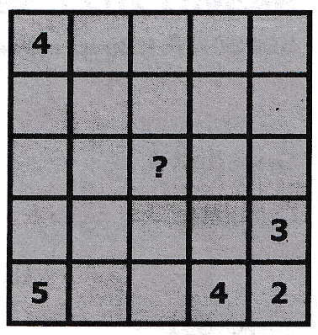
Fill the 5 × 5 table with the numbers 1 to 5 so that every row, every column and each of the two main diagonals contains each number exactly once. Some entries are given in the diagram. Find the number in the square marked “?”.
Eva and Justin play a carnival game. They choose one special power and draw one character card; only the power can be chosen. Eva randomly draws Batman, Superman or Wonder Woman. Justin chooses fireball, tornado, lightning, telekinesis or invisibility. The table gives their final score; for example, Batman with fireball scores 59. They win a prize if their score is prime. Which power gives the highest chance of winning?
Interpretation: Assume the three character cards are equally likely.
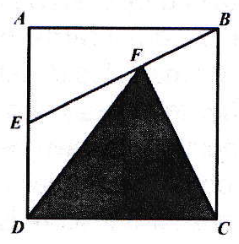
In square $ABCD$, $E$ is the midpoint of $AD$ and $F$ lies on $BE$ with $FE=2BF$. The square has area 24. Find the area of the shaded triangle $FDC$ in the diagram.
Paul has 100 marbles and splits them into 7 piles. Exactly one pile must contain more marbles than every other pile. What is the least possible number of marbles in that largest pile?
A number is formed by writing the whole numbers from 1 to 399 next to each other:
$$123456\ldots397398399.$$
Which digit has three times as many digits to its right as to its left?
Derrick spent 200 dollars over 5 days. Each day he spent no more than on the previous day, and each daily amount was an integer number of dollars. What is the smallest possible total, in dollars, spent on the 1st, 3rd and 5th days?
Interpretation: Daily expenditure is nonnegative; a day with zero spending is allowed, as in the source solution.
A very large multiple of 19 ends in the digits 64 and has exactly 133 positive integer factors. Express this number as $n\times a^b$, where $n,a,b$ are integers. What is the smallest possible value of $n+a+b$?
Interpretation: For the intended minimum, take n, a and b to be positive integers. The printed word “integers” without positivity does not define a bounded minimization problem.
An “interesting” number is a four-digit whole number whose first two digits, read as a two-digit number, equal the product of its tens and units digits. For example, 1535 is interesting because $3\times5=15$, but 6623 is not because $2\times3=6$, which is not 66. What is the difference between the largest and smallest interesting numbers?
Answer format: enter the integer answer without units. Leading zeros are optional; the original paper uses four-digit boxes.
From the list of 90 integers 21, 22, 23, …, 109, 110, only distinct even numbers are selected. What is the least number that must be selected to guarantee that two selected numbers have sum 100?
Answer format: enter the integer answer without units. Leading zeros are optional; the original paper uses four-digit boxes.