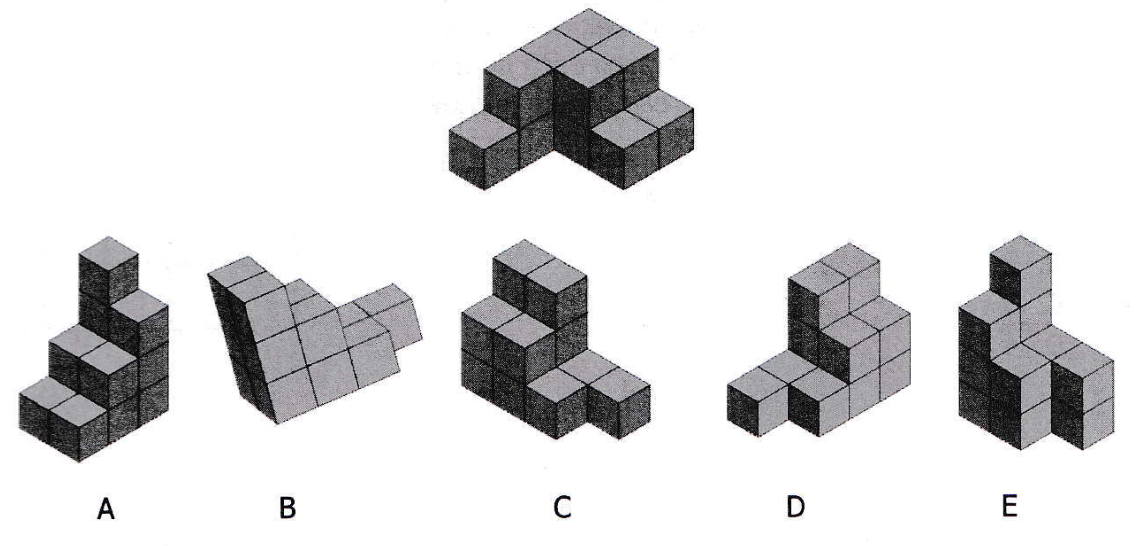
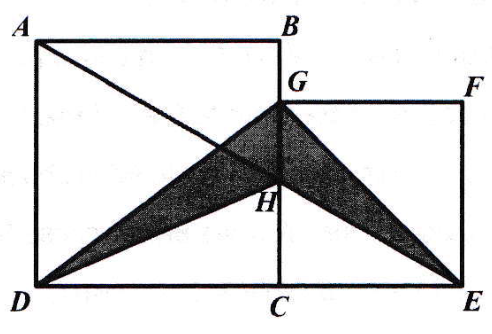
Scoring for this entire paper: on this platform, start at 0; Q1–15 earn 2 points each and Q16–25 earn 4 points each. Incorrect or blank answers earn 0; maximum 70. Official SASMO rules: start with 15 points; Section A (Q1–15) awards +2/−1/0 for correct/incorrect/blank, and Section B (Q16–25) awards +4/0/0; maximum 85.
There were 107 people in a conference room. The first woman shook hands with 8 men, the second with 9 men, the third with 10 men, and so on, until the last woman shook hands with all the men. How many women were there?
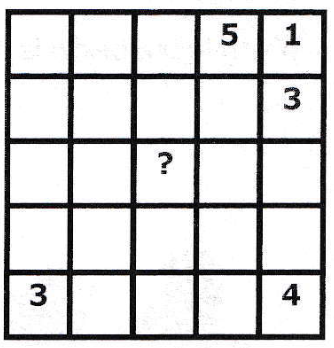
Fill the table with the numbers 1 to 5 so that every row, every column and each of the two diagonals contains each number exactly once. Some numbers are given. Find the number in the square marked “?”.
Nancy, Jessie, Gita and Peter won medals in several Math Olympiad competitions. Nancy won 25% of the total won by the other three. Jessie won $1/5$ of the total won by the other three. The ratio of Gita’s medals to the total won by the others was $3:4$. Jessie won 16 fewer medals than Peter. How many medals did they win altogether?
A school has 50 teachers. Of them, 43 can teach Science, 38 can teach Mandarin and 45 can teach Mathematics. At least how many can teach all three subjects?
Derrick spent 150 dollars in 10 days. Each day he spent a whole number of dollars, strictly more than on the previous day. On the tenth day he spent no more than twice what he spent on the first day. How many dollars did he spend on the seventh day?
Aston, Bieber, Caitlyn, Dior and Eden each chose a different option among A, B, C, D and E in a SASMO multiple-choice question. They said:
- Aston: “Bieber chose C; Caitlyn chose E.”
- Bieber: “Dior chose B; Eden chose D.”
- Caitlyn: “Aston chose A; Eden chose D.”
- Dior: “Caitlyn chose A; Bieber chose B.”
- Eden: “Dior chose B; Aston chose C.”
Each person was only half correct: exactly one of their two claims was true. Which option did Dior choose?
The denominators continue as $k(k+1)$ for consecutive integers $k=4,5,\ldots,45$.
Answer format: enter one whole number without units; leading zeros are optional. The source answer sheet uses four digits (for example, 7 is shaded as 0007).
Vivian and her friend left school for a tuition centre at 2:45 p.m. Vivian cycled at 200 m/min and her friend at 100 m/min. Twenty minutes after arriving, Vivian returned towards school because she had forgotten her wallet. On the way back she met her friend, who was still going to the centre, at 3:30 p.m. What is the distance between school and the tuition centre, in metres?
Assume both follow the same route and keep their stated speeds whenever cycling, including Vivian’s return trip.
Answer format: enter one whole number without units; leading zeros are optional. The source answer sheet uses four digits (for example, 7 is shaded as 0007).
What is the least number of distinct even numbers that must be selected from the list of 80 numbers 21, 22, 23, …, 99, 100 to guarantee that two selected numbers have sum 100?
Answer format: enter one whole number without units; leading zeros are optional. The source answer sheet uses four digits (for example, 7 is shaded as 0007).
Two positive integers $a,b$ have highest common factor 4 and lowest common multiple 720. Given $a\le b$, how many pairs $(a,b)$ are there?
Answer format: enter one whole number without units; leading zeros are optional. The source answer sheet uses four digits (for example, 7 is shaded as 0007).
It is given that $a,b,c,d,e$ are prime numbers, and their product $abcde$ is the sum of 111 consecutive positive integers. Find the smallest possible value of $a+b+c+d+e$. The primes need not be distinct.
Answer format: enter one whole number without units; leading zeros are optional. The source answer sheet uses four digits (for example, 7 is shaded as 0007).