Exam grading: platform starts at 0; Q1–15 award 2 points each, Q16–25 award 4 each; no penalties; maximum 70. Official reference: starts at 15; Section A +2/−1/0 for correct/incorrect/blank, Section B +4/0/0; maximum 85. Duration: 90 minutes (official-reference default).
Find the sum of the digits of the product $123454321\times9$.
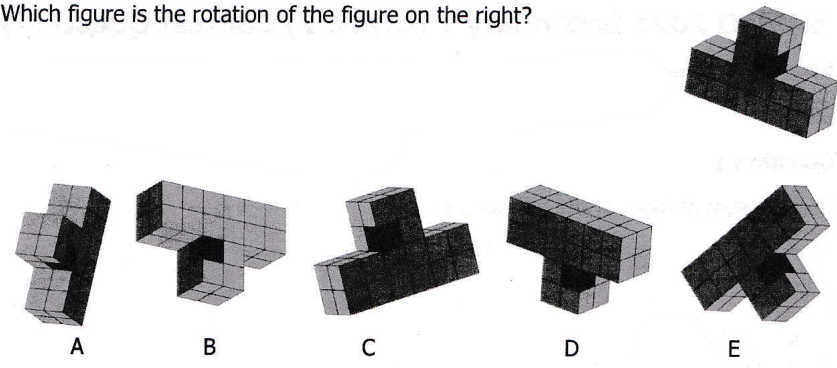
Which figure is a rotation of the figure at the upper right? The five labelled options are shown in the original diagram. A rotation must preserve the positions of the dark cubes relative to the rest of the solid.
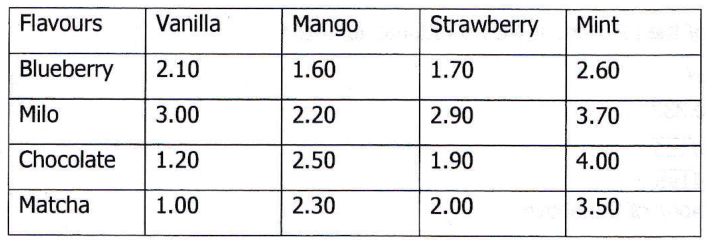
Tom and Michael are buying ice cream under a special promotion. Tom chooses vanilla, mango, strawberry or mint. Michael chooses blueberry, Milo, chocolate or matcha. The table gives the price in dollars for any pair of choices. For example, with vanilla and Milo, they both pay 3.00 dollars.
Which flavour should Tom choose to spend the minimum amount regardless of Michael's choice?
Interpretation: follow the source's worst-case rule: Tom chooses the flavour with the smallest possible maximum price.
There are 15 students in Mr Tan's class. He is 16 years older than twice the average age of his students. He is also 30 years older than the average age of all people in the class, including himself. How old is Mr Tan?
The “last-sum” of a number is found by repeatedly adding its digits until a one-digit number remains. For example, the last-sum of 88 is 7 because $8+8=16$ and $1+6=7$. Find the last-sum of $8^{2021}+1$.
Derrick travels in a train at 18 metres per second. A truck travelling in the opposite direction is 6 metres long and passes Derrick in $\frac3{10}$ second. What is the truck's speed in metres per second?
The paper defines a special power notation $n!!$ by the following tower and example. Find the last digit of $2021!!-2020!!$.
Notation note: this is the paper's special notation, not the usual double factorial. The printed tower and its parenthesised example use inconsistent grouping. For this question, either grouping makes each expression a positive integer power of its first number, so the requested last digit is unaffected.
Derrick spent 150 dollars in 10 days. Each day he spent more than on the previous day, and each daily amount was an integer number of dollars. On the tenth day, he spent no more than twice the amount on the first day. How many dollars did he spend on the seventh day?
What are the last two digits of $88888\times99999$? For example, if the product were 9874312, the answer would be 12.
Answer format: enter one whole number without units. The printed paper uses four answer-sheet digits with leading zeros when needed; ordinary numeric entry is used here.
How many numbers less than 1000 are both perfect squares and perfect cubes?
Convention: consider nonnegative integers and include 0, as in the source answer.
Answer format: enter one whole number without units. The printed paper uses four answer-sheet digits with leading zeros when needed; ordinary numeric entry is used here.
The denominators follow $n(n+1)$ for consecutive integers $n=4,5,\ldots,47$.
Answer format: enter one whole number without units. The printed paper uses four answer-sheet digits with leading zeros when needed; ordinary numeric entry is used here.
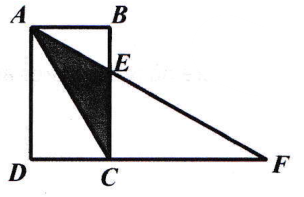
In the diagram, $ABCD$ is a rectangle with $AD=30$ cm. Triangle $ECF$ is right-angled at $C$, $CF=48$ cm, and $A,E,F$ are collinear. The area of triangle $AEC$ is 240 square centimetres. Find the area of triangle $ABE$, in square centimetres.
Answer format: enter one whole number without units. The printed paper uses four answer-sheet digits with leading zeros when needed; ordinary numeric entry is used here.
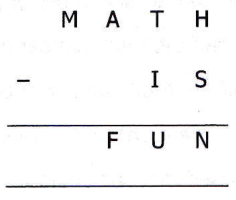
In the cryptarithm, different letters stand for different digits. Find the largest possible value of the four-digit number MATH.
Convention: leading digits $M,I,F$ are nonzero.
Answer format: enter one whole number without units. The printed paper uses four answer-sheet digits with leading zeros when needed; ordinary numeric entry is used here.