Skip to content / Đến nội dung
ThichHocToan.com

SASMO 2021 Grade 6

Question 1

Platform scoring: start at 0; Q1–15: 2 points each; Q16–25: 4 each; wrong or blank: 0; maximum 70. Official SASMO reference scoring is separate: start at 15, Section A +2/−1/0 and Section B +4/0/0 for correct/wrong/blank, maximum 85.

Calculate $12\times(0.28+0.14)+16\times\left(\frac{21}{50}+0.14\right)$.
  1. 14.2
  2. 14
  3. 12
  4. 16
  5. None of the above

Question 2

In the figure, the sum of the numbers in any three adjacent squares is 21. Find X.

Question illustration
  1. 6
  2. 7
  3. 8
  4. 9
  5. None of the above

Question 3

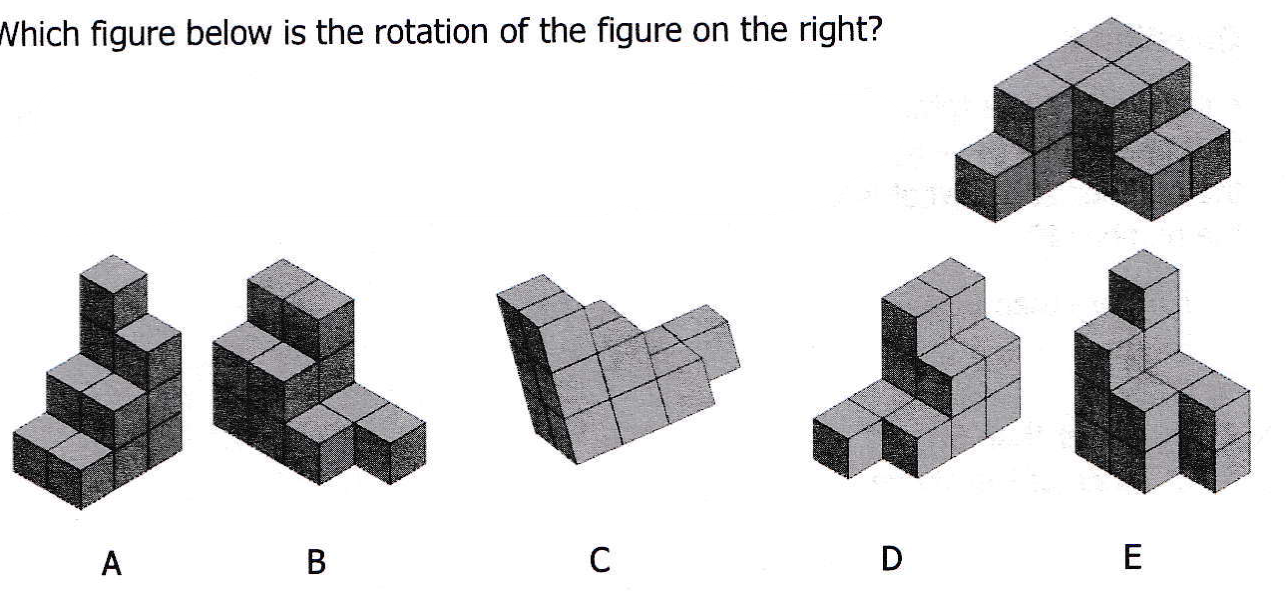
Which figure A–E is a rotation of the reference figure at the upper right?

Question illustration

Compare by rotating the entire solid in three dimensions; do not reflect it or rearrange cubes.
  1. Figure A
  2. Figure B
  3. Figure C
  4. Figure D
  5. Figure E

Question 4

Which of the following is the smallest?
  1. $\frac{12}{46}$
  2. $\frac{2-1}{6-4}$
  3. $\frac{1+2}{4+6}$
  4. $\frac{1\div2}{4\div6}$
  5. 1

Question 5

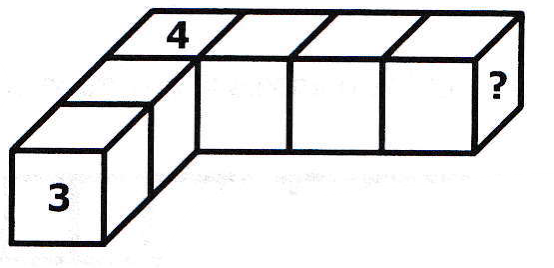
Each of the six cubes has the numbers 1 to 6 on its faces. Opposite faces of each cube sum to 7. In the arrangement, every pair of faces facing and touching each other sums to 8. Find “?”.

Question illustration

Each digit 1–6 occurs exactly once on each cube.
  1. 6
  2. 5
  3. 4
  4. 3
  5. None of the above

Question 6

A calculator has 15 buttons: the digits 0–9, the four operations (+, −, ×, ÷), and “=”. It currently displays 2021. What is the least number of button presses needed to obtain 1?

Entry convention for grading: continue from the displayed 2021 without clearing or replacing it. Enter each binary operation followed by an explicit nonnegative whole-number operand, and finish with “=”. No implicit/repeated operands or calculator-specific shortcuts are allowed.
  1. More than 6
  2. 6
  3. 5
  4. Fewer than 5
  5. None of the above

Question 7

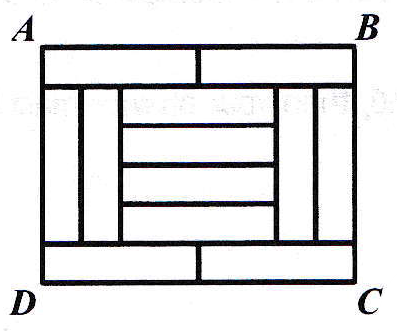
Rectangle ABCD is divided into 12 identical smaller rectangles as shown. If BC = 36 cm, find the area of ABCD in square centimetres.

Question illustration
  1. $1728\text{ cm}^2$
  2. $864\text{ cm}^2$
  3. $48\text{ cm}^2$
  4. $1296\text{ cm}^2$
  5. None of the above

Question 8

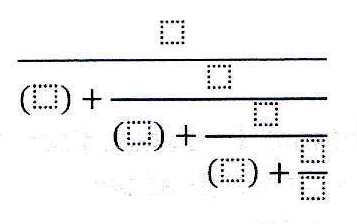
Jill places the digits 1, 2, 3, 4, 5, 6, 7 and 8 exactly once in the eight boxes to obtain the largest possible fraction. In simplest form its numerator is a and its denominator is b. Find a + b.

Question illustration

The fraction bars define the nesting shown: p/(q + r/(s + t/(u + v/w))). The eight letters here denote the eight boxes, not extra digits.
  1. 1505
  2. 1397
  3. 1441
  4. 1379
  5. None of the above

Question 9

Tom uses the digits 0–9 exactly once to form ten-digit numbers. Let x be the smallest possible number, and y the smallest possible multiple of 45. Find the last four digits of x + y. (For example, the last four digits of 9876543210 are 3210.)
  1. 4674
  2. 4679
  3. 4684
  4. 5780
  5. None of the above

Question 10

Liz has 1006 stamps. She sells bundles of 5 stamps for 2 dollars, 9 stamps for 5 dollars, or 12 stamps for 6 dollars. She need not sell all her stamps. What is the largest amount she can earn?
  1. 502 dollars
  2. 555 dollars
  3. From 503 to 554 dollars
  4. More than 555 dollars
  5. None of the above

Question 11

A 45-kg cake is divided into 10 pieces. Each successive piece is 250 grams lighter than the preceding piece. What percentage of the heaviest piece’s weight is the lightest piece’s weight?
  1. 6%
  2. 20%
  3. 40%
  4. 60%
  5. None of the above

Question 12

Derrick is travelling in a train at 21 metres per second. A 9-metre-long truck travelling in the opposite direction passes Derrick in $\frac38$ second. What is the truck’s speed in metres per second?

Assume constant speeds during the pass; Derrick is treated as a point. The interval runs from the front of the truck reaching him until its back passes him.
  1. 3 m/s
  2. 9 m/s
  3. 21 m/s
  4. 24 m/s
  5. None of the above

Question 13

The average of $\frac56,\frac78,\frac7{13},\frac{11}{17}$ is A. In exactly one fraction, interchange the numerator and denominator, giving a new average B. What is the greatest possible value of B − A?
  1. $\frac{42}{187}$
  2. $\frac{30}{91}$
  3. $\frac{15}{224}$
  4. $\frac{11}{120}$
  5. None of the above

Question 14

Dominic has 350 grams of 8% salt solution. He adds 150 grams of 4% salt solution. What is the final percentage of salt?

Percentages are by mass; assume no loss of solution or salt during mixing.
  1. 4.5%
  2. 6%
  3. 6.8%
  4. 7%
  5. None of the above

Question 15

Write the whole numbers from 1 through 399 consecutively to form $123456\ldots397398399$. Which digit has three times as many digits to its right as to its left?
  1. 2
  2. 7
  3. 8
  4. No such digit exists
  5. None of the above

Question 16

What are the last two digits of 77777 × 99999? (For example, if the product were 9874312, the answer would be 12.)

Input: enter the requested whole-number answer without units. Leading zeroes from the paper grid may be omitted.

Question 17

Study the pattern and find the sum of the two numbers in the 100th column.

Question illustration

Use the intended elementary alternating/repeating pattern shown; finite data can admit other artificial rules.

Input: enter the requested whole-number answer without units. Leading zeroes from the paper grid may be omitted.
Question 18

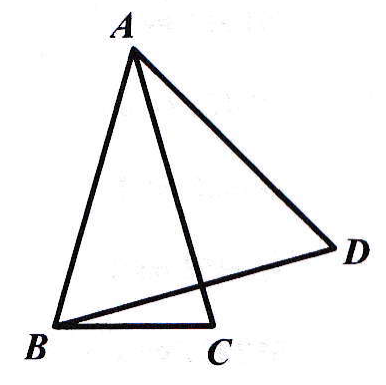
ABC and DAB are isosceles triangles with AB = AC and DA = DB, respectively. AC bisects $\angle BAD$. If $\angle BAD=56^\circ$, find $\angle ACB$ in degrees.

Question illustration

Input: enter the requested whole-number answer without units. Leading zeroes from the paper grid may be omitted.
Question 19

What is the least number of whole numbers that must be selected from $\{1,2,3,\ldots,32,33\}$ to ensure that one selected number is divisible by another selected number?

Select distinct numbers without replacement; “another” means a different selected number. The guarantee must hold for every possible selection of that size.

Input: enter the requested whole-number answer without units. Leading zeroes from the paper grid may be omitted.
Question 20

Find the intended pattern and determine x: $23306\leftrightarrow3$, $61811\leftrightarrow1$, $71428\leftrightarrow0$, $93063\leftrightarrow4$, $123456\leftrightarrow2$, $512907\leftrightarrow x$.

Use the source’s intended simple digit-counting rule; finite examples alone do not mathematically determine a unique rule.

Input: enter the requested whole-number answer without units. Leading zeroes from the paper grid may be omitted.