Platform scoring: start at 0; Q1–15 earn 2 each, Q16–25 earn 4 each; wrong or blank earns 0; maximum 70. Official SASMO rules use 15 starting points, −1 for a wrong Section A answer, maximum 85. Time: 90 minutes, from the official-format reference rather than these source pages.
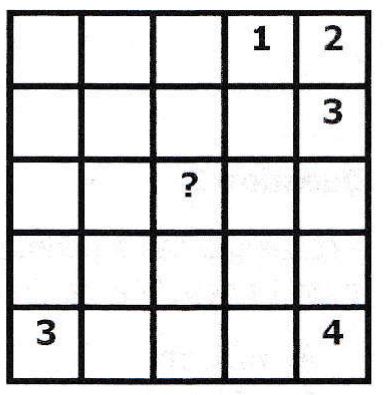
Fill the table with numbers 1 to 5 so that every row, every column and each of the two main diagonals contains each number exactly once. Some numbers are already shown. Find the number in the square marked “?”.
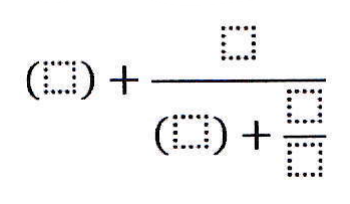
Jill puts the digits 2, 3, 4, 5 and 6 exactly once into the five boxes in the expression shown, to obtain the largest possible fraction. In simplest form its numerator is $n$ and denominator is $d$. Find $n+d$.
The layout means $a+\dfrac{b}{c+\dfrac{d_1}{e}}$, with one digit in each box.
Alison is 30 years older than Bernard. Last year, Bernard was 20 years older than Caitlyn. Next year, Caitlyn will be 10 years older than Donald. The sum of their four ages was 180 years five years ago. How old is Alison now?
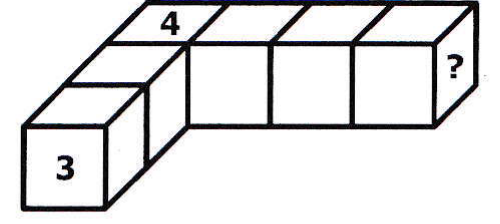
Each of the six cubes below has numbers 1 to 6 on its faces, one number per face. Opposite faces of the same cube sum to 7. Any two touching faces of adjacent cubes sum to 8. Find “?”.
If Arnold buys 5 pairs of jeans and 3 shirts, he has 115 dollars left. If he wants to buy 8 pairs of jeans and 7 shirts, he is short of 115 dollars. How much do 3 pairs of jeans and 4 shirts cost altogether?
Assume each pair of jeans has the same price, and each shirt has the same price.
During a festival, the airline ticket price per person increases by 40%. With the same amount of money that previously bought 98 tickets, how many tickets can be bought at the new price?
Paul splits 100 marbles into 7 piles. Exactly one pile must have strictly more marbles than every other pile. What is the least possible number of marbles in that largest pile?
Jay thinks of 8 distinct whole numbers. No number is a multiple of any other number in his list. What is the smallest possible product of the two smallest numbers?
Use the usual definition of a multiple: 0 is a multiple of every positive integer.
Answer entry: enter the whole number only, without units. The paper uses four shaded digits with leading zeros; ordinary integer entry is accepted here.
An “interesting” number is a four-digit whole number whose first two digits, read as a two-digit number, equal the product of its tens and ones digits. For example, 1535 is interesting because $3\times5=15$, but 6623 is not because $2\times3=6$, not 66. What is the difference between the largest and smallest interesting numbers?
Answer entry: enter the whole number only, without units. The paper uses four shaded digits with leading zeros; ordinary integer entry is accepted here.
A school has an art club and a music club. Each Primary 5 student belongs to neither club, one club, or both. There are 900 Primary 5 students in total, and 253 belong to neither club. The two clubs have equal membership. The art club has 171 more members than the number of students in neither club. How many students belong to both clubs?
Answer entry: enter the whole number only, without units. The paper uses four shaded digits with leading zeros; ordinary integer entry is accepted here.
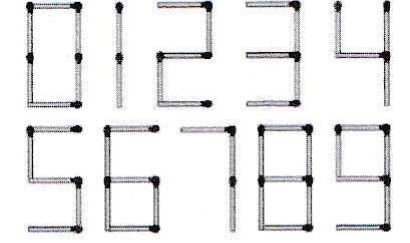
Edison forms three-digit numbers using the matchstick digit shapes shown. Turning a number upside down may produce another three-digit number; for example, 108 becomes 801. He forms a number whose upside-down version is 825 greater than the original. What is the new three-digit number?
“Upside down” means a 180° turn of the whole display, so the digit order also reverses. Use the exact digit shapes shown.
Answer entry: enter the whole number only, without units. The paper uses four shaded digits with leading zeros; ordinary integer entry is accepted here.
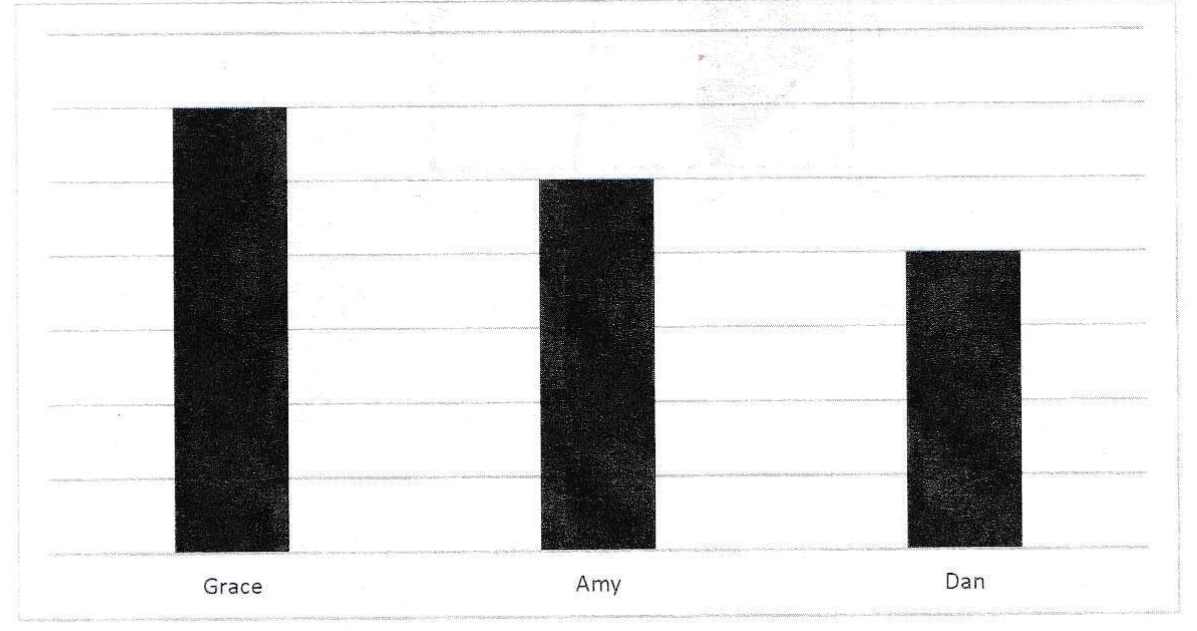
The bar graph shows the initial numbers of pencils Grace, Amy and Dan had. All horizontal lines are equally spaced.
Day 1: Grace gives half her pencils to Amy. Day 2: Amy gives half her pencils to Dan. Day 3: Dan gives half his pencils to Grace. Repeat these transfers on days 4, 5 and 6. On day 7, Grace cannot give an integer number of pencils to Amy, so the process stops. What is the lowest possible number of pencils Dan has on day 7?
Each completed transfer is of whole pencils. Day 7 stops before any transfer. Read the bottom horizontal line as zero.
Answer entry: enter the whole number only, without units. The paper uses four shaded digits with leading zeros; ordinary integer entry is accepted here.