Skip to content / Đến nội dung
ThichHocToan.com

SASMO 2020 Grade 9

Question 1

Scoring note — platform: initial 0; Q1–15: 2 points each; Q16–25: 4 points each; wrong/blank: 0; maximum 70.

Official reference rules: initial 15; Section A correct +2, wrong −1, blank 0; Section B correct +4, wrong/blank 0; maximum 85.

Find the value of $2020\times2020-2020\times20+2020$.
  1. 2020
  2. 4042020
  3. 4040000
  4. 4024020
  5. None of the above

Question 2

Which of the following has the largest value?
  1. 2020
  2. $\dfrac{2020^{20}}{2020^{18}}$
  3. 4080400
  4. $\dfrac{2020^{20}-2020}{2020^{18}-2020}$
  5. Options B and C

Question 3

In mathematics, the product of the first $n$ positive integers is written as $n!=n\times(n-1)\times\cdots\times1$. For example, $2!=2\times1$ and $7!=7\times6\times5\times4\times3\times2\times1$. Find the number of consecutive zeros at the end of $11!-10!$.
  1. 1
  2. 2
  3. 24
  4. 26
  5. None of the above

Question 4

Find $\dfrac{2025(19!)^2-5(19!)^2}{100\times18!\times20!+18!\times20!}$.
  1. 19
  2. 2020
  3. 2025
  4. $2020\times19!$
  5. None of the above

Question 5

Which number below is a factor of $91^4-1$?
  1. 2019
  2. 2020
  3. 2021
  4. 2022
  5. None of the above

Question 6

What is the smallest positive integer that can be expressed as a product of six positive integers such that any two of them are not coprime?

Interpretation: Repeated factors are allowed; “any two” refers to two different positions in the list.
  1. 60
  2. 64
  3. 360
  4. 5040
  5. None of the above

Question 7

Four friends have accounts in some social networks. Any two of them use at least one common social network, and no social network is used by more than two of them. At least how many social networks are used by the friends?
  1. 4
  2. 5
  3. 6
  4. 8
  5. None of the above

Question 8

The value of $f(x)=ax^2+bx+c$ is $0$ when $x=-1$. Given $f(2)-f(1)=11$ and $f(3)-f(2)=15$, what is $a+b+c$?
  1. −3
  2. −1
  3. 1
  4. 3
  5. None of the above

Question 9

What is the next number in the sequence $16,37,58,89,145,42,\ldots$?

Interpretation: Use the intended rule: each new term is the sum of the squares of the decimal digits of the previous term.
  1. 20
  2. 31
  3. 72
  4. 96
  5. None of the above

Question 10

There is one counterfeit coin among 2019 identical-looking coins. The genuine coins have the same weight while the counterfeit coin is lighter. Andy wants to determine the counterfeit coin using a balance scale. There are no restrictions on the number of coins placed on the pans each time. What is the least number of weighings needed to find the counterfeit coin?

Interpretation: “Needed” means sufficient in the worst case. The counterfeit is known to be lighter.
  1. 7
  2. 10
  3. 11
  4. 1009
  5. None of the above

Question 11

How many four-digit numbers contain the digit 1 but do not contain the digit 2?
  1. 2248
  2. 2673
  3. 2816
  4. 3528
  5. None of the above

Question 12

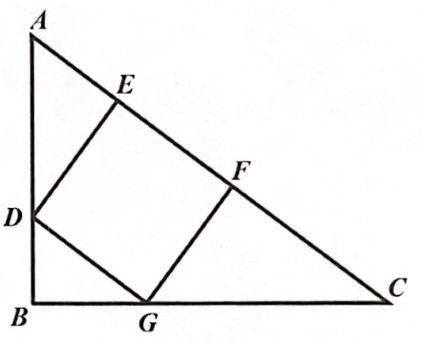
In the diagram, $\angle ABC=90^\circ$ and $DEFG$ is a square. If $AE=4$ and $EF=6$, find the area of quadrilateral $ACGD$.

Question illustration
  1. 84
  2. 75
  3. 63
  4. 60
  5. None of the above

Question 13

Anthony, Judith, Daniel and Edward were born in 1975, 1976, 1977 and 1978 in the cities of New York, Moscow, Barcelona and Singapore, though not in that order. It is given that:
- The person born in Barcelona is one year older than the one born in Singapore.
- Edward was born one year later than the person born in Barcelona.
- Daniel was born in Moscow.
- Anthony was born two years later than Edward.

Which year was Judith born in?

Interpretation: Each of the four years and four cities is used exactly once. “One year older” refers to birth-year difference.
  1. 1975
  2. 1976
  3. 1977
  4. 1978
  5. Impossible to determine

Question 14

A convex polyhedron has 48 edges. Its faces are either quadrilaterals or hexagons. Each vertex is an endpoint of exactly three edges. How many faces does the polyhedron have?
  1. 16
  2. 18
  3. 20
  4. 24
  5. None of the above

Question 15

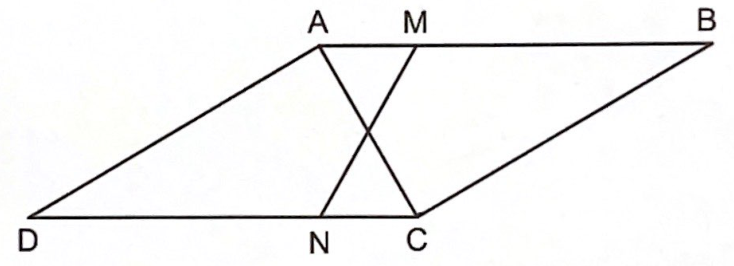
In the diagram, $ABCD$ is a parallelogram and $\angle ACB=90^\circ$. Points $M,N$ lie on sides $AB,CD$ with $AM:MB=CN:ND=1:3$. Given $AC=MN=2$, find the area of $ABCD$.

Question illustration
  1. $2\sqrt3$
  2. 6
  3. $4\sqrt3$
  4. 8
  5. None of the above

Question 16

Find $11^2-12^2+13^2-14^2+15^2-16^2+\cdots+99^2-100^2+101^2$.

Answer format: an integer without units. Leading zeros are optional; the source uses four digit boxes.
Question 17

How many digits are there in $5^{2020}\times4^{1010}$?

Answer format: an integer without units. Leading zeros are optional; the source uses four digit boxes.

Question 18

The six-digit number $\overline{2X3Y72}$ is divisible by $66$. Find $X+Y$.

Answer format: an integer without units. Leading zeros are optional; the source uses four digit boxes.

Question 19

Take a two-digit number, multiply its digits, then multiply the digits of the obtained product and continue until a one-digit number is reached. How many two-digit numbers produce zero at the end of this process?

Answer format: an integer without units. Leading zeros are optional; the source uses four digit boxes.

Question 20

Find $(a+2b)(2b+3c)(a+3c)+6abc$ where $a+2b+3c=0$.

Answer format: an integer without units. Leading zeros are optional; the source uses four digit boxes.