Platform scoring: start at 0; Q1–15: 2 points each; Q16–25: 4 each; wrong or blank: 0; maximum 70. Official SASMO reference scoring is separate: start at 15, Section A +2/−1/0 and Section B +4/0/0 for correct/wrong/blank, maximum 85.
Find the value of $2020\times2020-2019\times2021$.
In a supermarket, chicken nuggets are available only in packs of either 3 or 7 nuggets. For example, you cannot purchase exactly 2, 5 or 8 nuggets. What is the largest number of chicken nuggets that one cannot purchase?
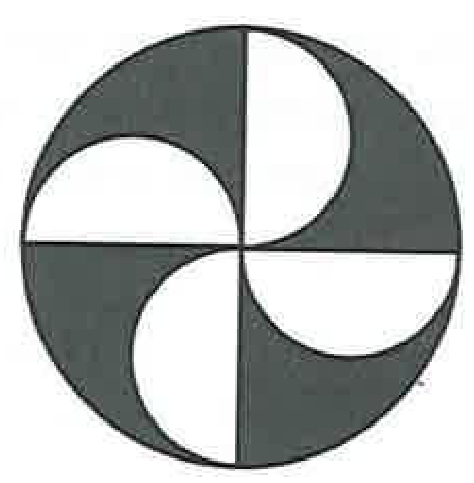
In the diagram, the unshaded area is made of 4 semicircles touching at the centre of the large circle. If the diameter of the large circle is 28 cm, find the area of the shaded region. Use $\pi=\frac{22}{7}$.
James has tiles of size 3 cm × 7 cm. He wants to put them on a floor of size 23 cm × 10 cm. What is the largest number of tiles he can put without overlapping or breaking any tiles?
Tiles may be rotated but must lie completely inside the rectangular floor.
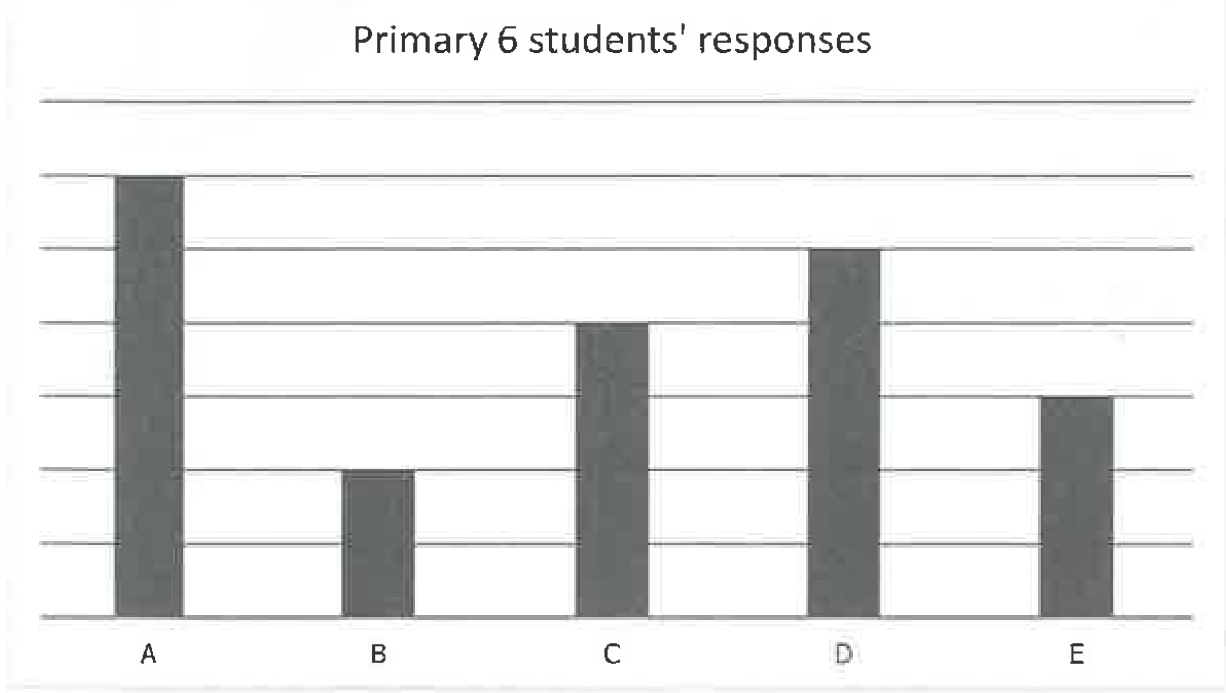
The following bar chart shows the responses made by SASMO Primary 6 students in a multiple-choice question. All the horizontal lines are equally spaced. Each student selected one of the possible choices, and the correct answer is C. Find the percentage of students who answered this question correctly.
Working alone, Ryan can dig a 5 m by 5 m by 5 m hole in six hours. Castel can dig a 10 m by 10 m by 5 m hole in twelve hours. How many hours would it take them to dig a 5 m by 5 m by 5 m hole if they worked together?
Assume each person digs at a constant rate and their rates add when working together.
Stacy bought a pack of M&M chips. After she ate some, the ratio of the number of chips she ate to the number remaining in the pack was 3 : 5. If she eats 50 chips more, the new ratio will be 7 : 5. How many M&M chips were there in the pack when Stacy bought it?
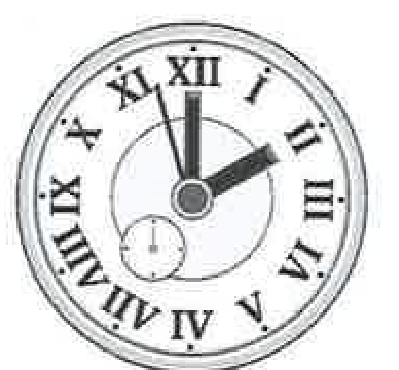
The minute hand of a certain clock is 3 times as long as the hour hand. In 24 hours, the tips of the hour and minute hands travel $1036\pi$ cm in total. How long is the hour hand? Use $\pi=\frac{22}{7}$.
In mathematics, the product of the first $n$ positive integers is written as $n!=n\times(n-1)\times\cdots\times1$. For example, $2!=2\times1$ and $7!=7\times6\times5\times4\times3\times2\times1$. How many consecutive digits 0 are at the end of $8!+9!$?
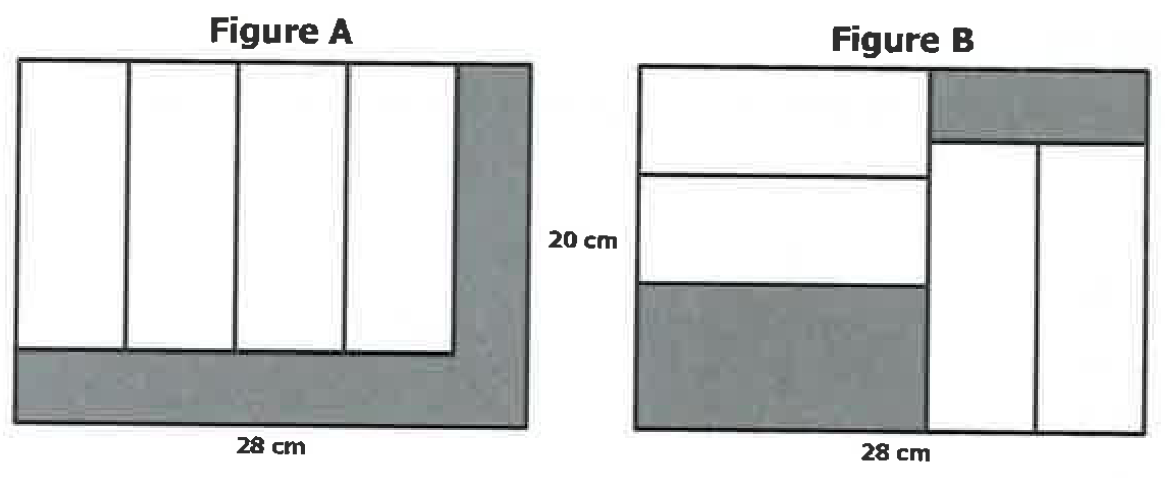
Four identical rectangles are placed side by side on a 28 cm by 20 cm rectangular piece of paper in two ways, as shown in Figures A and B. What is the difference between the perimeters of the shaded regions in Figures A and B?
For Figure B, add the perimeters of both disconnected shaded pieces.
Hailey, Lydia, Julia, Asher and Charles are Primary 4 or 6 students. They study in either Bright Primary School or Light Primary School.
- Lydia and Charles are in the same grade.
- Julia and Asher study at different levels.
- Three students study in Primary 4 and the other two in Primary 6.
- Asher and Charles are from different schools.
- Hailey and Julia go to the same school.
- Three students go to Bright Primary School and the other two to Light Primary School.
If one of them is a Primary 6 student from Light Primary School, who is that person?
Find the last digit of the product of twenty factors equal to 2 and twenty-four factors equal to 3: $\underbrace{2\times2\times\cdots\times2}_{20\text{ factors}}\times\underbrace{3\times3\times\cdots\times3}_{24\text{ factors}}$.
Input: enter the requested whole-number answer without units. Leading zeroes from the paper grid may be omitted.
The number of apples in a basket is $\frac45$ of the number of oranges. The ratio of pears to apples is $3:8$. The rest of the fruits are bananas, and 20% of all the fruits in the basket are oranges. The number of bananas is 48 more than the total number of apples, oranges and pears. How many fruits are there in the basket?
Input: enter the requested whole-number answer without units. Leading zeroes from the paper grid may be omitted.
The number of digits used to number the pages of a book is twice the number of pages of the book. If the number of pages is a three-digit number, how many pages does the book have?
Pages are numbered consecutively from 1, with no leading zeroes.
Input: enter the requested whole-number answer without units. Leading zeroes from the paper grid may be omitted.