Skip to content / Đến nội dung
ThichHocToan.com

SASMO 2019 Grade 9

Question 1

Platform scoring: initial 0; Q1–15: 2 points each, Q16–25: 4 points each; wrong/blank: 0; maximum 70. Official source rules: initial 15; Section A correct +2, wrong −1, blank 0; Section B correct +4, wrong/blank 0; maximum 85.

Evaluate $-\frac14\times2019.625-0.625+0.75\times2019.625+\frac12\times2019.625$.
  1. 2019
  2. 2019.625
  3. 2020
  4. -2019
  5. None of the above

Question 2

Let x be a positive integer whose prime factors are 5 and 11 only. If x has exactly 6 different positive integer factors, what is the smallest value of x?

Interpretation: Both 5 and 11 occur as prime factors.
  1. 110
  2. 605
  3. 165
  4. 275
  5. None of the above

Question 3

Suppose $-11\le y+3\le3$ and $0<x<8$. What is the greatest possible value of $xy$?
  1. 112
  2. 24
  3. 0
  4. 98
  5. None of the above

Question 4

Which of the following is true?

Interpretation: Read each statement as an identity, wherever defined; the denominator in D is −2⁴, not (−2)⁴.
  1. $\sqrt{81}=\pm9$
  2. $(x^{12})^{18}=x^{30}$
  3. $5x^{-1}=\frac1{5x}$
  4. $-\frac{2(-x+1)(x+1)}{32}=\frac{1-x^2}{-2^4}$
  5. None of the above

Question 5

Let $A,M,N,P,S,W$ be real numbers such that
$$M=S^1W^2A^3P^4,\qquad N=P^1A^2W^3S^4.$$
Suppose $W\times A\times S\times P=1331^{1/15}$. What is $M\times N$?

Interpretation: The source question has a faint/missing first factor before ×A×S×P. We restore W, as explicitly used in the source solution.
  1. 11
  2. 21
  3. 1331
  4. Insufficient data
  5. None of the above

Question 6

Which of the following is NOT true about a gradient (or slope)?

Interpretation: Use standard perpendicular coordinate axes with equal unit scales.
  1. If a line is horizontal, then its gradient is zero.
  2. If a line has a negative gradient and another has a positive gradient, the two lines intersect at exactly one point.
  3. A line with gradient 1 forms a 45° angle with the x-axis.
  4. If $m_1=-m_2$ for the gradients of two lines, the lines are parallel.
  5. None of the above

Question 7

Assuming the list $\{19,X,13,11,23,17\}$ has a mode, what is the greatest difference between the median and mode?

Interpretation: Mode means a value occurring more often than the others; difference means absolute difference.
  1. 4
  2. 5
  3. 6
  4. 12
  5. None of the above

Question 8

Which of the following fractions is the largest?
  1. $\frac{654321}{654322}$
  2. $\frac{65432}{65433}$
  3. $\frac{6543}{6544}$
  4. $\frac{654}{655}$
  5. $\frac{65}{66}$

Question 9

A six-digit positive integer contains the digit 8 and is divisible by 9. All its digits are different. What is the sum of the digits of the least possible such integer?
  1. 9
  2. 19
  3. 27
  4. 36
  5. None of the above

Question 10

If $A=10^{2019}-2019$, how many digits of A are odd?
  1. 2015
  2. 2016
  3. 2017
  4. 2018
  5. None of the above

Question 11

Gryffindor Secondary School has 170 students. A survey of their hobbies shows:
- 79 like alchemy, 75 like origami, and 34 like stage illusion;
- 32 like both alchemy and origami;
- 24 like both alchemy and stage illusion;
- 13 like all three;
- 45 have hobbies not listed above.
How many like both stage illusion and origami but not alchemy?

Interpretation: The 45 students have none of the three listed hobbies; counts of “both” include those liking all three.
  1. 20
  2. 7
  3. 46
  4. 96
  5. None of the above

Question 12

Twelve people receive twelve different positive integers. In the first round, person 1 says “My number is bigger than 1”, person 2 says “My number is bigger than 2”, and so on, up to person 12 saying “My number is bigger than 12”.
In the second round their responses, in random order, are “My number is less than 1”, “My number is less than 2”, …, “My number is less than 12”. Each person is either always truthful or always lying. Excluding the host, what is the largest possible number of truth-tellers?
  1. 11
  2. 10
  3. 8
  4. 6
  5. None of the above

Question 13

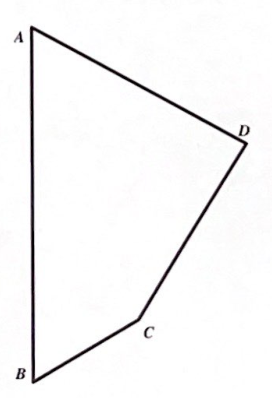
In the diagram, ABCD is a quadrilateral with $\angle ABC=\angle BAD=60^\circ$ and $\angle DAC=\angle DBA$. Given $AD=13$ and $BC=7$, find AB.

Question illustration
  1. 20
  2. 18
  3. $18\sqrt3$
  4. Insufficient data
  5. None of the above

Question 14

Two calendars are the same if all dates fall on the same weekdays. The calendar for 2019 is the same as that for which listed year? Years 2020, 2024, 2028 and 2032 are leap years.
  1. 2026
  2. 2030
  3. 2033
  4. 2024
  5. 2028

Question 15

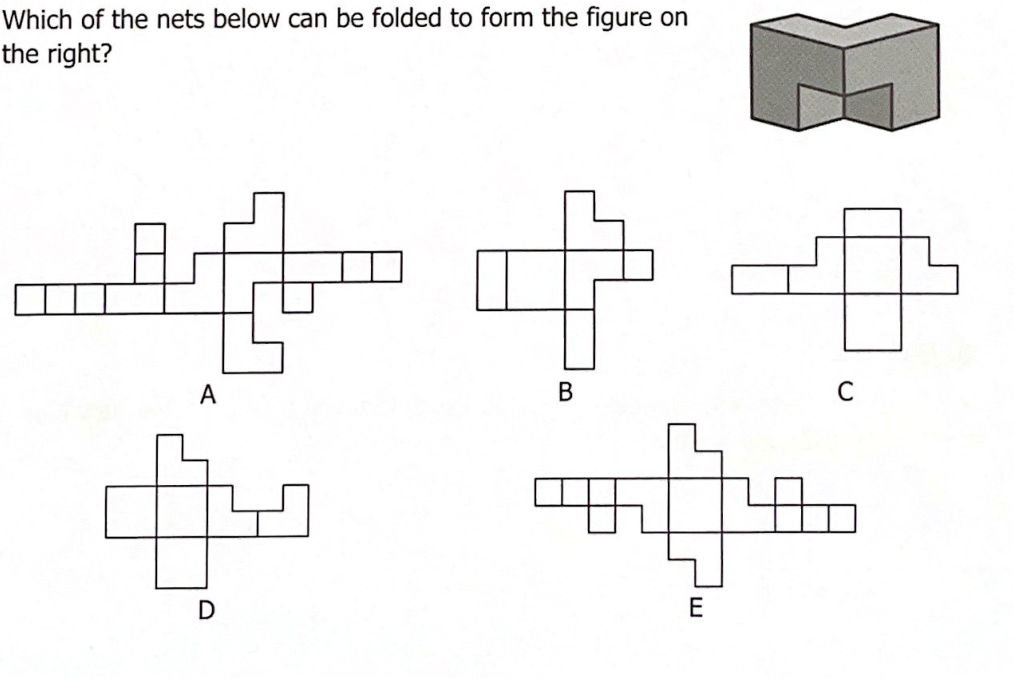
Which of the nets below can be folded to form the solid shown at the upper right?

Question illustration
  1. Net A in the diagram
  2. Net B in the diagram
  3. Net C in the diagram
  4. Net D in the diagram
  5. Net E in the diagram

Question 16

In mathematics, the product of the first n positive integers is written $n!=n(n-1)\cdots1$. For example, $2!=2\times1$ and $7!=7\times6\times5\times4\times3\times2\times1$. What is the remainder when $2018!+2018$ is divided by 2019?

Answer format: an integer without units. Leading zeros are optional; the source uses four digit boxes.
Question 17

How many two-digit positive integers have an odd product of their tens and ones digits?

Answer format: an integer without units. Leading zeros are optional; the source uses four digit boxes.

Question 18

The product of three consecutive integers is a four-digit number beginning with 4 and ending with 6. What is the sum of those three integers?

Answer format: an integer without units. Leading zeros are optional; the source uses four digit boxes.

Question 19

In the expression below, b is a digit, $\overline{bbbbb}$ is a five-digit number, and $\overline{bb}$ is a two-digit number. Find the numerical value in simplest form.
$$\frac{(b+b)(\overline{bbbbb}-b)-b\overline{bb}}{b\overline{bb}}$$

Answer format: an integer without units. Leading zeros are optional; the source uses four digit boxes.

Question 20

Find the value of
$$\frac{1-(1/2019)^2}{1+(1/2019)^2}+\frac{1-(1/2018)^2}{1+(1/2018)^2}+\cdots+\frac{1-(1/2)^2}{1+(1/2)^2}$$
$$+\frac{1-1^2}{1+1^2}+\frac{1-2^2}{1+2^2}+\cdots+\frac{1-2019^2}{1+2019^2}.$$

Answer format: an integer without units. Leading zeros are optional; the source uses four digit boxes.