Scoring for this entire paper: on this platform, start at 0; Q1–15 earn 2 points each and Q16–25 earn 4 points each. Incorrect or blank answers earn 0; maximum 70. Official SASMO rules: start with 15 points; Section A (Q1–15) awards +2/−1/0 for correct/incorrect/blank, and Section B (Q16–25) awards +4/0/0; maximum 85.
In Mathematics, the product of the first $n$ positive integers is written as $n!=n\times(n-1)\times\cdots\times1$. For example, $2!=2\times1$ and $7!=7\times6\times5\times4\times3\times2\times1$. Evaluate:
$$9+(8+7)\times(6!\div5-4-3-2-1).$$
The price of an ice cream cone in a shop has increased by 20%. How many ice cream cones can now be bought using the amount of money that used to buy 60 such cones?
The sum of the speeds of two cyclists is 34 km/h. If the first cycles for 3 hours and the second for 7 hours, the total distance travelled is 150 km. Assuming both cycle at constant speeds, what is the difference between their speeds?
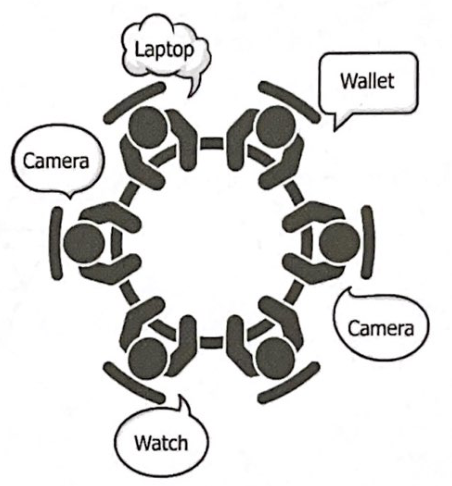
A leader asked his 6 followers what was inside a gift box. They sit around a table. Two truth-tellers sit next to each other, and two liars also sit next to each other. Each of the remaining two followers is either a truth-teller or a liar, and these remaining two do not sit next to each other. Their responses are shown below. What is inside the gift box?
Reading convention: the bottom-right follower has no response printed in the source; leave that response unknown. A truth-teller gives the true object and a liar gives a false object. The adjacent pairs and remaining two are a partition of the six followers.
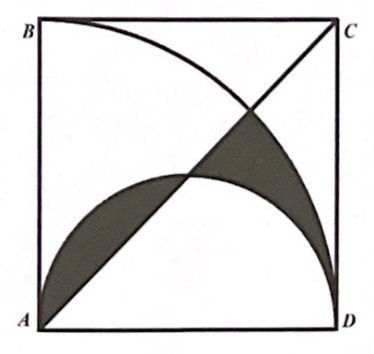
In the diagram, $ABCD$ is a square with $AB=20$ cm, $AD$ is a diameter of the semicircle, and $AB$ is a radius of the quadrant. Find the area, in cm², of the shaded region.
Answer format: enter one whole number without units; leading zeros are optional. The source answer sheet uses four digits (for example, 7 is shaded as 0007).
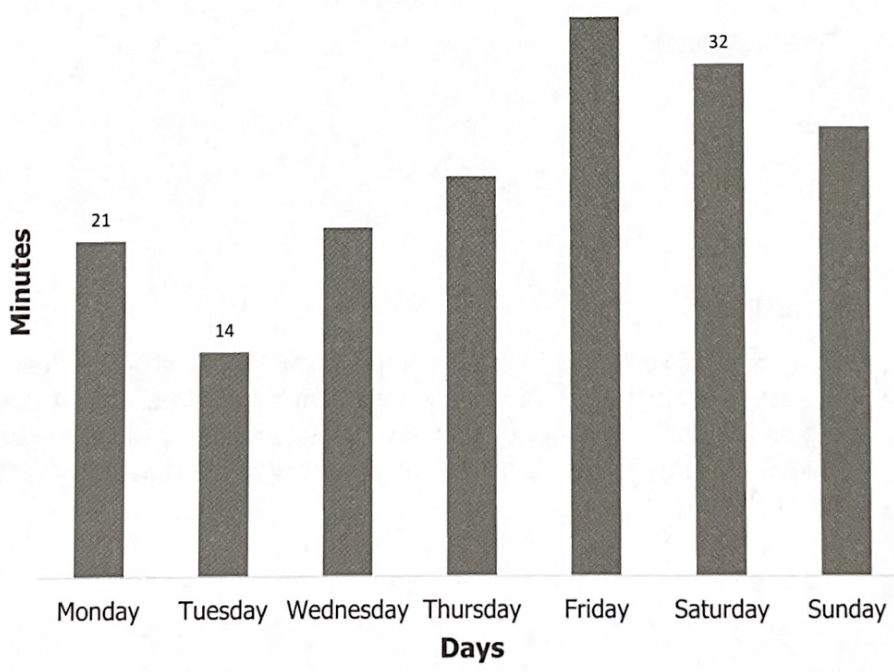
The bar chart shows the time Lou spent in the gym last week. The average time of the first 3 days was 72% of the average time of the last 4 days. His total time was 183 minutes. How many minutes did he spend in the gym on Wednesday? Round to the nearest integer.
Chart reading: Monday 21, Tuesday 14 and Saturday 32 minutes are printed values. Other bar heights are schematic and should not be measured as exact data. Monday–Sunday are the seven days in order.
Answer format: enter one whole number without units; leading zeros are optional. The source answer sheet uses four digits (for example, 7 is shaded as 0007).
What is the remainder when $2018!+13$ is divided by 2019?
Answer format: enter one whole number without units; leading zeros are optional. The source answer sheet uses four digits (for example, 7 is shaded as 0007).
The operator $\otimes$ acts on two numbers as follows:
$$2\otimes6=44,\quad4\otimes10=87,$$
$$8\otimes18=1613,\quad16\otimes22=2019.$$
Find $7\otimes9$.
Pattern convention: finitely many examples do not uniquely define an operator. This source puzzle is graded using the published intended arithmetic-and-digit-concatenation pattern; other rules are mathematically possible.
Answer format: enter one whole number without units; leading zeros are optional. The source answer sheet uses four digits (for example, 7 is shaded as 0007).
At a camp, 134 students received a burger and 62 received an ice cream. Fifteen received a burger and an ice cream but no fries, and 31 received all three types of food. There are 200 students. What is the largest possible number who received none of the three types?
Answer format: enter one whole number without units; leading zeros are optional. The source answer sheet uses four digits (for example, 7 is shaded as 0007).