Skip to content / Đến nội dung
ThichHocToan.com

SASMO 2019 Grade 4

Question 1

Exam-wide scoring on this platform (user-approved): start at 0 points; a correct answer earns 2 points for Q1–15 and 4 points for Q16–25; an incorrect or blank answer earns 0. Maximum: 70 points. Official SASMO reference rules differ: start with 15 points; Section A awards +2 for correct, −1 for incorrect and 0 for blank; Section B awards +4 for correct and 0 for incorrect or blank. Official maximum: 85 points.

Find the next number in the sequence below.

4, 7, 13, 22, 34, ___

Editorial pattern convention: continue the simple pattern of successive differences.
  1. 15
  2. 18
  3. 49
  4. 60
  5. None of the above

Question 2

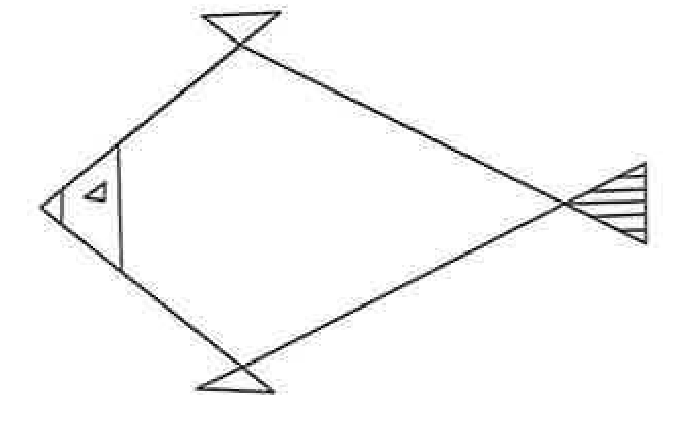
How many triangles are there in the picture below?

Question illustration

Count triangles with three complete drawn straight sides, including triangles formed from several regions.
  1. 16
  2. 12
  3. 8
  4. 6
  5. None of the above

Question 3

If the 3-digit number 2M4 is divisible by 6, what is the smallest value of the digit M?
  1. 0
  2. 3
  3. 6
  4. 9
  5. None of the above

Question 4

Eight days after the day before yesterday is Friday. Which day of the week is tomorrow?
  1. Friday
  2. Saturday
  3. Sunday
  4. Thursday
  5. None of the above

Question 5

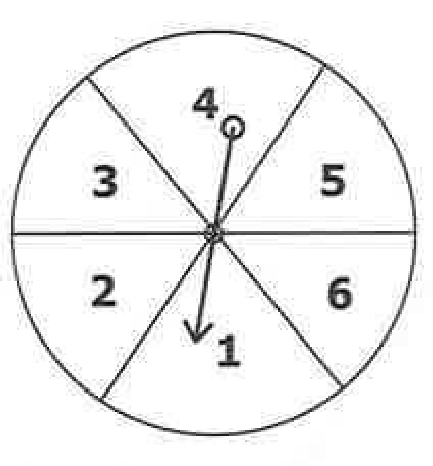
Which of the following options are you most likely to spin?

Question illustration

Editorial assumption: the spinner is fair; its six numbered sectors are intended to be equally likely.
  1. An even number
  2. An odd number
  3. A multiple of 3
  4. A number bigger than 2
  5. A number less than 4

Question 6

Jonathan has 4 regular dice. Each die has numbers from 1 to 6. Which of the following could not be the sum of the numbers on top of the 4 dice?
  1. 6
  2. 11
  3. 19
  4. 26
  5. All the above numbers are possible sums

Question 7

In Mathematics, the product of the first n whole numbers starting from 1 is written as \(n!=1\times2\times3\times\cdots\times n\). For example, \(2!=1\times2\) and \(7!=1\times2\times3\times4\times5\times6\times7\). The number of hours in September can be written as n!. Find n.
  1. 5
  2. 6
  3. 7
  4. 8
  5. None of the above

Question 8

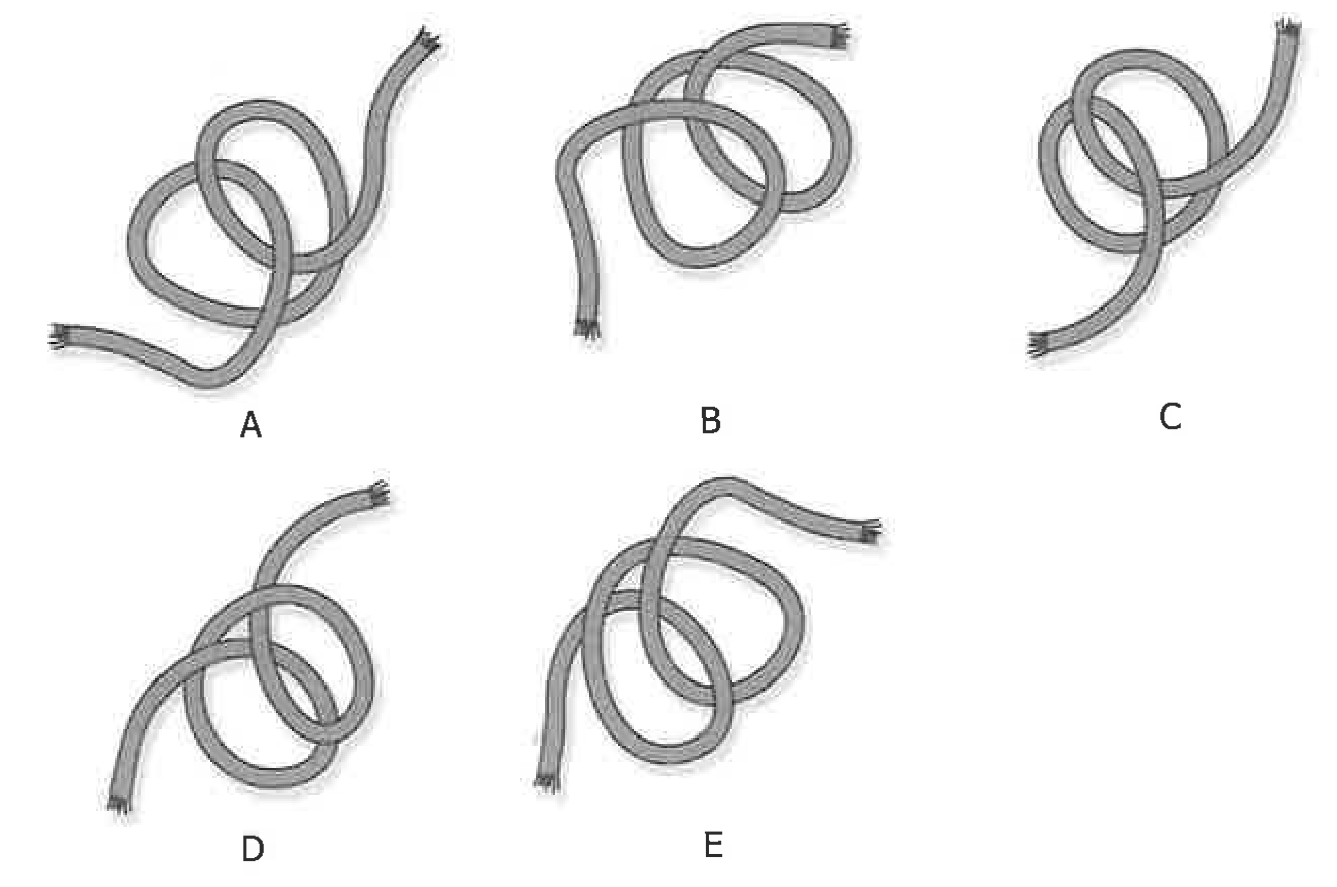
Which of the following will form a knot when the two ends are pulled away from each other at the same time?

Question illustration

Follow the over/under crossings exactly as drawn; a crossing is not a junction joining the strands.
  1. A
  2. B
  3. C
  4. D
  5. E

Question 9

Adam can travel from City A to City B by a bus, a train or a plane. To get from City B to Town C, he can hire a taxi, rent a car, a motorcycle or a bicycle. There is no direct transportation from City A to Town C. How many ways can Adam travel from City A to Town C?

Count one choice for each of the two legs A to B and B to C; no detours or repeated legs.
  1. 8
  2. 7
  3. 12
  4. 9
  5. None of the above

Question 10

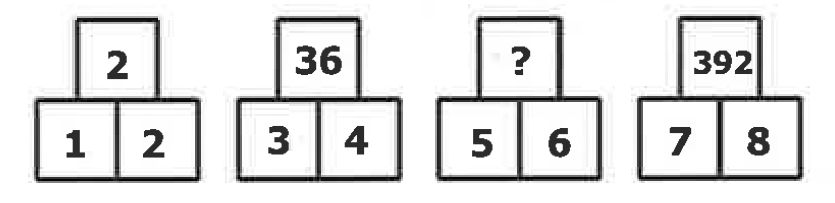
What is the missing number in the diagram below?

Question illustration

Editorial pattern convention: use one simple multiplication rule relating the two lower numbers to the top number in all four groups.
  1. 150
  2. 360
  3. 31
  4. 205
  5. None of the above

Question 11

Calculate the sum of the following mixed fractions.

\(1\frac13+2\frac9{12}+3\frac35+4\frac14+5\frac46+6\frac{10}{25}\)
  1. 18
  2. 19
  3. \(21\frac7{12}\)
  4. 24
  5. None of the above

Question 12

The plans for Mobile Data offered by a company are given below.

- Plan A: 20 minutes at 2 dollars
- Plan B: 50 minutes at 4 dollars
- Plan C: 60 minutes at 6 dollars
- Plan D: 100 minutes at 9 dollars

Which plan offers the best rate per minute?
  1. Plan A
  2. Plan B
  3. Plan C
  4. Plan D
  5. None of the above

Question 13

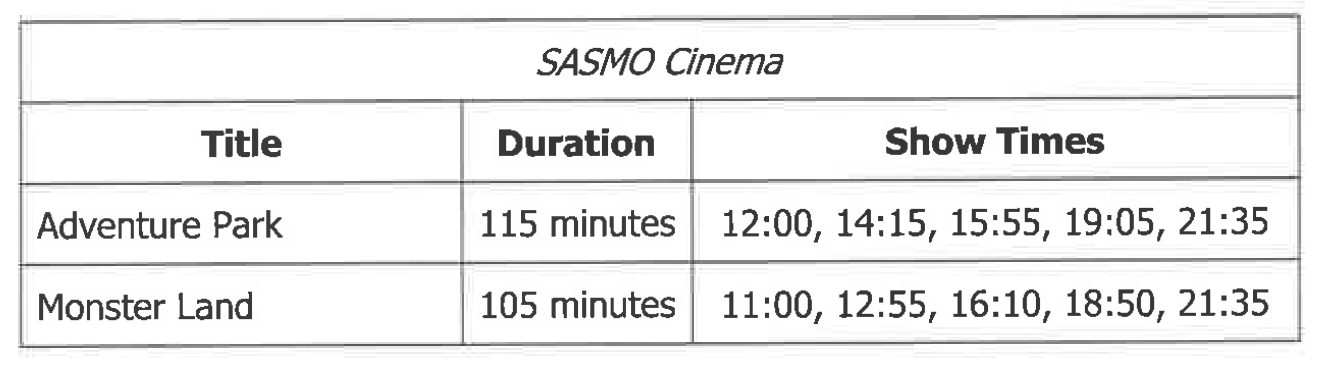
A group of friends arrive at SASMO Cinema at 11:30. They watch any movie together. What is the earliest time they could finish watching both movies?

Question illustration

Watch each of the two different movies once, from its listed starting time to the end. Assume no extra transfer time between screenings.
  1. 16:00
  2. 14:40
  3. 17:50
  4. 17:55
  5. None of the above

Question 14

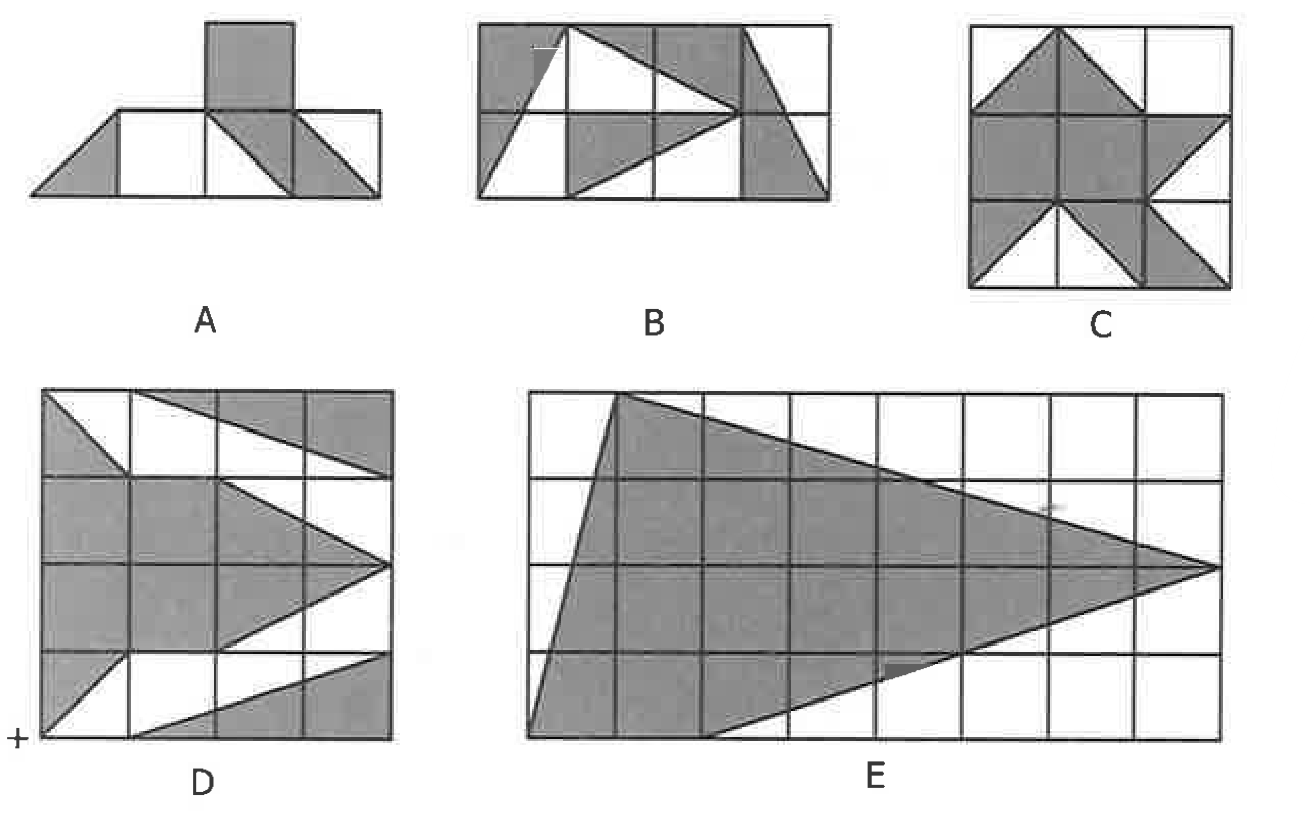
Which of the following figures has the largest fraction of its area shaded?

Question illustration

Each small grid square has equal area; compare shaded area divided by the whole area of each figure.
  1. Figure A
  2. Figure B
  3. Figure C
  4. Figure D
  5. Figure E

Question 15

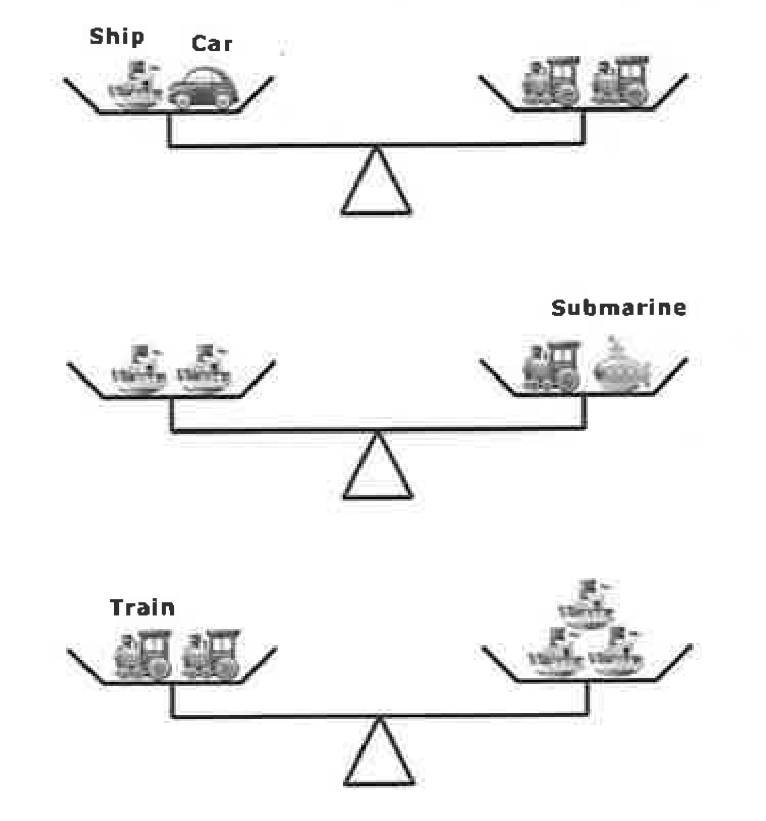
Study the picture below. Which toy is the heaviest?

Question illustration

Each pictured balance is level. Copies of the same toy have the same positive weight.
  1. Car
  2. Train
  3. Ship
  4. Submarine
  5. Impossible to know

Question 16

Find the sum of the whole numbers from 31 to 41:

31 + 32 + 33 + ⋯ + 40 + 41

Input: enter a whole number using digits only, without units. Leading zeroes from the paper answer grid may be omitted.
Question 17

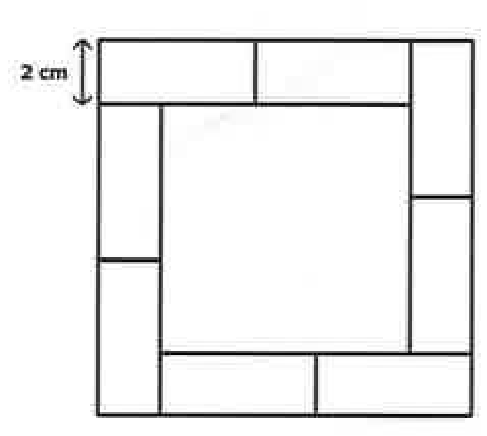
The big square on the right is made up of 8 identical rectangles and 1 small square. The width of each rectangle is 2 cm and the area of the small square is 64 square cm. Find the perimeter, in cm, of the big square.

Question illustration

Input: enter a whole number using digits only, without units. Leading zeroes from the paper answer grid may be omitted.
Question 18

Find the smallest 3-digit number such that the product of all its digits is also a 3-digit number.

Input: enter a whole number using digits only, without units. Leading zeroes from the paper answer grid may be omitted.
Question 19

Some children are in a summer camp. If the children are divided into groups of 7, then each child will be in a group. If the children are divided into groups of 9, then 2 children will be left out. What is the smallest possible number of children in the summer camp?

Input: enter a whole number using digits only, without units. Leading zeroes from the paper answer grid may be omitted.
Question 20

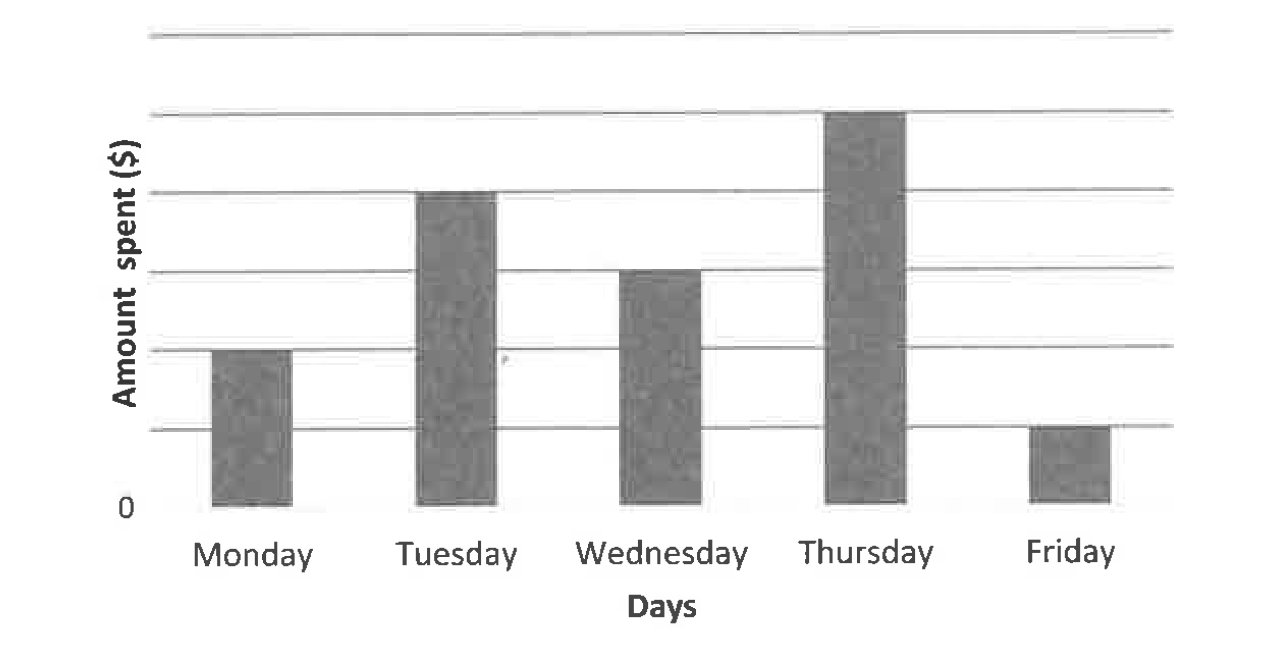
The following bar chart shows the amount of money Mary spent, in dollars, in the first 5 days of the last week. All horizontal lines are equally spaced. The day with the second highest amount and the day with the lowest amount differ by 60 dollars. On the following Saturday, Mary spent \(1/5\) of the total amount spent from Monday to Friday. How much did she spend on Saturday?

Question illustration

Input: enter a whole number using digits only, without units. Leading zeroes from the paper answer grid may be omitted.