The harmonic mean of two numbers can be computed as twice their product divided by their sum. The harmonic mean of $1$ and $2016$ is closest to which integer?
The ratio of the measures of two acute angles is $5:4,$ and the complement of one of these two angles is twice as large as the complement of the other. What is the sum of the degree measures of the two angles?
The War of $1812$ started with a declaration of war on Thursday, June $18,$ $1812.$ The peace treaty to end the war was signed $919$ days later, on December $24,$ $1814.$ On what day of the week was the treaty signed?
All three vertices of $\triangle ABC$ lie on the parabola defined by $y=x^2,$ with $A$ at the origin and $\overline{BC}$ parallel to the $x$-axis. The area of the triangle is $64.$ What is the length of $BC?$
Josh writes the numbers $1,$ $2,$ $3,$ $\ldots,$ $99,$ $100.$ He marks out $1,$ skips the next number $(2),$ marks out $3,$ and continues skipping and marking out the next number to the end of his list. Then he goes back to the start of his list, marks out the first remaining number $(2),$ skips the next number $(4),$ marks out $6,$ skips $8,$ marks out $10,$ and so on to the end. Josh continues in this manner until only one number remains. What is that number?
A thin piece of wood of uniform density in the shape of an equilateral triangle with side length $3$ inches weighs $12$ ounces. A second piece of the same type of wood, with the same thickness, also in the shape of an equilateral triangle, has side length $5$ inches. Which of the following is closest to the weight, in ounces, of the second piece?
Carl decided to fence in his rectangular garden. He bought $20$ fence posts, placed one on each of the four corners, and spaced out the rest evenly along the edges of the garden, leaving exactly $4$ yards between neighboring posts. The longer side of his garden, including the corners, has twice as many posts as the shorter side, including the corners. What is the area, in square yards, of Carl’s garden?
A quadrilateral has vertices $P(a,b),$ $Q(b,a),$ $R(-a,-b),$ and $S(-b,-a),$ where $a$ and $b$ are integers with $a\gt b\gt0.$ The area of $PQRS$ is $16.$ What is $a+b?$
How many squares whose sides are parallel to the axes and whose vertices have coordinates that are integers lie entirely within the region bounded by the line $y=\pi x,$ the line $y=-0.1,$ and the line $x=5.1?$
All the numbers $1,$ $2,$ $3,$ $4,$ $5,$ $6,$ $7,$ $8,$ $9$ are written in a $3\times3$ array of squares, one number in each square, in such a way that if two numbers are consecutive then they occupy squares that share an edge. The numbers in the four corners add up to $18.$ What number is in the center?
Alice and Bob live $10$ miles apart. One day Alice looks due north from her house and sees an airplane. At the same time Bob looks due west from his house and sees the same airplane. The angle of elevation of the airplane is $30^\circ$ from Alice’s position and $60^\circ$ from Bob’s position. Which of the following is closest to the airplane’s altitude, in miles?
The sum of an infinite geometric series is a positive number $S,$ and the second term in the series is $1.$ What is the smallest possible value of $S?$
All the numbers $2,$ $3,$ $4,$ $5,$ $6,$ $7$ are assigned to the six faces of a cube, one number to each face. For each of the eight vertices of the cube, a product of three numbers is computed, where the three numbers are the numbers assigned to the three faces that include that vertex. What is the greatest possible value of the sum of these eight products?
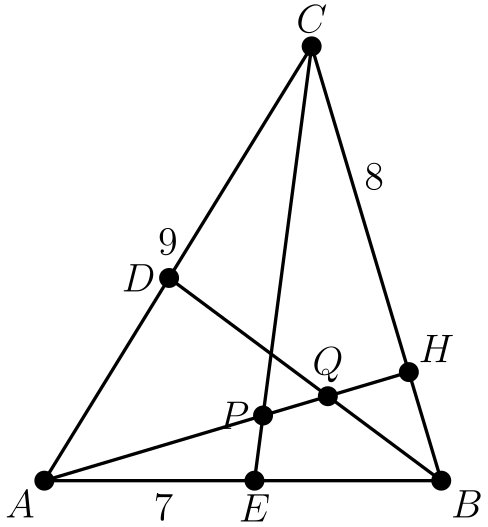
In $\triangle ABC$ shown in the figure, $AB=7,$ $BC=8,$ $CA=9,$ and $\overline{AH}$ is an altitude. Points $D$ and $E$ lie on sides $\overline{AC}$ and $\overline{AB},$ respectively, so that $\overline{BD}$ and $\overline{CE}$ are angle bisectors, intersecting $\overline{AH}$ at $Q$ and $P,$ respectively. What is $PQ?$
Tom, Dick, and Harry are playing a game. Starting at the same time, each of them flips a fair coin repeatedly until he gets his first head, at which point he stops. What is the probability that all three flip their coins the same number of times?
A set of teams held a round-robin tournament in which every team played every other team exactly once. Every team won $10$ games and lost $10$ games; there were no ties. How many sets of three teams $\{A,B,C\}$ were there in which $A$ beat $B,$ $B$ beat $C,$ and $C$ beat $A?$