How many times does the digit 0 appear in the list of integers from 1000 to 2021, including both endpoints? Count occurrences of the digit, not just numbers containing it.
Three cubes with volumes $1\text{ cm}^3$, $8\text{ cm}^3$ and $125\text{ cm}^3$ are glued together to form a solid. What is its least possible surface area, in $\text{cm}^2$? Use the source's face-to-face model: cubes remain intact, do not overlap, and their corresponding edges are parallel; partial face contacts are allowed.
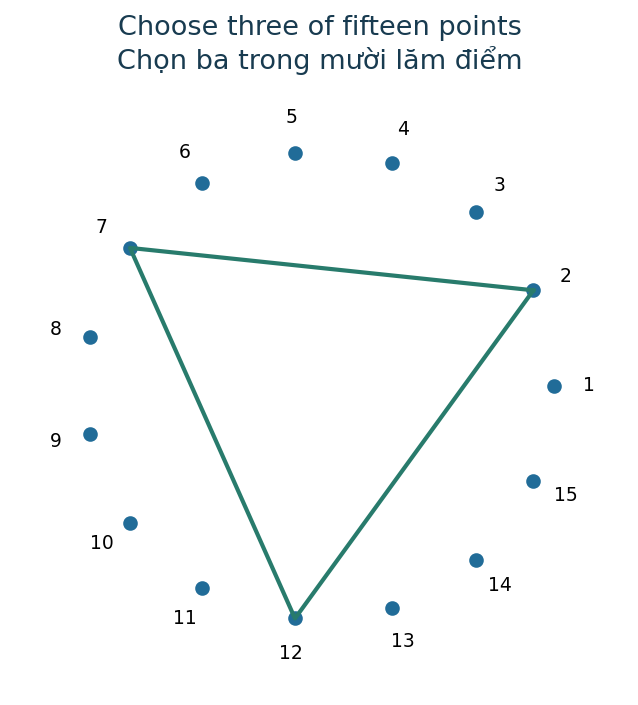
Consider 15 points, no three of which lie on one straight line. How many different triangles can be formed by choosing three of these points as vertices?
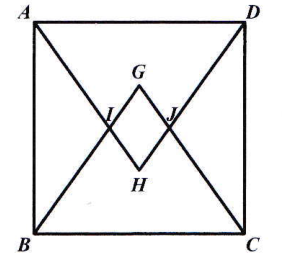
In the diagram, $ABCD$ is a square, and $AHD$ and $BCG$ are equilateral triangles. Points $I,J$ are the intersections shown. If the square has side length 6, find the area of rhombus $IGJH$. The source diagram is schematic, not to scale.
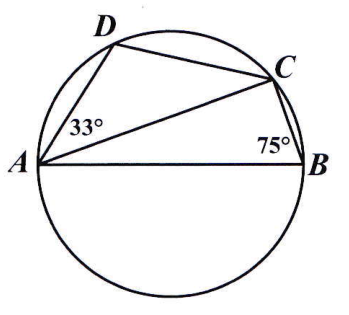
In the figure, $AB$ is a diameter of the circle, and $C,D$ lie on the same side of it. Given $\angle ABC=75^\circ$ and $\angle DAC=33^\circ$, find $\angle DCA$ in degrees.
Adding 1 to the numerator and 5 to the denominator of a fraction gives the same value as subtracting 5 from its numerator and 1 from its denominator. Find the fraction if its decimal value is 1.5. Choose the displayed numerator–denominator pair satisfying these operations; the original fraction need not be reduced.
Two vectors in three-dimensional Euclidean space are $4\hat\imath+9\hat\jmath-13\hat k$ and $7\hat\imath+6\hat k+5\hat\jmath$, where $\hat\imath,\hat\jmath,\hat k$ are the standard mutually perpendicular unit vectors. Find their dot product.
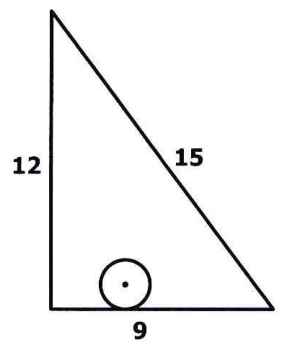
A circle of radius 1 rolls without slipping around the inside of a right-angled triangle with side lengths 9, 12 and 15, returning to its starting point after one circuit. How far does its centre travel? Use the source's idealized path: along each side the circle remains internally tangent to that side, transferring at a position tangent to two sides; no extra looping motion is included.
Find the sum of positive integers $p,q,r$ given
$$\gcd(p,q)=45,\quad\gcd(q,r)=21,\quad\gcd(p,r)=3,$$
$$\operatorname{lcm}(p,q)=4725,$$
$$\operatorname{lcm}(q,r)=11025,\quad\operatorname{lcm}(p,r)=6615.$$