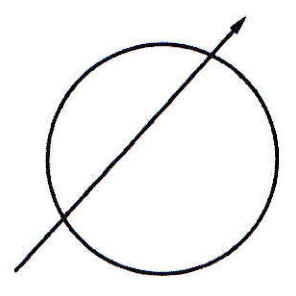
One straight line can divide the inside of a circle into two regions, as shown. What is the least number of straight lines needed to divide it into exactly 407 regions?
Tom travels the first 25 km at 60 km/h, then slows to $x$ km/h for the rest of his 50 km journey. His average speed for the whole journey is 40 km/h. Find $x$.
Three cubes of volumes $8\text{ cm}^3$, $27\text{ cm}^3$ and $64\text{ cm}^3$ are glued together. What is the least possible surface area of the resulting solid, in $\text{cm}^2$?
**Added editorial restriction for this self-study question:** all cube vertices must lie on one common cubic grid with spacing 1 cm, and all cube edges must be parallel to the grid axes. The cubes are not cut, their interiors do not overlap, and planar face contacts may be partial. This grid restriction is not stated in the original question. Enter the number.
Adding 1 to the numerator and 5 to the denominator of a fraction gives the same result as subtracting 5 from its numerator and 1 from its denominator. Its decimal value is 1.5. Which displayed fraction is it? The stated changes apply to the displayed numerator and denominator before reduction.
For a positive integer $n$, $n!=n(n-1)\cdots1$. For example, $4!=4\times3\times2\times1$. Find the greatest prime factor of $14!+16!$. Enter the integer.
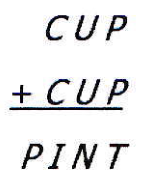
Different letters represent different decimal digits. In the cryptarithm below, $P$ and $C$ are nonzero. Find the first three digits of the least possible four-digit number $PINT$.