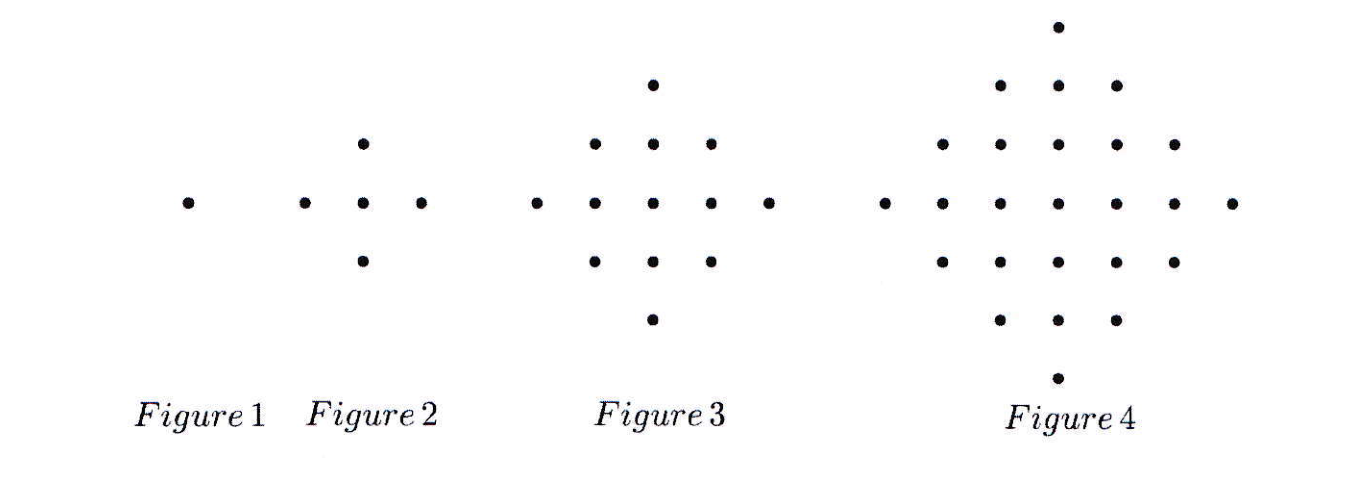
Study the dot figures below. Continue the same pattern of adding a complete outer diamond layer. Let $N$ be the total number of dots from Figure 1 through Figure 31. Find $N/31$.
An ant travels from $(7,10)$ to its anthill at $(19,25)$ and must touch the $x$-axis, where sugar is spread. What is its shortest possible travel distance? Assume an unobstructed Euclidean plane. Enter the distance in coordinate units.
Rationalise the denominator of
$$\frac1{\sqrt6-\sqrt3+\sqrt2+1}.$$
The printed source offers the following expressions, retained unchanged for comparison:
- A. $\dfrac{\sqrt6+\sqrt3-\sqrt2+1}{2}$
- B. $\dfrac{\sqrt6-\sqrt3+\sqrt2+1}{2}$
- C. $\sqrt6-\sqrt3+\sqrt2+1$
- D. $\sqrt6+\sqrt3-\sqrt2+1$
- E. $\sqrt6-\sqrt3-\sqrt2+1$
For this edition, submit your rationalised expression rather than an option letter. Write the result as $(a+b\sqrt2+c\sqrt3+d\sqrt6)/e$, where the five coefficients are integers with no common factor greater than 1 and $e>0$. Enter a;b;c;d;e in that order, separated by semicolons, with no spaces. Keep every sign, including negative coefficients.
A cricket climbs a staircase by jumping either 1 or 2 steps each time. In how many different ways can it climb an 8-step staircase? For example, a 3-step staircase has exactly three ways: $1+1+1$, $1+2$, and $2+1$. The order of jumps matters. Enter the number of ways.
How many numbers in the list $\frac11,\frac12,\frac13,\ldots,\frac1{98},\frac1{99},\frac1{100}$ have a terminating decimal expansion? Integers count as terminating decimals.
Stacy lies on Tuesdays, Wednesdays and Thursdays and tells the truth on all other days. Anthony lies on Saturdays, Sundays and Mondays and tells the truth on the other days. On what day can both say, “Tomorrow, I will lie”?
Enter the weekday code: Monday = 001, Tuesday = 002, Wednesday = 003, Thursday = 004, Friday = 005, Saturday = 006, Sunday = 007. Leading zeros are optional.
How many different sums can be obtained by adding two different integers chosen from $\{-102,-101,-100,\ldots,86,87,88\}$? Count distinct sum values, not pairs.
Let $f(x)=2^x+86$ and $g(x)=3x^2+x-4$. Find $g\bigl(f^{-1}(g(14))\bigr)$. Here $f^{-1}$ means the inverse function of $f$, not a reciprocal. Enter the numerical value.
The largest circle lying completely inside an equilateral triangle has radius 16 cm. Find the altitude of the triangle in cm. Enter the numerical length only.