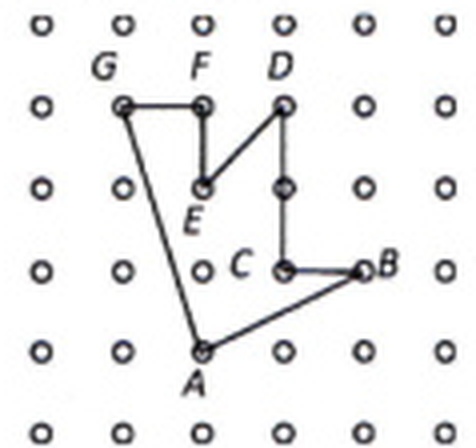
Thirty-six points are arranged in a unit-square array as shown. Figure $ABCDEFG$ is composed entirely of straight-line segments, with vertices $A,B,C,D,E,F,G$. Find its area in square units.
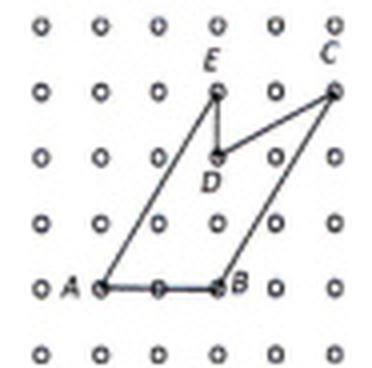
Thirty-six points are arranged in a unit-square array as shown. Figure $ABCDE$ consists entirely of straight-line segments. If its perimeter is $x+y\sqrt5+z\sqrt{13}$ units, find $x+y+z$.
Here $x,y,z$ are the nonnegative integer coefficients after like radical terms have been collected.
A photographer enlarges a photo diagonally in software to fit a digital album. The larger photo keeps its proportions and is neither squished nor stretched disproportionately. The original dimensions are 6 inches by 4 inches; the new dimensions are 12 inches by $p$ inches. Find $p$.
A lattice point in a Cartesian coordinate system has integer $x$- and $y$-coordinates. How many lattice points are on the line through $(2,4)$ and $(3,6)$? The line extends infinitely in both directions.
Phineas forms an ordered list of seven consecutive whole numbers. The sum of the first, third and sixth numbers is 175. Find the sum of the remaining four numbers.
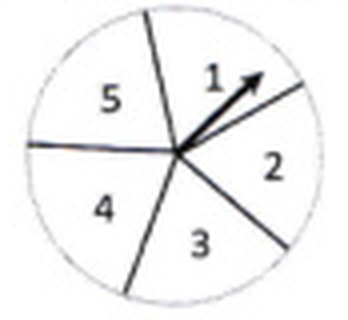
The spinner is divided into five equal parts. Spin once. If it lands on a perfect square number, flip a fair coin once. If it lands on a prime number, do not flip the coin. What is the probability that you flipped a coin and it landed heads up? If that probability is $p/q$ in simplest form, choose the value of $p+q$.
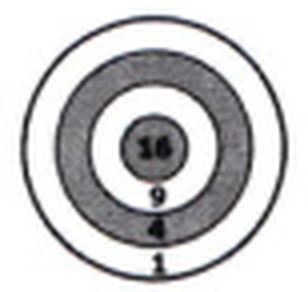
Four darts are thrown at the dartboard shown. A miss scores 0 points. Add the four scores. Find the least whole-number total that is impossible to obtain.
Assume all sections within each given shape have equal area. Consider only the area of the shape itself (the flower, circle, etc.), excluding surrounding space. Which option represents the shaded fraction of at least one shape, in simplest form?
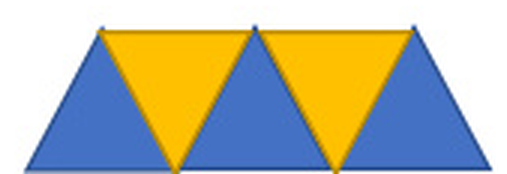
A tessellation covers a plane without gaps or overlaps. The triangular example below can continue infinitely in horizontal and vertical directions. Consider three identical regular pentagons. In how many ways can three such pentagons be arranged so that they form a tessellation?
Interpret this as asking whether an arrangement can extend to a tiling of the plane using only identical regular pentagons.