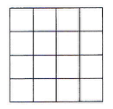
Sixteen $1\text{ cm}\times1\text{ cm}$ tiles form a square in 4 rows and 4 columns, as shown. Its perimeter is 16 cm. If it is cut into exactly two pieces along tile edges, what is the greatest total perimeter of the two pieces, in centimetres?
Each piece must remain connected through shared tile edges. Choose one option.
Given $\square+\triangle+\diamond=30$, $\triangle+\diamond+\star=22$, $\diamond+\star+\square=26$, and $\triangle+\diamond+\star+\square=37$, find $\star+\square+\triangle$.
Ari, Barry and Carrie chose a number. Ari said it was a multiple of 3, 5 and 11. Barry said it was a multiple of 2 and 7. Carrie said it had 4 digits, one of which was 9, but none of which were 6. Find the last 3 digits of the number.
Josh drove from his house toward his aunt’s house, 15 km away. He travelled 3 km in the first hour, then drove at 2.5 km per hour. How far was he from his aunt’s house 4 hours after leaving home?
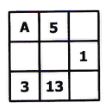
In a magic square, every row, column and diagonal has the same sum. The odd numbers from 1 through 17 are placed in this square, each once. What number goes in the cell marked A?
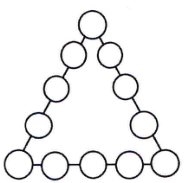
The numbers 1 through 12 are placed in the diagram, one in each circle, so that the sum along each side of the triangle is the same. What is the smallest possible sum per side?
Read carefully: dividing two positive whole numbers by their GCD (HCF) leaves two co-prime numbers. For example, 50 and 70 have GCD 10; their underlying co-primes are 5 and 7, obtained by dividing both numbers by 10.
Now use this idea. Two numbers add to 1085 and have GCD 35. What is the average of their underlying co-prime numbers, rounded to the nearest whole number?
Use ordinary rounding: a fractional part of exactly 0.5 rounds up. Enter one whole number.
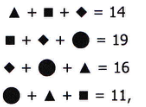
Given $\blacktriangle+\blacksquare+\blacklozenge=14$, $\blacksquare+\blacklozenge+\bullet=19$, $\blacklozenge+\bullet+\blacktriangle=16$, and $\bullet+\blacktriangle+\blacksquare=11$, what is the value of $\blacktriangle$?