Robin thought of a five-digit number that begins with 8. Her number is the smallest such number divisible by 9, and all its digits are different. Find the last four digits of the number.
Enter exactly four digits, retaining any leading zero. Do not insert spaces.
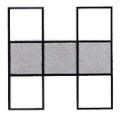
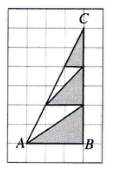
Place the whole numbers 1 through 7 in the figure, one per square. The sum in the left column, the sum in the right column, and the sum on each diagonal must all be equal. What is the largest possible product of the numbers across the grey row?
Use each of the seven numbers exactly once. Choose one option.
Mangoes were bought and placed into baskets to be distributed in an orphanage. If each basket was filled with 13 mangoes, 54 mangoes were left. But when 16 mangoes were put in each basket, there was a shortage of 27 mangoes. How many mangoes were bought?
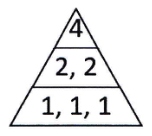
In the pyramid below, each number is the sum of the two numbers immediately below it. For example, three 1s on the lowest layer give two 2s above, then one 4 above them. If a similar pyramid has five 1s on its lowest layer, what is the sum of the numbers on its topmost layer?
The keys to nine rooms are all mixed up in a box. What is the least number of key trials needed to guarantee that every key can be matched to its room lock?
There are exactly nine distinct keys, each opening exactly one different lock. Count physical key-in-lock trials; a match known by deduction needs no trial. Find the worst-case guarantee, not a lucky outcome. Enter one whole number.
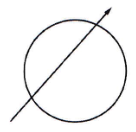
One straight line through the region inside a circle can cut it into two parts, as shown. If the circle is cut into 232 parts, what is the least number of straight lines that must be drawn through the region?
Lines are straight and may be placed freely; count regions inside the circle. Enter one whole number.
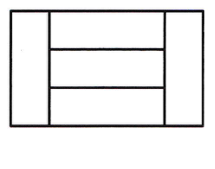
The figure below is made of five identical rectangles. Its total area is $60\text{ cm}^2$. What is the perimeter, in centimetres, of one small rectangle?