One-fifth of all apples in a basket are red. Three-fourths are yellow. The remaining apples are green. There are 200 apples in the basket. How many are green?
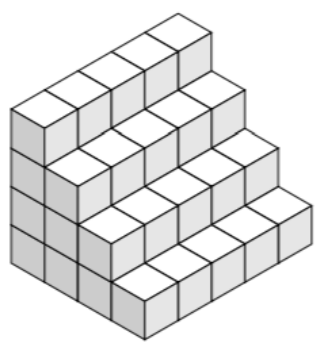
Raziya started with the structure below, fully packed all the way to the back of the top stairs. She added similar unit cubes to form a packed staircase, 10 steps high. Each unit cube measures $1\times1\times1$ cm. The source mentions cubes filling a box with dimensions $3\times11\times10$ cm and asks for the length (width) of each step.
**Editorial interpretation for this question:** use that box volume as the TOTAL number of cubes in the final staircase, including cubes already present, not as the number added. Each step rises 1 cm and has a tread depth of 1 cm; all steps have the same width. Find that width in cm.
The mangoes remaining in a cart weigh 3 kg after 10 mangoes are removed. If only 8 mangoes are removed from the same original cart, the remaining mangoes weigh 3400 grams. How many mangoes were originally in the cart? Editorial assumption: all mangoes have equal mass, as required by the source solution; the cart itself is not included in either mass.
Which statement is true? For option D, interpret the two heptagons as joined along one complete side, with no overlap, and count the outer boundary sides.
Choose one option.
If a circle and a regular octagon have the same area, the radius of the circle equals the distance from the centre to a vertex of the octagon.
The difference between the numbers of sides of an octagon and a trapezium is a prime number.
All regular quadrilaterals have sides of equal length.
Four more than the number of sides of a decagon equals the number of sides of the figure formed by joining two identical regular heptagons next to each other.
Only right-angled triangles have area $(\text{base}\times\text{height})\div2$.
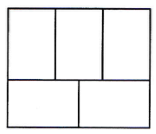
A large rectangle is divided into five identical small rectangles as shown. Each small rectangle has width 8 cm. What is the perimeter of the large rectangle, in cm?
How many times does the digit 5 appear in the page numbers of a 350-page book? Count page numbers 1 through 350 once each; count both 5s in a number such as 55.
Amanda's score was twice Brian's score. Cassie scored 5 points less than Brian. Dora scored 10 points more than Amanda. Dora's score was 6 times Cassie's score. Whose score was 10?
A five-digit number satisfies all these conditions:
- It is a multiple of 3 and 5.
- Its third digit is half its first digit and one less than its second digit.
- The first three digits sum to 13 and the last three digits sum to 8.
- Its fourth digit is the second-largest digit in the number.
Find the sum of its digits.
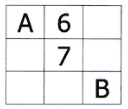
Fill the grid with the numbers 1 to 9, using each exactly once, so that:
- first row sum = first column sum = 16;
- second row sum = second column sum = 15;
- third row sum = third column sum = 14.
Find $A\times B$.