Each of the whole numbers 1 through 9 is written on 9 cards, one number per card. Three cards are dealt to each of the three players. The sum of Player One's cards is 15. The sum of Player Two's cards is 23. What is the highest single card Player Three could have?
Enter only the whole-number answer, without units.
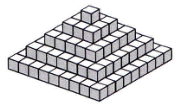
There are 165 unit cubes arranged in 5 square layers with no space between the cubes as shown. The layers are 1 by 1, 3 by 3, 5 by 5, 7 by 7, and 9 by 9. If a sixth layer is placed on the bottom of the arrangement following the pattern, how many unit cubes are completely surrounded by six other unit cubes?
Follow the centred, aligned square-layer arrangement shown; “surrounded” means sharing each of the six faces with a neighbouring cube.
A solid brick is formed by gluing together eighty $1\times1\times1$ cubes. The brick has as little surface area as possible. The two faces with the least area are painted blue. What is the number of square units in the area of one blue face?
Here “brick” means a completely filled rectangular prism with whole-number side lengths.
Enter only the whole-number answer, without units.
Sam filled up some boxes with sweets. If he put 5 sweets in each box, he would have left with 4 extra sweets. If he put 6 sweets in each box, the last box would have only 2 sweets. Find the number of sweets Sam had.
Use the same number of boxes in both arrangements.
Enter only the whole-number answer, without units.
Patrick scored 82 and 85 marks respectively in English and Science. If the total marks of these papers are 100, how many marks should he score in Mathematics so that his average marks in these three subjects becomes 87?
Each paper is marked out of 100; all three subjects have equal weight.
Enter only the whole-number answer, without units.
Amy spent $\frac14$ of the cash in her wallet at the game store, $\frac23$ of the remaining cash at a clothing store, $\frac13$ of what was left for lunch, and $\frac34$ of what remained at the shoe store. After spending all that money, she had 10 dollars left. How much cash did she have at first?
Karen can paint a wall in 2.5 hours. Stephanie takes 1.25 hours to paint the same size wall. How many minutes will it take for Karen and Stephanie working together to paint the same wall?
Assume constant individual painting rates, with their rates adding when they work together.
Enter only the whole-number answer, without units.