The year $2002$ is a palindrome (a number that reads the same from left to right as it does from right to left). What is the product of the digits of the next year after $2002$ that is a palindrome?
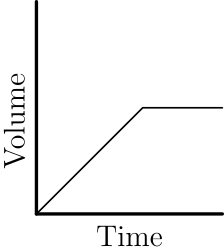
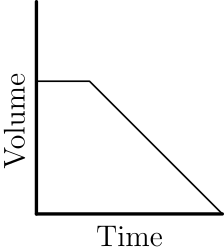
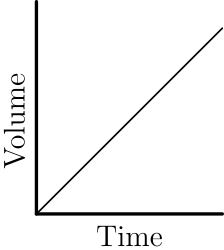
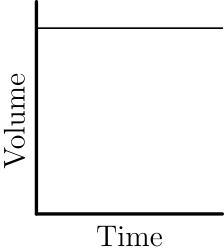
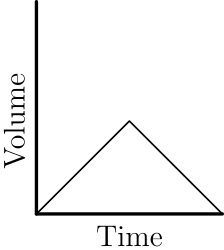
A birdbath is designed to overflow so that it will be self-cleaning. Water flows in at the rate of $20$ milliliters per minute and drains at the rate of $18$ milliliters per minute. One of these graphs shows the volume of water in the birdbath during the filling time and continuing into the overflow time. Which one is it?
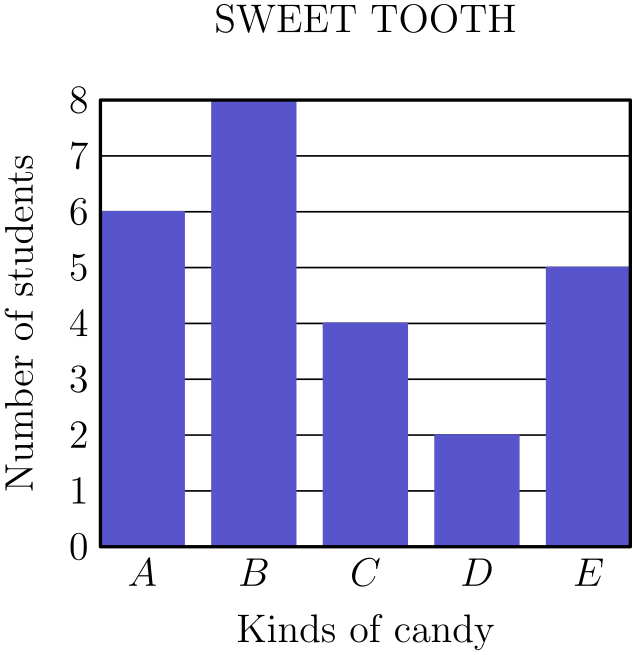
The students in Mrs. Sawyer’s class were asked to do a taste test of five kinds of candy. Each student chose one kind of candy. A bar graph of their preferences is shown. What percent of her class chose candy $E?$
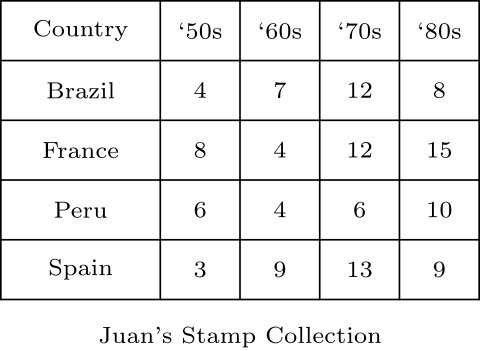
Problems $8,$ $9,$ and $10$ use the data found in the accompanying paragraph and table.
Juan’s Old Stamping Grounds
Juan organizes the stamps in his collection by country and by the decade in which they were issued. The prices he paid for them at a stamp shop were: Brazil and France, $6$¢ each, Peru $4$¢ each, and Spain $5$¢ each. (Brazil and Peru are South American countries and France and Spain are in Europe.)
**Number of Stamps by Decade**
How many of his European stamps were issued in the ‘$80$s?
A sequence of squares is made of identical square tiles. The edge of each square is one tile length longer than the edge of the previous square. The first three squares are shown. How many more tiles does the seventh square require than the sixth?
A board game spinner is divided into three regions labeled $A,$ $B$ and $C.$ The probability of the arrow stopping on region $A$ is $\frac{1}{3}$ and on region $B$ is $\frac{1}{2}.$ The probability of the arrow stopping on region $C$ is
For his birthday, Bert gets a box that holds $125$ jellybeans when filled to capacity. A few weeks later, Carrie gets a larger box full of jellybeans. Her box is twice as high, twice as wide and twice as long as Bert’s. Approximately, how many jellybeans did Carrie get?
A merchant offers a large group of items at $30\%$ off. Later, the merchant takes $20\%$ off these sale prices and claims that the final price of these items is $50\%$ off the original price. The total discount is
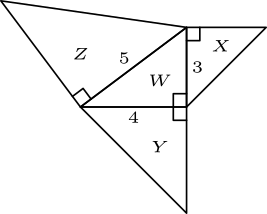
Right isosceles triangles are constructed on the sides of a $3-4-5$ right triangle, as shown. A capital letter represents the area of each triangle. Which one of the following is true?
In a mathematics contest with ten problems, a student gains $5$ points for a correct answer and loses $2$ points for an incorrect answer. If Olivia answered every problem and her score was $29,$ how many correct answers did she have?
Gage skated $1$ hr $15$ min each day for $5$ days and $1$ hr $30$ min each day for $3$ days. How long would he have to skate the ninth day in order to average $85$ minutes of skating each day for the entire time?
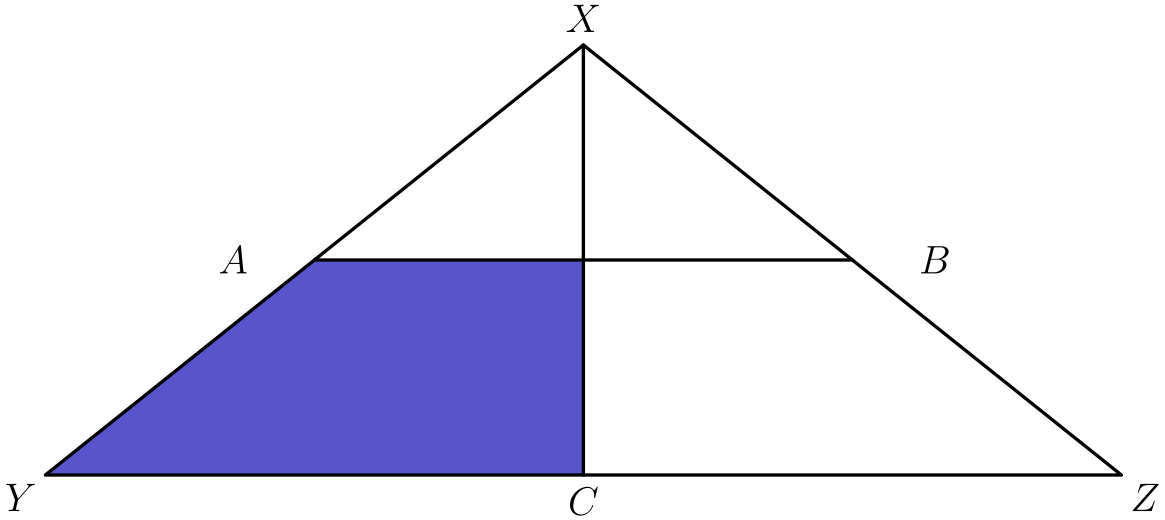
The area of triangle $XYZ$ is $8$ square inches. Points $A$ and $B$ are midpoints of congruent segments $\overline{XY}$ and $\overline{XZ}.$ Altitude $\overline{XC}$ bisects $\overline{YZ}.$ The area (in square inches) of the shaded region is