Find the value of the digit in the ones place of the following expression: $99\times101\times103\times105\times107-100\times102\times104\times106\times108$.
Radha has to cut small strips of ribbon of 5 cm each. But after every 3 strips of 5 cm, she cuts a strip of 4 cm mistakenly. If a total roll of 100 cm was cut into small ribbons, how many 5 cm ribbon strips are there?
Fill in the operations to make the following equation true. Follow the order of operations strictly from left to right, not the usual BODMAS order: $45\ \square\ 54\ \square\ 11\ \square\ 2=18$.
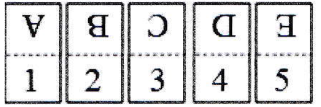
The place cards shown are folded along the dotted line so that only a number or letter is visible. Chrissy enters the room and sees all five place cards, with at least 2 number cards being shown. The sum of the numbers she sees is less than 8. How many different sets of numbers are there?
There are 5 pairs of different colours of socks in a drawer. What is the least number of socks Jeena must take out without looking to be sure that she has a pair of the same colour?
Ayer and Kumar tossed a coin. Ayer wins if it is a head while Kumar wins if it is a tail. The winner gets 3 marbles from the loser. Both had 20 marbles each in the beginning. They played 10 rounds and Ayer won 4 rounds. What is the total number of marbles Kumar had in the end?
A basket contains 30 red balls. Karla takes 5 red balls and replaces them with 6 green balls. She continues to exchange the balls in the same way until all the red balls are replaced by green balls. How many balls are there in the basket now?
There are three boxes labelled 1, 2 and 3. Each box contains different numbers of different coloured marbles.
- The number of yellow marbles is half the sum of the red and blue marbles.
- There are more blue marbles than red marbles.
- Box 1 has 10 marbles.
- The total number of marbles is 60.
How many blue marbles are there?
**Assumption for this self-study exercise:** Each box contains marbles of just one colour, and the three boxes contain red, yellow and blue marbles, one colour per box. This is the interpretation used by the source solution; the original wording does not state it clearly.
Harry brought a few marbles to school. He distributed one-third of the marbles among his friends on the bus. He then gave 20 marbles to his classmates. Now he is left with only one-fourth of his marbles. How many marbles did he have at first?
Both fractions refer to his original number of marbles.