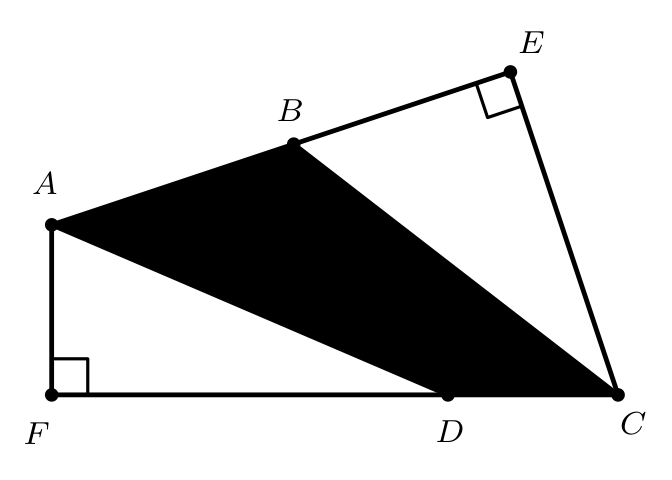
Exercise 13. In the quadrilateral $AECF$ below, $AB=3\text{ cm}$, $CE=4\text{ cm}$ and $CD=AF=2\text{ cm}$. Find the area (in $\text{cm}^2$) of the quadrilateral $ABCD$.
Question 7. Jack wants to bike from his house to Jill’s house, which is located three blocks east and two blocks north of Jack’s house. After biking each block, Jack can continue either east or north, but he needs to avoid a dangerous intersection one block east and one block north of his house. In how many ways can he reach Jill’s house by biking a total of five blocks?
Exercise 10. A fruiterer has a certain number of apples. If he arranges them in groups of 2, 3, 4, 5, 6, 7, 8 or 9, he will always have one left over for each group. What is the least number of apples he can possibly have?
**Editorial input convention:** Both minima are accepted: the literal remainder-only reading, or the reading requiring at least one full group of every size. The solution explains each.
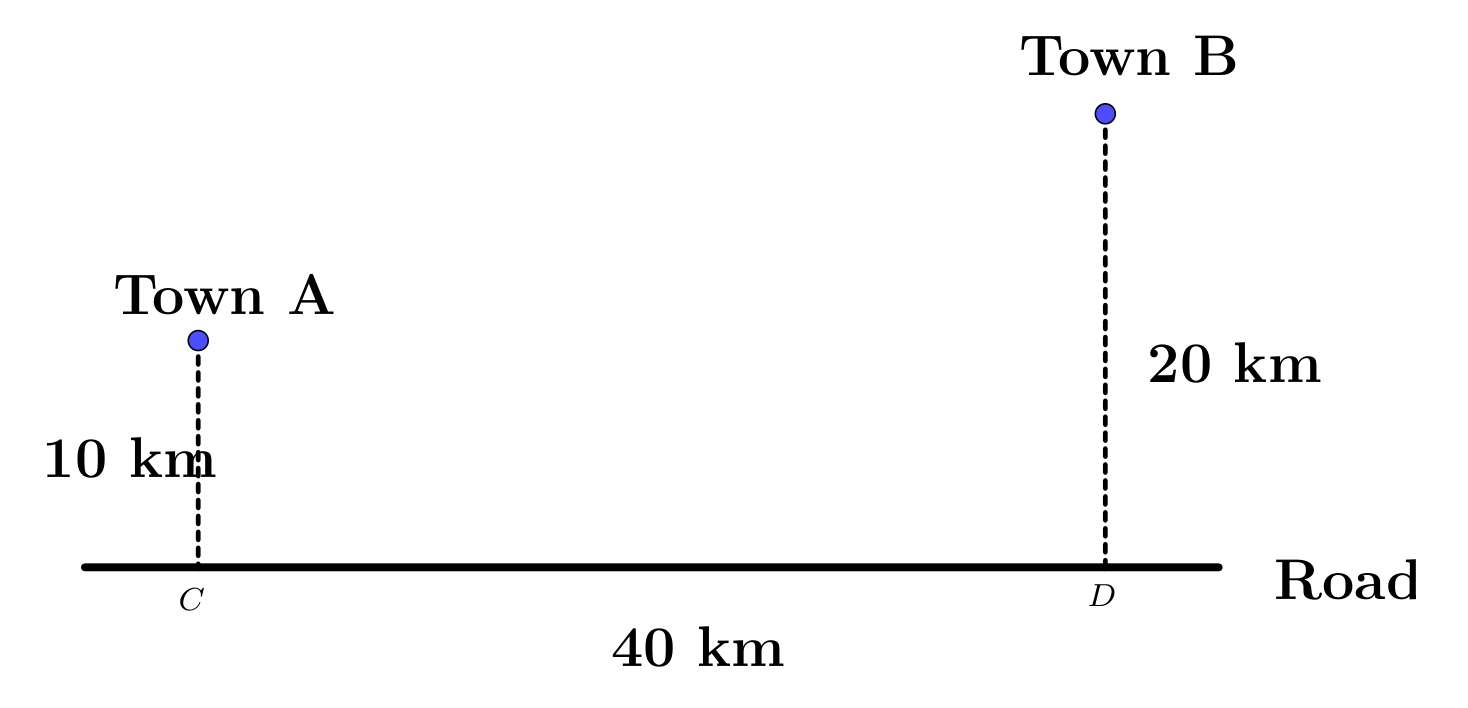
Question 25. Two towns, $A$ and $B$, lie to the north of a straight road running in the East-West direction (as shown in the diagram below). Unfortunately they are neither connected to the road nor to each other. The people living in the two towns decide to build two new roads, one from each town, to the existing road, such that the route connecting the two towns via the existing road will be the shortest. Given that $AC=10\text{ km}$, $BD=20\text{ km}$ and $CD=40\text{ km}$, find the length of the shortest route from town $A$ to town $B$.
**Editorial input convention:** The two new roads may use a common junction on the existing road. Enter the minimum distance in kilometres.
Exercise 10. At a local football stadium, the benches are 8 meters long. If two people sit randomly on the bench, what is the probability that they will be at least two meters apart from each other?
**Editorial input convention:** Use independent uniform point positions on the 8-metre bench, without a seat-width constraint.
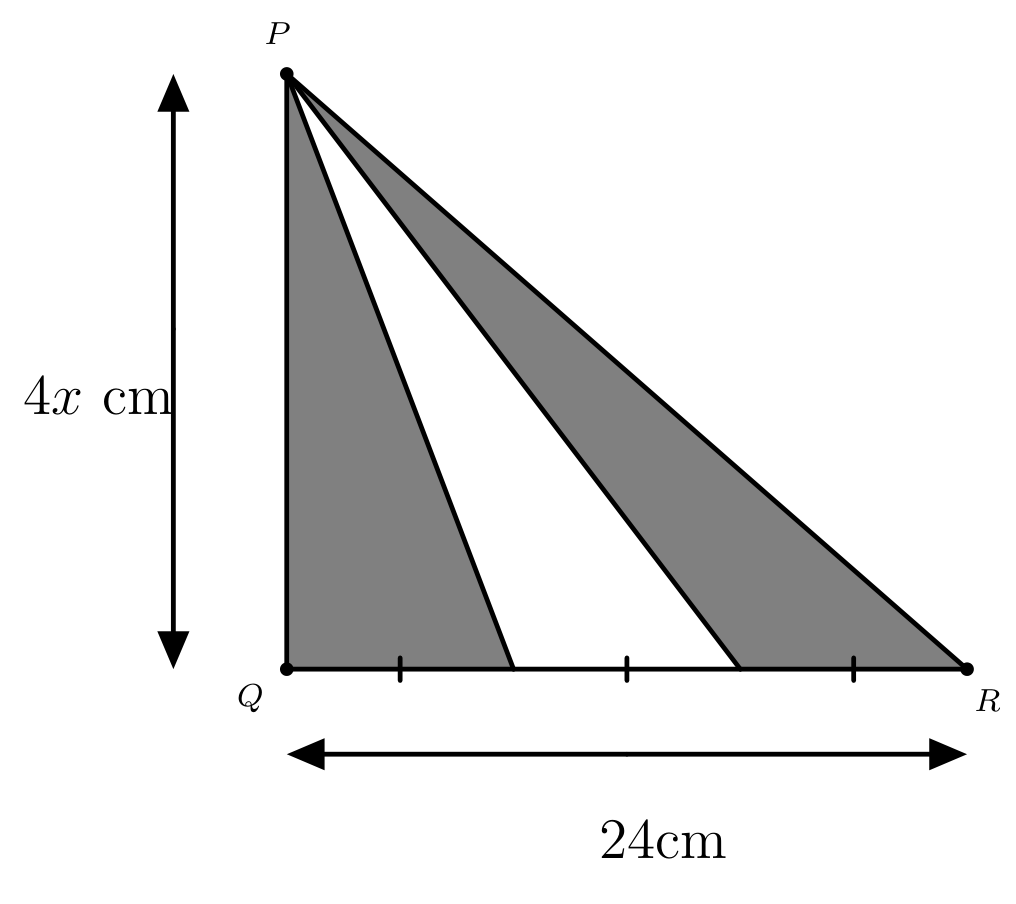
a) Find the total area of the shaded parts in terms of $x$.
b) If $x=7$, find the total area of the shaded parts.
**Editorial input convention:** Enter the expression in x for a and the numerical area for b, separated by a comma; omit units. Example format only: 5x, 35.
**Editorial input note:** Use no spaces anywhere in your entry, including within the expression. Apply this rule to the format example above.
Exercise 15. The LCM of three numbers $P,Q$ and $R$ is $2^5\times3^6\times5^2\times7^2$. Given that $P=2^4\times3^5\times7^2$ and $Q=2^5\times3^2\times5\times7$. Find the smallest value of $R$, in index notation.
**Editorial input convention:** Use index notation with ^ for exponents and * or × for multiplication; example format only: 2^3*7^2.
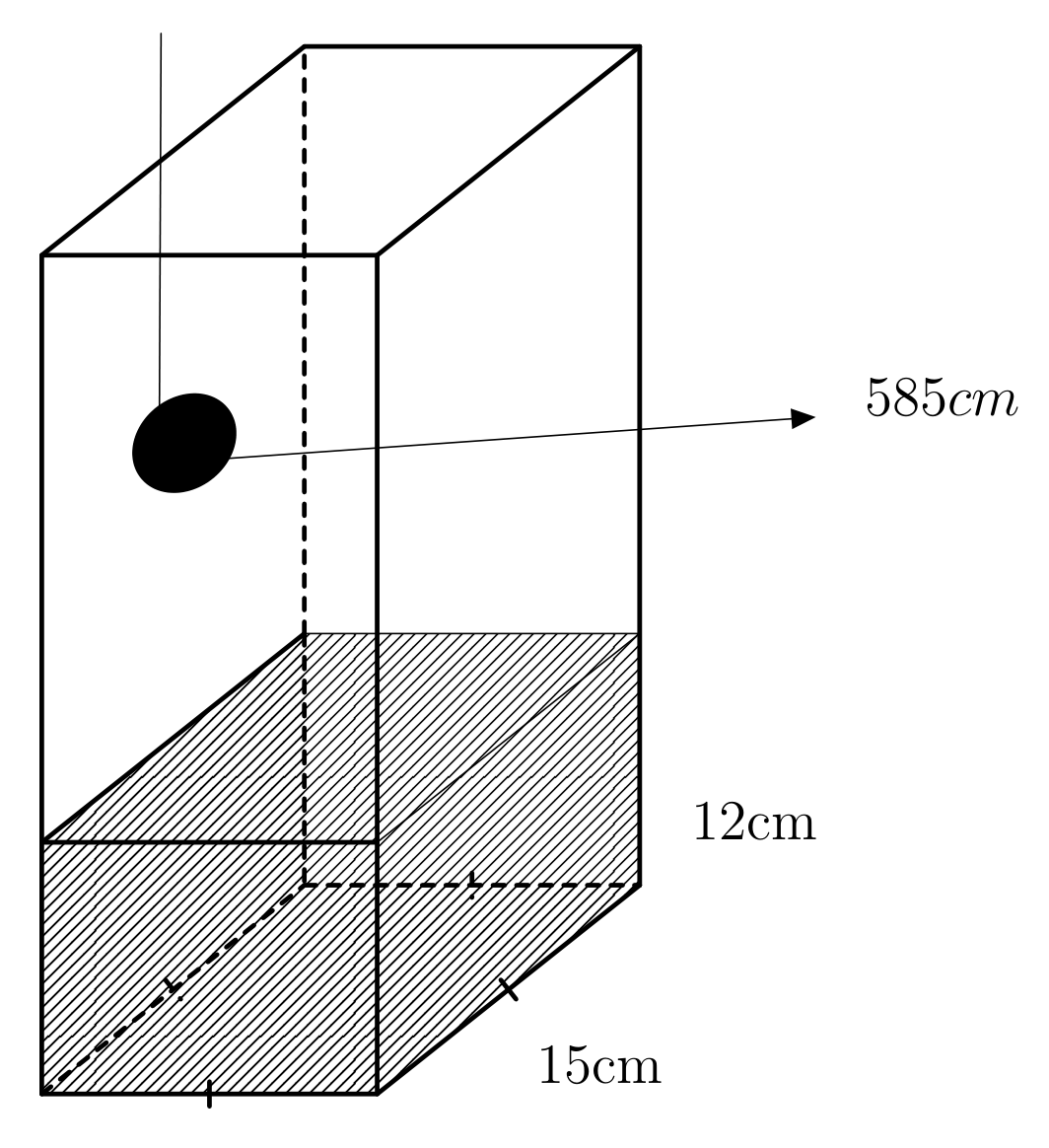
Example 8. A container is filled with water to a height of $12\text{ cm}$. A stone of volume $585\text{ cm}^3$ is dropped into it. Find the new height of the water if the tank has a square base of $15\text{ cm}$ length.
**Editorial input convention:** Assume full submersion, vertical walls and no overflow or water loss. Enter the new height in centimetres.
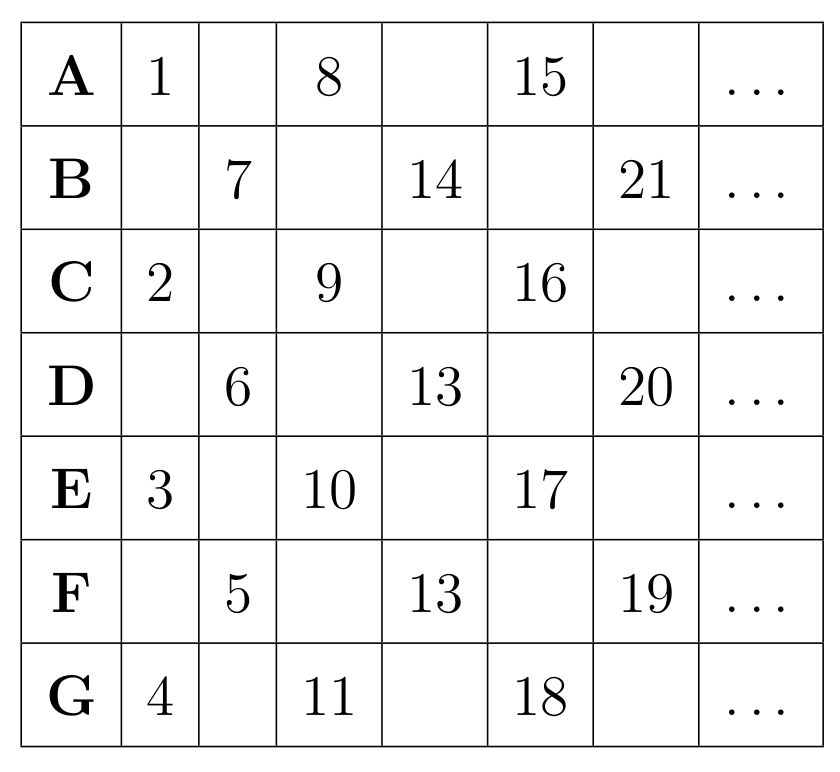
Exercise 4. Study the pattern below. In which will you find the number 300?
**Editorial input convention:** Use the +7 continuation evident in the six consistent rows and enter its row label. The source defect in row F is discussed in the solution.