There are 2 red cars and 3 blue cars. The 5 cars contain a total of 12 people. No car has more than 4 people. Every car has at least 1 person. The only cars with the same number of people are the red cars. How many people are there in 1 red car?
Count whole people. The three blue-car occupancies are mutually different and also different from the shared red-car occupancy.
There are chickens and rabbits in a cage. Look at the top of the cage - there are totally 35 heads. Look at the bottom of the cage - there are 94 legs. How many rabbits are there in the cage?
Use the usual model: one head per animal, two legs per chicken and four per rabbit.
16% of the balls in a basket are purple. 8/21 rest are yellow and the balance green. There are 48 more yellow balls than purple ones. How many balls are there in the basket altogether?
The fraction 8/21 applies to the remainder after the purple balls.
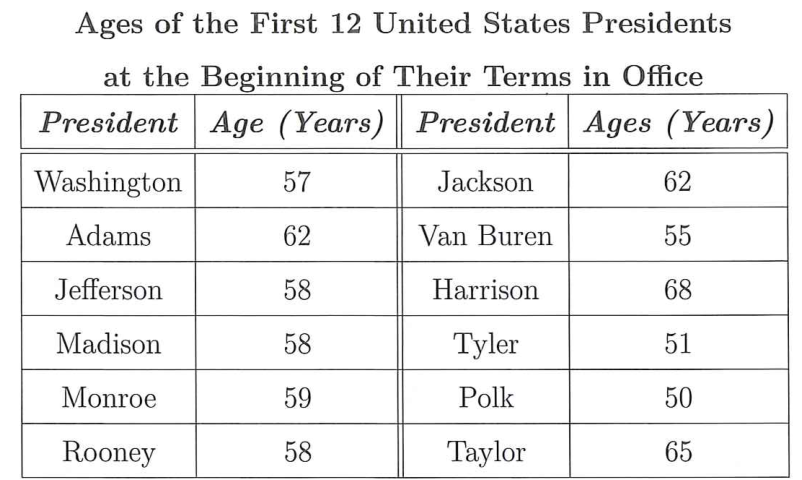
Ages of the First 12 United States Presidents at the Beginning of Their Terms in Office
| President | Age (years) | President | Age (years) |
|---|---:|---|---:|
| Washington | 57 | Jackson | 62 |
| Adams | 62 | Van Buren | 55 |
| Jefferson | 58 | Harrison | 68 |
| Madison | 58 | Tyler | 51 |
| Monroe | 59 | Polk | 50 |
| Rooney | 58 | Taylor | 65 |
The table above lists the ages of the first 12 United States presidents when they began their first term in office. According to the table, what was the mean age, in years, of these presidents at the beginning of their terms? Round your answer to the nearest tenth.
The label “Rooney” is retained exactly as printed; this question uses the supplied table rather than verifying historical information.
Answer entry: use a decimal point, for example 12.3.
There are 14 rows of seats in a school hall. There are 70 seats in the last row. If there is an increase of 3 seats, starting from the first row, how many seats are there in the school hall?
Row convention: each successive row has exactly 3 more seats than the row before it.
Jack’s salary in June was 4000 dollars. He spent 40% of his salary on rent, 15% on transport, 20% on food and saved the rest. In July his salary was increased. The amount of money he spent on rent and transport for July remained the same. However, he spent 400 dollars more on food. If Jack saved the remaining 20% of his salary in July, find the percentage increase in his salary.
Answer entry: the percentage number only, using a decimal point if needed; omit the % sign.
Mrs Walker bought a box of paper clips. She shared the paper clips among her 4 children. Alice received 190 paper clips. Rita received 56 more paper clips than Jim. Jim received 25% of the paper clips while Tom received 20% of the paper clips. How many paper clips did Mrs Walker buy altogether?
A square-shaped floor is covered with congruent square tiles. If the total number of tiles that lie on the two diagonals is 37, how many tiles cover the floor?
Grid convention: the tiles form aligned rows and columns; count tiles whose interiors a diagonal crosses, not tiles touched only at a corner. A tile on both diagonals is counted once.
Henry, Charlie and Daisy were classmates. One of them cleaned up the classroom one day while there was nobody around. Below were their replies when the teacher questioned about who cleaned up the classroom.
• Henry: ”Charlie cleaned the classroom.”
• Charlie: ”I did not do it.”
• Daisy: ”Neither did I.”
If one of them was telling the truth, find out who cleaned up the classroom.
Interpret “one” as exactly one true statement. Enter the name only: Henry, Charlie or Daisy.
A cistern can be filled in 9 hours. But it takes 10 hours, due to a leak in its lower part. If the cistern is full, then how many hours does it take to empty the cistern?
Use constant inlet and leak rates. During emptying, close the inlet and let only the leak drain the full tank completely.