Skip to content / Đến nội dung
ThichHocToan.com

AMO 2027 Grades 4-5 SET 23 - Self-study

Question 1

The average weight of five friends Alan, Bob, Carl, Don and Earl is 51 kg. The average weight of Alan, Bob and Carl is 49 kg, the average of weight of Bob, Don and Earl is 54 kg. What is the weight of Bob?
  1. 51
  2. 52
  3. 53
  4. 54
  5. None of the above

Question 2

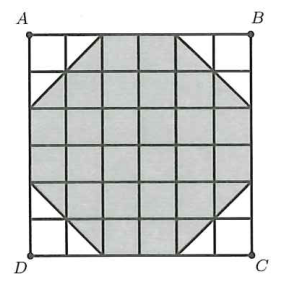
Square ABCD is composed of 36 squares of the same size, as shown. The area of square ABCD is 144 square centimeters. What is the area of the shaded region?

Read the vertices at the displayed grid intersections; the grid cells are equal squares.

Question illustration

Question 3

Let a and b be two consecutive whole numbers. Which of the following is ALWAYS true about a × b?

Whole numbers here mean nonnegative integers, including zero.
  1. Bigger than 5
  2. Divisible by 3
  3. Divisible by 4
  4. Odd number
  5. Even number

Question 4

Trees are planted on one side of Liang Street. Two consecutive trees are 8 meters away from each other and trees are planted at the two ends of Liang Street. If there are 21 trees in total, how long is Liang Street?

Measure along the straight row of trees, including both endpoint trees; answer choices are in metres.
  1. 152
  2. 160
  3. 168
  4. 176
  5. None of the above

Question 5

Tian measured her steps and found that it took her 625 steps to walk 500 m. If she walks 10,000 steps at this same rate, what distance will she walk?
  1. 6.4 km
  2. 6.25 km
  3. 7.5 km
  4. 8 km
  5. None of the above

Question 6

Find the next fraction in the sequence below.

$$\frac13,\ \frac12,\ \frac59,\ \frac7{12},\ \frac35,\ \ldots$$

Use the simple intended rule: write successive terms with numerators 1,3,5,7,9,… and denominators 3,6,9,12,15,…, then reduce if possible.
  1. $17/18$
  2. $11/18$
  3. $5/18$
  4. $5/7$
  5. None of the above

Question 7

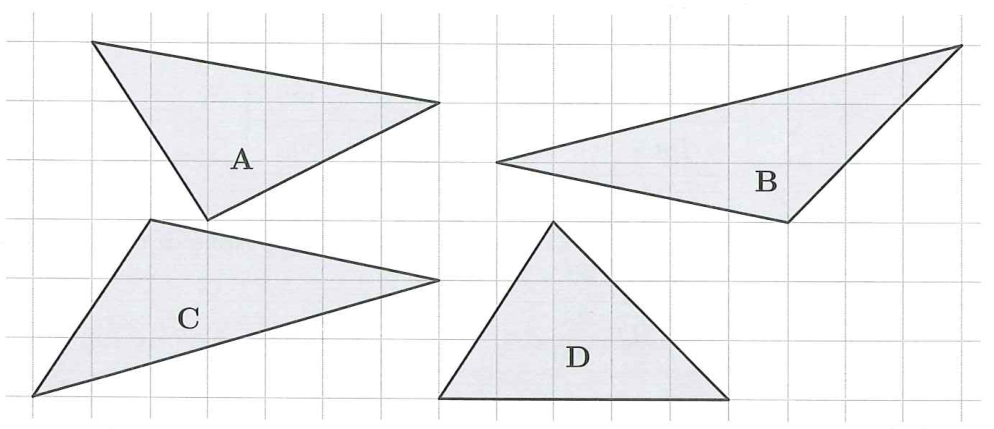
Arrange the triangles below from the smallest to the largest area.

Use the equal square-grid cells as unit squares and the indicated vertices as grid intersections.

Question illustration
  1. A, B, C, D
  2. B, C, A, D
  3. D, C, A, B
  4. D, A, C, B
  5. None of the above

Question 8

Alex, George and Frank have 132 fruits. Alex has 1/3 of George’s and Frank’s total fruits. George has 4/7 of Frank’s number of fruits. How many fruits does George have?

Alex’s fraction refers to the combined number of fruits of George and Frank.
  1. 60
  2. 36
  3. 56
  4. 32
  5. None of the above

Question 9

There are 21 players in a chess tournament. Each player must play exactly one match against the rest of the players. How many matches are there in the competition?

Interpret the tournament as one match for each distinct pair of players.
  1. 210
  2. 220
  3. 230
  4. 240
  5. None of the above

Question 10

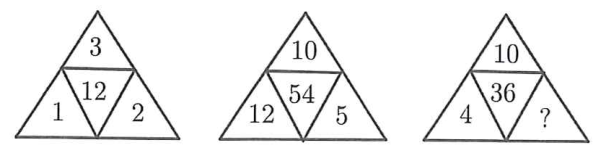
What number should replace “?” in the following diagram?

| Triangle | Top | Lower left | Lower right | Center |
|---|---|---|---|---|
| 1 | 3 | 1 | 2 | 12 |
| 2 | 10 | 12 | 5 | 54 |
| 3 | 10 | 4 | ? | 36 |

Use the simple intended rule: the center number is twice the sum of the three outside numbers.

Question illustration

Question 11

Given $1!=1$, $2!=1\times2$, $3!=1\times2\times3$, and $4!=1\times2\times3\times4$. Find $6!$.

Continue the factorial rule: n! is the product of all positive integers from 1 through n.

Question 12

Melissa, Frank and Shelly are going to meet for a picnic. Melissa has 5 berries while Frank has 9 berries. How many berries should Shelly bring so that they can share and have 8 berries each?
  1. 7
  2. 8
  3. 9
  4. 10
  5. None of the above

Question 13

The sum of the ages of Rohan, his father and his grandfather is 108. The father’s age is 4 times more than Rohan’s age. The grandfather’s age is the same as Rohan’s age in months (1 year = 12 months). How old is Rohan’s grandfather now?

The original phrase “4 times more than” is ambiguous. For this practice question, interpret it as the father being older by four times Rohan’s age: father = Rohan + 4 × Rohan. The grandfather’s age in years equals 12 times Rohan’s age in years. Choose under this convention; the explanation discusses the other reading. All numerical choices are in years.
  1. 48
  2. 60
  3. 84
  4. Impossible to know
  5. None of the above

Question 14

A book has 60 pages, numbered from 1 to 60. How many times will the digit 6 be used in numbering the book?

Question 15

Some people are standing equally spaced around a circle, and they are numbered starting from the number 1 in a clockwise direction. If the person numbered 2 is directly opposite the person numbered 8, how many people are there?
  1. 6
  2. 8
  3. 10
  4. 12
  5. 14