There were 42 mangoes in each crate. 7 such crates of mangoes were delivered to a factory. 4 mangoes were rotten and had to be thrown away. The remaining mangoes were packed into boxes of 10 mangoes each. How many boxes of mangoes were there?
Self-study clarification (editorial): the four rotten mangoes are four in the entire delivery, not four per crate. Enter the number of full boxes, without units.
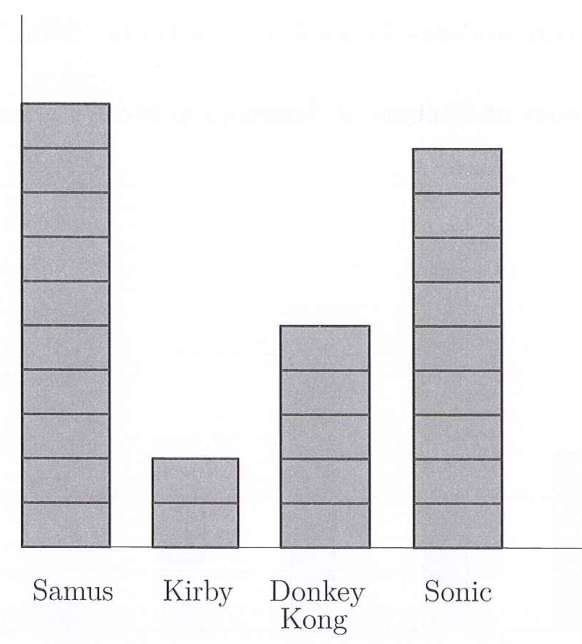
A game website asked its viewers which game character was their favorite and recorded the answers in the bar graph below. Use their graph to answer the questions. (Each small rectangle is 1 vote.)
a) What is the combined number of people who liked Sonic and Samus?
b) What is the difference in the number of people who liked Samus and the number who liked Kirby?
c) How many fewer people liked Donkey Kong than liked Sonic?
Self-study survey and input (editorial): each viewer casts exactly one vote for one character. Enter three numbers in order a;b;c, using digits and semicolons only, with no spaces or units.
When three girls jumped on a weighing scale together, it read 164 kilograms. One girl stepped off and the scale moved down to 104 kilograms. One more girl jumped off and the scale showed 55 kilograms. What was each girls weight?
Self-study input instruction (editorial): enter the three weights in kilograms separated by semicolons, in the order first girl off; second girl off; girl remaining.
Planned review repeat (editorial): this source item appeared in SET 11, Q06. It is one of the 12 final-fill repeats explicitly allocated by the frozen core plan.
Input format (editorial): use digits and semicolons only, with no spaces or units.
Planned review repeat (editorial): this source item appeared in SET 3, Q09. It is one of the 12 final-fill repeats explicitly allocated by the frozen core plan.
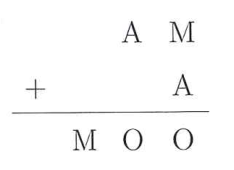
Self-study digit convention (editorial): leading digits A and M are nonzero. Enter the complete three-digit sum, without letter labels.
A sequence starts with 3. The second term is 7, the third is 11, the fourth is 15 and the fifth is 19. If you double the 14th number in the pattern, what is the new number?
Self-study rule (editorial): continue adding 4 to get each next term, then double term 14.
Planned review repeat (editorial): this source item appeared in SET 17, Q12. It is one of the 12 final-fill repeats explicitly allocated by the frozen core plan.
Given △ × △ × △ = 27 and N × N × N = 64, then what is △ × N?
Planned review repeat (editorial): this source item appeared in SET 14, Q13. It is one of the 12 final-fill repeats explicitly allocated by the frozen core plan.
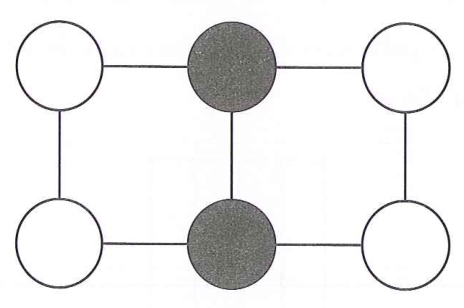
Each of the numbers 3, 4, 5, 6, 7 and 8 is to be placed in each circle in the below diagram. The sum of the numbers in each square is 20. What is the sum of the numbers in the shaded circles?
Self-study clarification (editorial): use each of the six numbers exactly once.
Planned review repeat (editorial): this source item appeared in SET 13, Q15. It is one of the 12 final-fill repeats explicitly allocated by the frozen core plan.
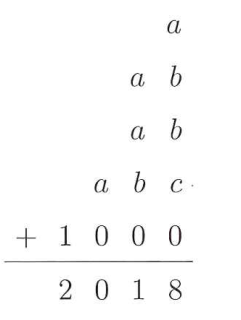
In the algorithm below, the letters a, b and c represent different digits from 0 to 9. What is the three-digit number abc?
Planned review repeat (editorial): this source item appeared in SET 4, Q14. It is one of the 12 final-fill repeats explicitly allocated by the frozen core plan.
Self-study digit convention (editorial): a is nonzero. Enter the whole three-digit number abc, without letter labels.
Paul counted correctly the number of times the digit “6” appears in the whole number list from 520 to 620. What answer did Paul get?
Planned review repeat (editorial): this source item appeared in SET 2, Q13. It is one of the 12 final-fill repeats explicitly allocated by the frozen core plan.
Self-study counting convention (editorial): include both 520 and 620, and count every occurrence of the digit, including two occurrences within one number.
A short street where Bernard lives has 6 houses. One day 35 letters are delivered in his street and he receives more letters than anyone else. What is the smallest number of letters he may have received?
Self-study interpretation (editorial): treat each house as one recipient of letters, with Bernard being one of the six recipients.
Planned review repeat (editorial): this source item appeared in SET 10, Q07. It is one of the 12 final-fill repeats explicitly allocated by the frozen core plan.
Self-study distribution convention (editorial): all 35 letters go to these six recipients, and Bernard has strictly more than each of the other five.
Planned review repeat (editorial): this source item appeared in SET 9, Q04. It is one of the 12 final-fill repeats explicitly allocated by the frozen core plan.
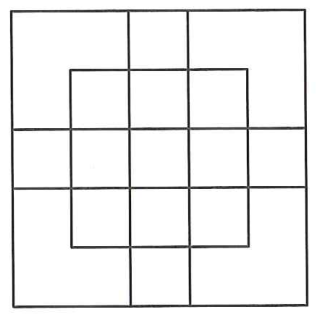
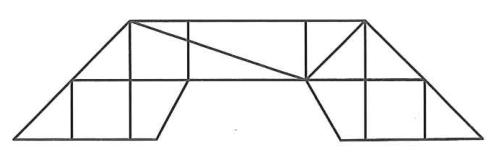
Self-study counting convention (editorial): count only squares whose four complete sides are drawn; do not fill missing line segments.
Self-study counting convention (editorial): count complete square boundaries formed by the drawn segments; a line through a square does not remove it. Do not add missing edges.
Planned review repeat (editorial): this source item appeared in SET 18, Q08. It is one of the 12 final-fill repeats explicitly allocated by the frozen core plan.
James has two dice: one 6-sided with numbers from 1 to 6, and one 8-sided with numbers from 1 to 8. He rolled these 2 dice. How many ways are there to get a sum of 6?
Planned review repeat (editorial): this source item appeared in SET 6, Q04. It is one of the 12 final-fill repeats explicitly allocated by the frozen core plan.
Self-study outcome convention (editorial): the dice are distinguished; record the 6-sided die first and the 8-sided die second.
32 athletes are going camping for the weekend. Three athletes can sleep in one tent. What is the minimum number of tents that will be needed?
Planned review repeat (editorial): this source item appeared in SET 15, Q12. It is one of the 12 final-fill repeats explicitly allocated by the frozen core plan.