A murderer is condemned to death. He has to choose among three rooms. The first is full of raging fires, the second is full of assassins with loaded guns, and the third is full of lions that haven’t eaten in 3 years. Which room is safest for him?
Self-study riddle convention (editorial): assume ordinary lions have had no food for three full years, and compare only the hazards described. Enter the safest room number.
Alice read 5 pages of storybook on the first day. She read 10 pages of the same storybook on the second day, 15 pages on the third day and so on. How many pages had the storybook at most if Alice finished reading it on the 10 day?
Self-study reading model (editorial): planned daily new-page reading increases by 5 pages each day. She reads the full planned amount before the final day; she may stop sooner on day 10 if the book ends. Find the maximum whole-page total.
Ksi lives in a small street with 6 houses. One day 35 letters were delivered in his street and he received more letters than anyone else. What is the smallest number of letters he could have received?
Self-study recipient convention (editorial): treat the six houses as six recipients, one of them Ksi, and distribute all 35 letters among them. Ksi must receive strictly more than each of the other five.
Pi’s teacher assigned 2 hours 30 minutes of reading during the weekend. On Friday night, Pi read for 26 minutes. On Saturday he read for 18 minutes. How many minutes does Pi have to read on Sunday to complete the assignment?
Self-study input convention (editorial): count the Friday and Saturday reading toward the assignment. Enter the remaining Sunday time in minutes, without units.
Self-study pattern and input convention (editorial): in (a), multiply the upper-left number by 3 to get the upper-right, and subtract 5 from the lower-left to get the lower-right. In (b), the upper-right is the sum of the two left numbers; the lower-right is their product minus that sum. Treat the letters in each part separately. Enter four numbers in order a-A;a-C;b-A;b-B, separated by semicolons.
Input format (editorial): use digits and semicolons only, with no spaces or units.
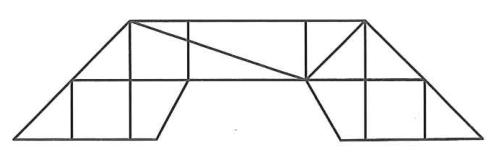
Self-study counting convention (editorial): count complete square boundaries formed by the drawn segments; a line through a square does not remove it. Do not add missing edges.
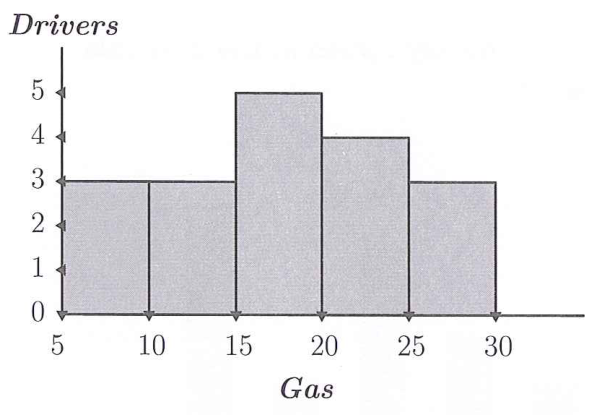
The histogram below show the gallons of gas drivers purchased each week.
a) Most drivers purchased between … and … gallons.
b) How many drivers are represented in this histogram?
c) If a driver purchased 15 gallons which bar would they be added to?
Self-study histogram convention and input (editorial): interpret “most” as the group with the highest bar. Each interval includes its lower bound and excludes its upper bound. Number bars 1 to 5 from left to right. Enter four numbers in order lower bound for (a);upper bound for (a);total drivers for (b);bar number for (c), separated by semicolons.
Input format (editorial): use digits and semicolons only, with no spaces or units.
Arnold baked cupcakes over the weekend. Each day during the week he took three cakes to school to share with his friends. On Saturday when he counted there were 18 left. How many had he baked?
Self-study school-week convention (editorial): take cupcakes to school on Monday through Friday only. Count the 18 remaining on Saturday before any further removal. No other cupcakes were eaten, removed or added.
A road is 120m long. If trees are planted on both its sides at intervals of 5m. How many trees are planted on the both sides of the road if both ends of the road are also planted with trees?
Self-study planting clarification (editorial): count two separate rows along the two long sides, each with trees at both endpoints.
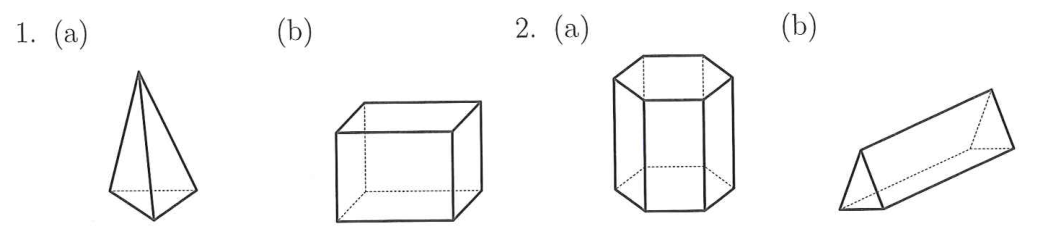
Self-study input convention (editorial): count all edges of each solid, including hidden dashed edges. Enter the two letter choices in order 1;2, separated by a semicolon.
Input format (editorial): use the letter choices and a semicolon only, with no spaces.
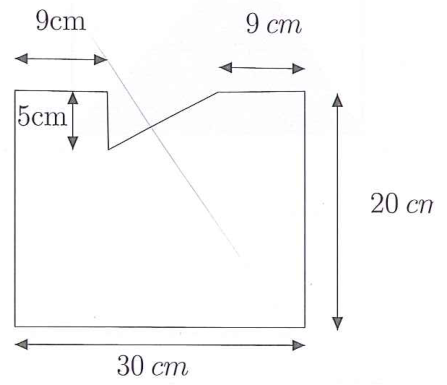
Self-study figure and input convention (editorial): use the dark outside outline and printed dimensions; the faint diagonal trace is not an extra cut or boundary. Enter the area in square centimeters, without units.