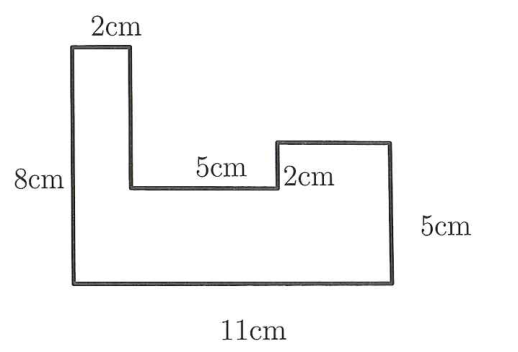
Self-study input convention (editorial): enter the perimeter in centimeters and area in square centimeters, in order perimeter;area, separated by a semicolon.
**Editorial input note:** Use no spaces before or after semicolons.
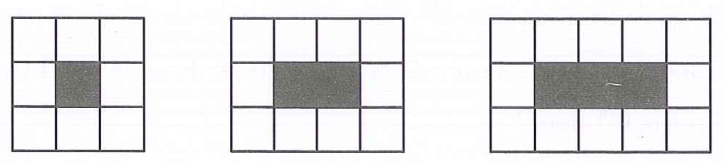
Each figure is formed by surrounding one row of black squares with white squares. How many white squares are needed to surround one row of 50 black squares?
Self-study border convention (editorial): use the one-square-thick rectangular white border, including its four corners, shown in the examples.
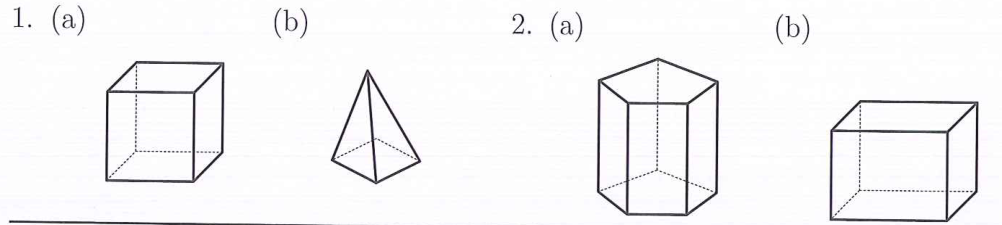
Self-study input convention (editorial): count all vertices of each solid, including hidden ones. Enter two letter choices in order 1;2, separated by a semicolon.
**Editorial input note:** Use no spaces before or after semicolons.
You planted sunflower seeds in your back garden. Every day, the number of flowers doubles. If it takes 52 days for the flowers to fill the garden, how many days would it take for them to fill half the garden?
Self-study model (editorial): each flower occupies the same amount of garden space, so doubling the flowers doubles the covered area. Enter the number of days.
Find the maximum number of trees which can be planted, 10 metres apart, on two sides of a straight road 150 metres long and 12 meters wide.
Self-study planting convention (editorial): plant along both long sides, with consecutive trees on each side 10 meters apart; trees may stand at both endpoints. Do not plant across the short ends. Enter the total number of trees.
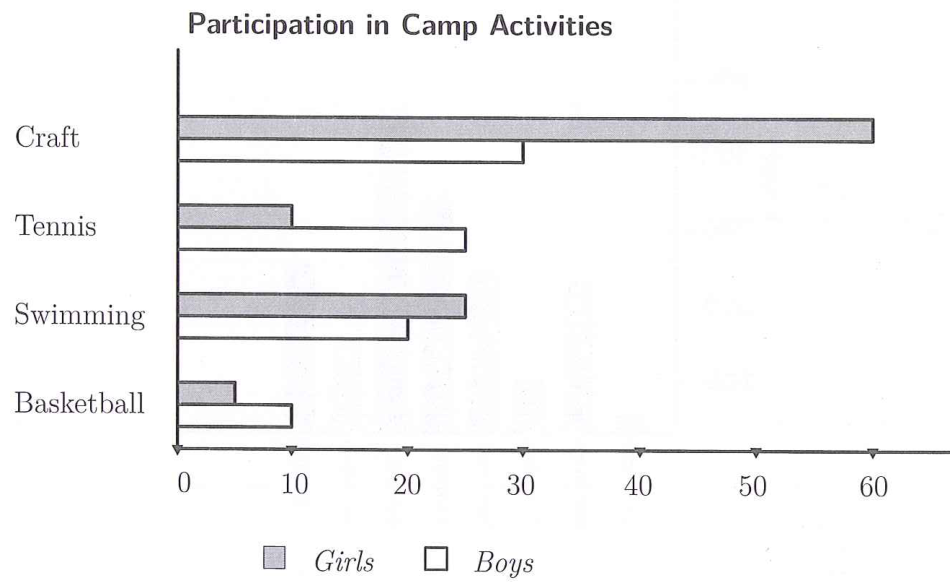
Using the double bar graph shown below, answer the following question.
a) In how many of the four activities, participation of girls in more than boys?
b) How many more girls participate in swimming than boys?
c) How many girls were surveyed?
Self-study survey assumption and input (editorial): assume every surveyed girl participates in exactly one of the four listed activities. Enter all three answers in order a;b;c, separated by semicolons.
**Editorial input note:** Use no spaces before or after semicolons.
The chess club is going on a trip to the fair. The cost of attending the trip is \(\text{\$62}\). Included in that price is \(\text{\$18}\) for lunch and four game tickets. How much is one game ticket?
Self-study price assumption (editorial): the 62 dollars consists only of the 18-dollar lunch and four equally priced game tickets, with no other charges. Enter the ticket price in dollars, without units.
5 years ago, sister's age was 5 times the age of her brother and the sum of present ages of sister and brother is 34 years. What will be the age of her brother after 6 years?
Self-study input (editorial): enter the brother’s age six years from now, in years, without units.
Self-study visual rule (editorial): count enclosed holes in the displayed digit shapes. Use 0 and 6 with one enclosed hole, 8 with two, and 1, 2 and 3 with none.
A sequence starts with 3. The second term is 7, the third is 11, the fourth is 15 and the fifth is 19. If you double the 14th number in the pattern, what is the new number?
Self-study rule (editorial): continue adding 4 to get each next term, then double term 14.
Pi walks to school. He leaves each morning at 7:32 A.M and arrives at school fifteen minutes later. If he travels at a steady rate of 4 miles per hour, what is the distance between his home and the school? (Distance = rate x time.)
Self-study input (editorial): enter the distance in miles, without units.
Six people entered a block building contest. Lynda built her pile of blocks twice as high as Selwyn’s. Michelle created a pile that was three times higher than Lynda’s pile. Warren built his pile one block higher than Michelle's. Jane's pile of blocks was six higher than Warren's. If Adrian piled up 27 blocks, which was two blocks higher than Jane's pile, how high was each person’s pile? How many blocks would be needed altogether?
Self-study interpretation and input (editorial): use single stacks of equal whole blocks. Interpret “three times higher” as “three times as high,” meaning Michelle has three times Lynda’s blocks. Enter seven numbers separated by semicolons, in this order: Selwyn;Lynda;Michelle;Warren;Jane;Adrian;total.
**Editorial input note:** Use no spaces before or after semicolons.
To fix fence wires in a garden, 70 m long and 50 m wide, Arvind bought metal pipes for posts. He fixed a post every 5 metres apart. Each post was 2 m long. What is the total length of the pipes he bought for the posts?
Self-study fence convention (editorial): use the complete closed rectangular boundary, with corner posts and no gate gap. Count only the stated 2-meter posts, with no additional pipe waste. Enter the total pipe length in meters, without units.