Skip to content / Đến nội dung
ThichHocToan.com

IMSO 2024 Science International - Theory II

Question 1

Figure 1 below shows a potometer, an instrument designed to measure the rate of transpiration. A plant is positioned in a sealed water-filled container, which is connected to a graduated capillary tube. A bubble is then introduced into the capillary tube. As transpiration takes place, water is drawn up by the plant, causing the bubble to move. The position of the bubble in the tube shows the volume of water taken up by the plant over time.
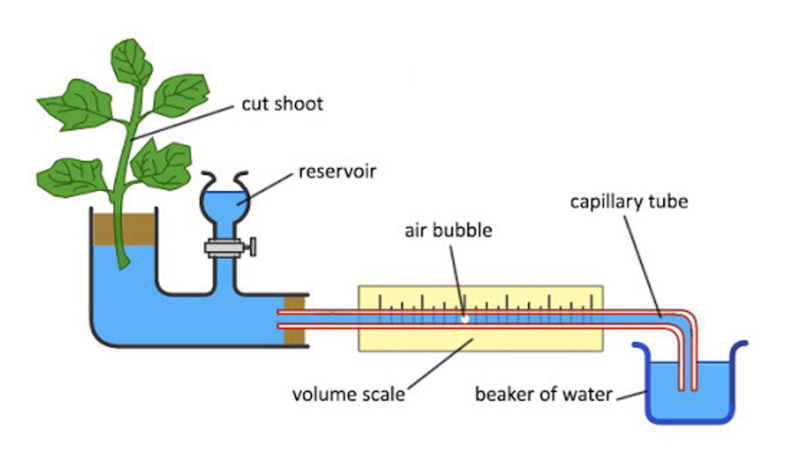
Question illustration

To investigate the transpiration rate of a specific spinach variety, scientists measured the water uptake by a young spinach plant at various temperatures. Water usage was recorded over the course of one hour for each temperature condition. Throughout the experiment, light intensity and humidity were maintained at constant levels. The results are presented in Table 1.

| Temperature (°C) | Water usage (mL/h) |
|---|---|
|10|0.05|
|15|0.08|
|20|0.13|
|25|0.18|
|30|1.2|
|34|1.8|
|40|2.4|

(a) Plot the data in Table 1 in a graph in the answer sheet. [2.5 marks]

(b) Based from the graph you created, at which temperature would you expect the plant to use 1.5 mL of water per hour? [1 mark]

(c) Transpiration rates are often expressed as volume of water lost per unit time per unit leaf area (i.e. mL/h/m²). If the total leaf area of this plant was found to be 0.05 m², calculate the transpiration rate of this plant at 30°C. [1 mark]

(d) Explain briefly the relationship between temperature and water usage. [1 mark]
Question 2

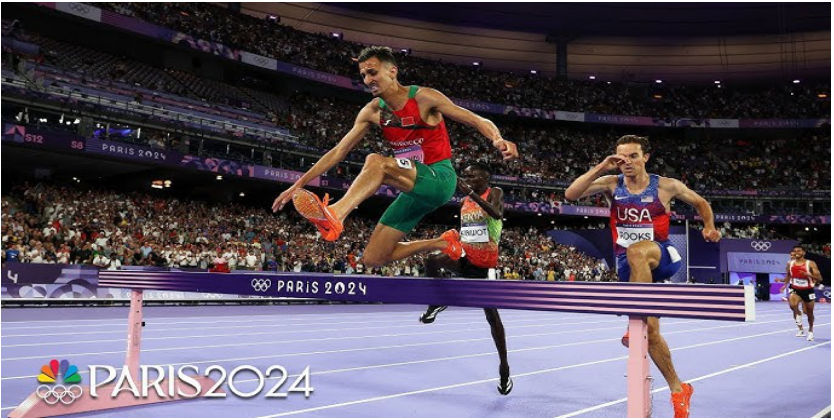
An athlete competing in the steeplechase event (Figure 2) suffered a fall on the track, resulting in significant blood loss. Before the fall, his heart rate (HR) was 3 beats per second, and his stroke volume (SV) was 130 mL per beat. After the fall, due to the loss of blood, his stroke volume dropped to 80 mL per beat. In response, his body compensated by increasing his heart rate to 4 beats per second.

Question illustration

(a) Calculate the athlete's cardiac output (CO) before and after the fall. [2 marks]

Cardiac output measures how much blood the heart pumps per minute: $CO=HR\times SV$, where HR is in beats/min and SV is the volume pumped per heartbeat, in mL/beat.

(b) Despite the increased heart rate after the fall, the athlete felt lightheaded and weak. Why might this occur even though the heart rate has increased? [1.5 marks]

(c) One of the medical interventions that could be given to the athlete after the fall is intravenous (IV) fluid therapy. Explain how this therapy can stabilize the athlete's cardiac output and overall condition after significant blood loss. [1 mark]

Question 3

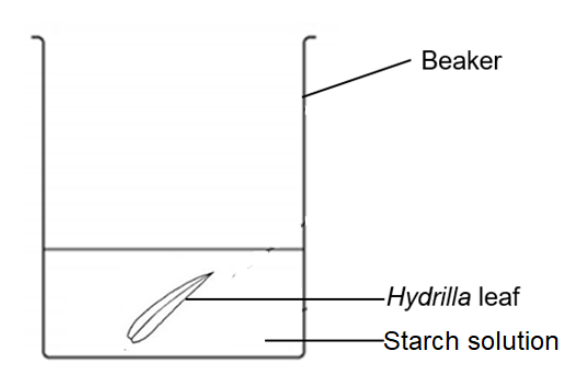
A student placed Hydrilla leaves of equal length in different beakers, each containing different concentrations of starch solutions, for 15 minutes. Each beaker contained one Hydrilla leaf immersed in starch solution. Figure 3 shows the experimental setup.

Question illustration

After 15 minutes, a drop of each liquid and the Hydrilla leaf were placed on a glass slide with a coverslip and examined under a light microscope. Table 3 shows the results.

| Type of liquid in each beaker with a Hydrilla leaf | Average length of protoplast (cells without the cell walls) in Hydrilla leaf cells (micrometre) |
|---|---|
|20% starch solution|150|
|50% starch solution|90|

After examining under the microscope, the leaves were placed in distilled water for 15 minutes and examined again. The average length of protoplast in the cells was 225 micrometres.

(a) With reference to Table 3, explain the results for Hydrilla leaf in 50% starch solution. [1.5 marks]

(b) With reference to Table 3, compare and explain the extent of the condition of cells immersed in 20% starch solution and those in 50% starch solution. [1.5 marks]

(c) Explain the results after the Hydrilla leaves were placed in distilled water. [1 mark]

(d) A can of tuna contains very concentrated salt solution. If bacteria cells happen to be present in the can, explain what will happen to the bacteria cells. [1 mark]

Question 4

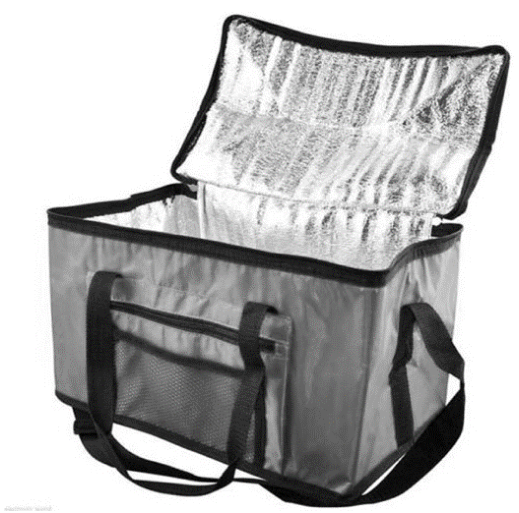
Figure 4 shows a thermal bag used during pizza delivery to keep pizzas warm for a few hours. The inner layer is made of foam and lined with a layer of aluminium.

Question illustration

(a) Explain how the design features of the bag help keep the pizza warm for a long period of time. [2.5 marks]

(b) A man wants to keep the pizza in the refrigerator so he can reheat and eat it the next day. He placed the pizza with the bag into his refrigerator to keep the pizza fresh. Should he keep the bag open as shown or zip up the bag? Explain. [2.5 marks]

Question 5

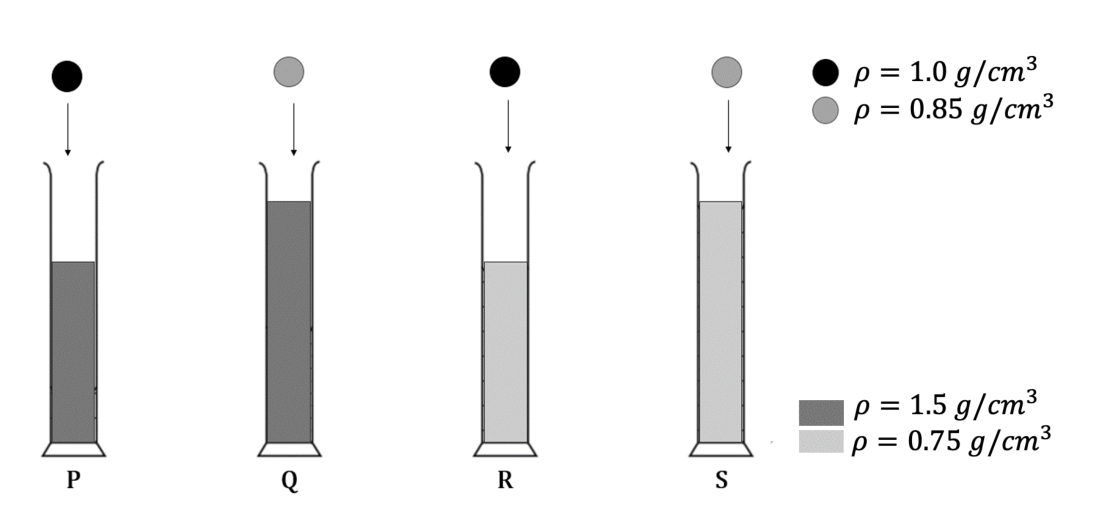
John conducts an experiment on fluids using the setup in Figure 5.

Question illustration

The figure labels P and Q as liquid density 1.5 g/cm³, and R and S as liquid density 0.75 g/cm³. The black balls (above P and R) have density 1.0 g/cm³; the grey balls (above Q and S) have density 0.85 g/cm³.

(a) Based on the densities of the balls and the liquids, describe whether each ball will sink or float after being dropped in the cylinder. [2 marks]

(b) Which ball experienced the most pressure after being submerged in the liquid? Explain. [2 marks]

Question 6

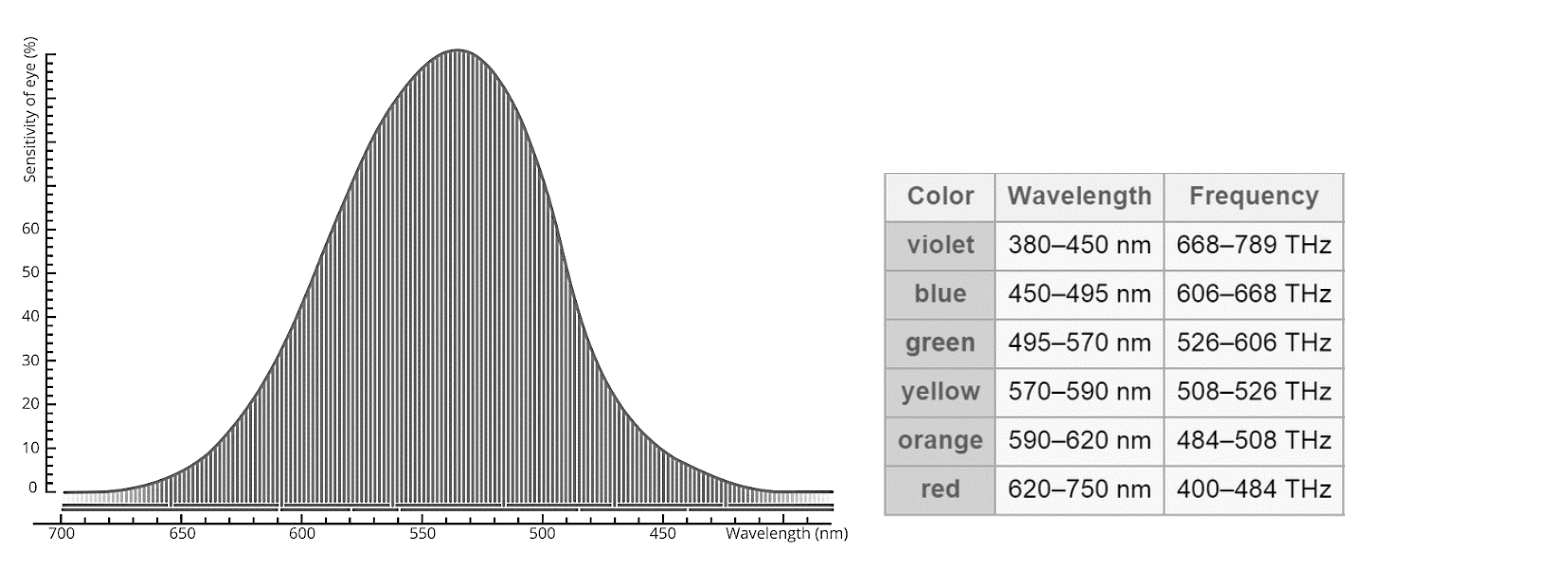
Figure 6 shows the sensitivity of the human eye to visible light.

Question illustration

(a) With reference to Figure 6, which color is the human eye more sensitive to? [1 mark]

(b) With reference to Figure 6, state the relationship of visible light's wavelength and frequency. [1 mark]

(c) Provide one example of electromagnetic radiation found in wavelengths (i) below 450 nm and (ii) above 700 nm. [2 marks]

(d) Explain why the human eye could not see spectral regions beyond visible light. [2 marks]

Question 7

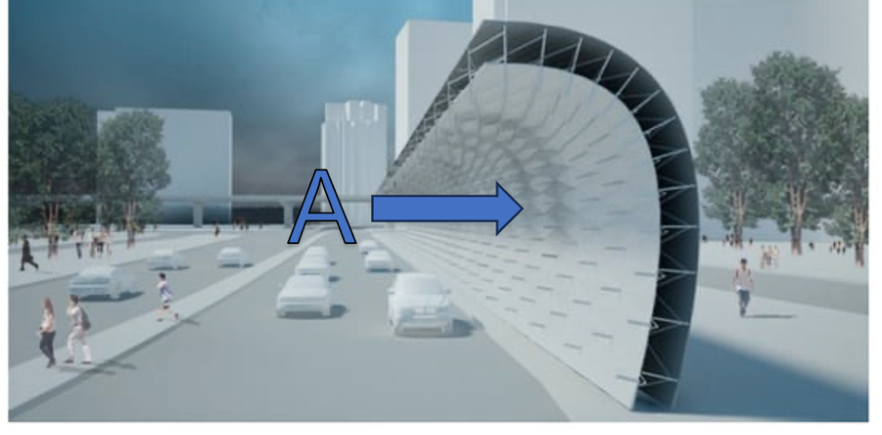
Study the structure labelled A in the figure and answer the following question.

Question illustration

Taken from OFL Architecture/Francesco Lipari, https://www.oflarchitecture.com/hknb, accessed on 18 June 2021, as cited in https://www.mdpi.com/2673-4931/8/1/11.

Explain the type of pollution(s) the structure is designed to address. [3 marks]

Question 8

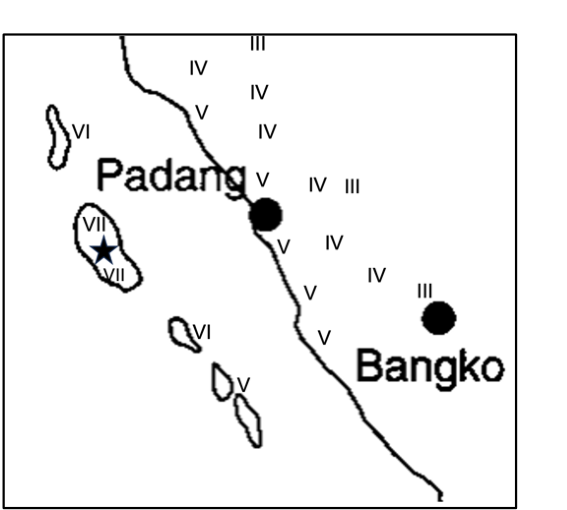
Asia is traversed by complex tectonic plate movements which makes the risk of megathrust earthquakes high in Asia. One example is the magnitude 7.1 earthquake that happened in April 2023 in Sumatra, Indonesia. Its intensity ratings are plotted in Figure 8.1 near the epicenter. Its epicenter is denoted by a star.

Question illustration

(a) A megathrust earthquake occurs in a subduction zone, where one tectonic plate is pushed under another.

(i) Identify the type of tectonic plate boundary nearest to the epicenter. [0.5 mark]

(ii) Identify which layer of the Earth this plate movement occurs in. [0.5 mark]

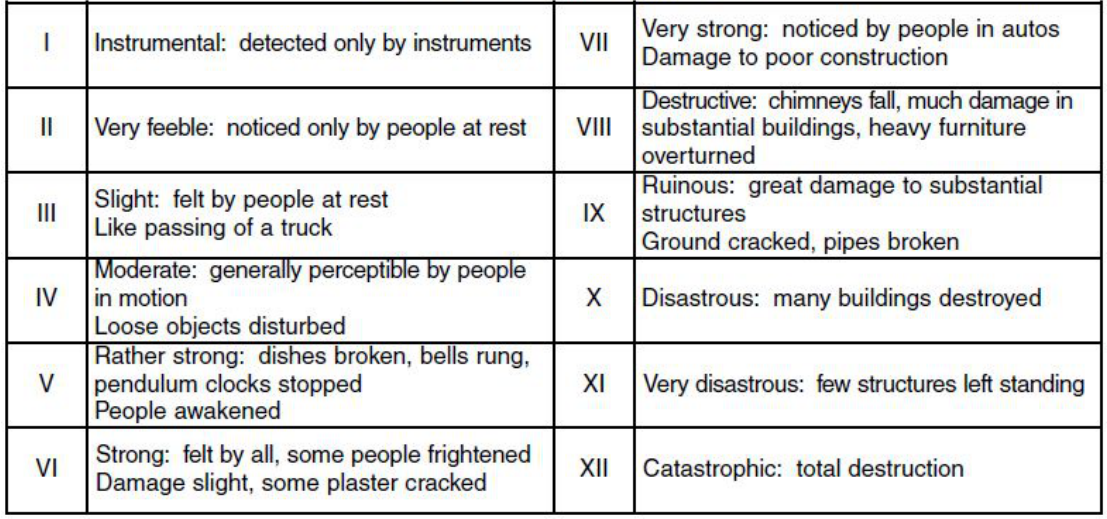
(b) Table 8 lists observations during an earthquake according to the modified Mercalli scale. Place a check mark on observations made in the city of Padang during the April 2023 earthquake. [3 marks]

Question illustration

- [ ] parked cars rock
- [ ] dishes and windows broken
- [ ] buildings shifted off foundations
- [ ] monuments fall
- [ ] felt by Sumatrans who are sleeping
- [ ] some heavy furnitures moved

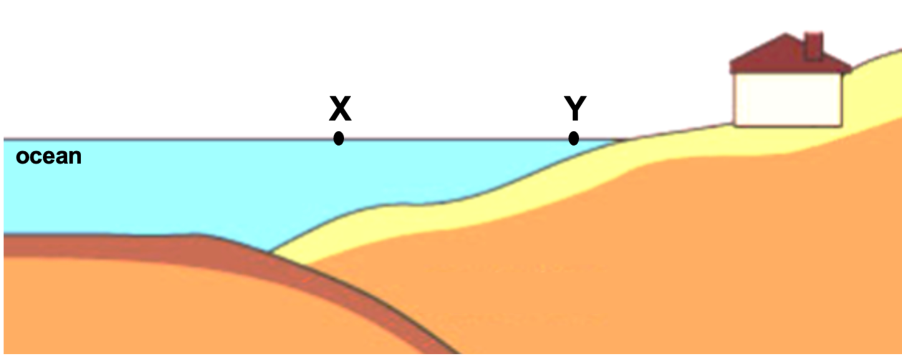
(c) A magnitude 7.1 megathrust earthquake can generate a tsunami.

Question illustration

(i) On Figure 8.2, draw arrow(s) from the origin to show the direction of energy causing a tsunami. [1 mark]

(ii) Compare the velocity (faster or slower) and height (higher or lower) of the tsunami as it gets shallower from point X to Y. [2 marks]

Question 9

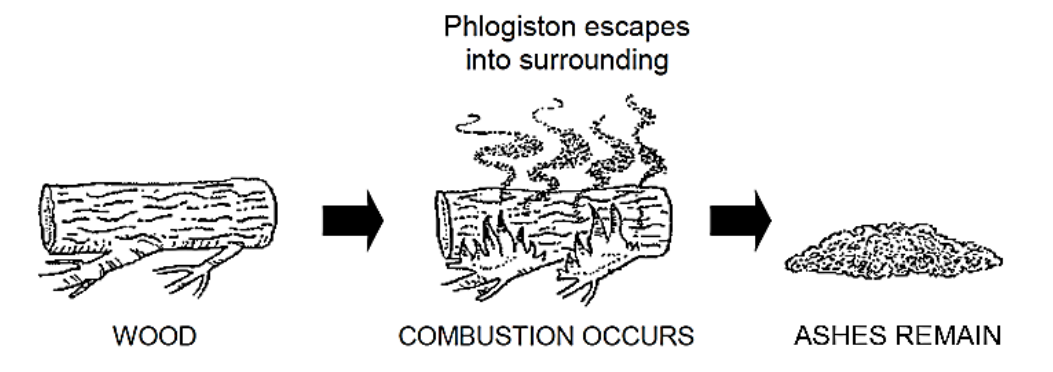
The early Greeks thought that earth, fire, water and air were the four basic elements that made up the world. An early scientist, Georg Ernst Stahl, first proposed that combustible substances contained a fire-like element called phlogiston, released when substances burned (combustion), as in Figure 9.

Question illustration

In 1774, Antoine Lavoisier challenged the Phlogiston Theory when he carried out combustion of mercury with air in a sealed container. He recorded the mass of mercury used and the product after combustion.

| Mass of substance (g) | Before combustion | After combustion |
|---|---|---|
| |1.00|1.08|

(a) Explain how Lavoisier's experimental results had disproved the Phlogiston Theory. [1 mark]

(b) Lavoisier also showed water was not an element. He reacted oxygen with an “inflammable air” to obtain water and concluded water was a compound of oxygen and “inflammable air”. What is this “inflammable air”? [0.5 mark]

(c) Complete the word equation by naming the substances needed and formed during complete combustion. [1.5 marks]

Combustible substance + ______ → (combustion) ______ + ______

(d) To cook soup noodles, a mountain climber heated pieces of ice (frozen at −15°C) in a pot until the water boiled for a few minutes. At atmospheric pressure 0.5 atm at his base camp, ice melts at 0°C and water boils at 81°C. Sketch a graph showing how the temperature of water in the pot changed over time. Clearly label the various temperatures. [2 marks]