Skip to content / Đến nội dung
ThichHocToan.com

IMSO 2023 Science International — Theory I

Question 1

Original source text (layout and all choices are preserved in the source panel below):

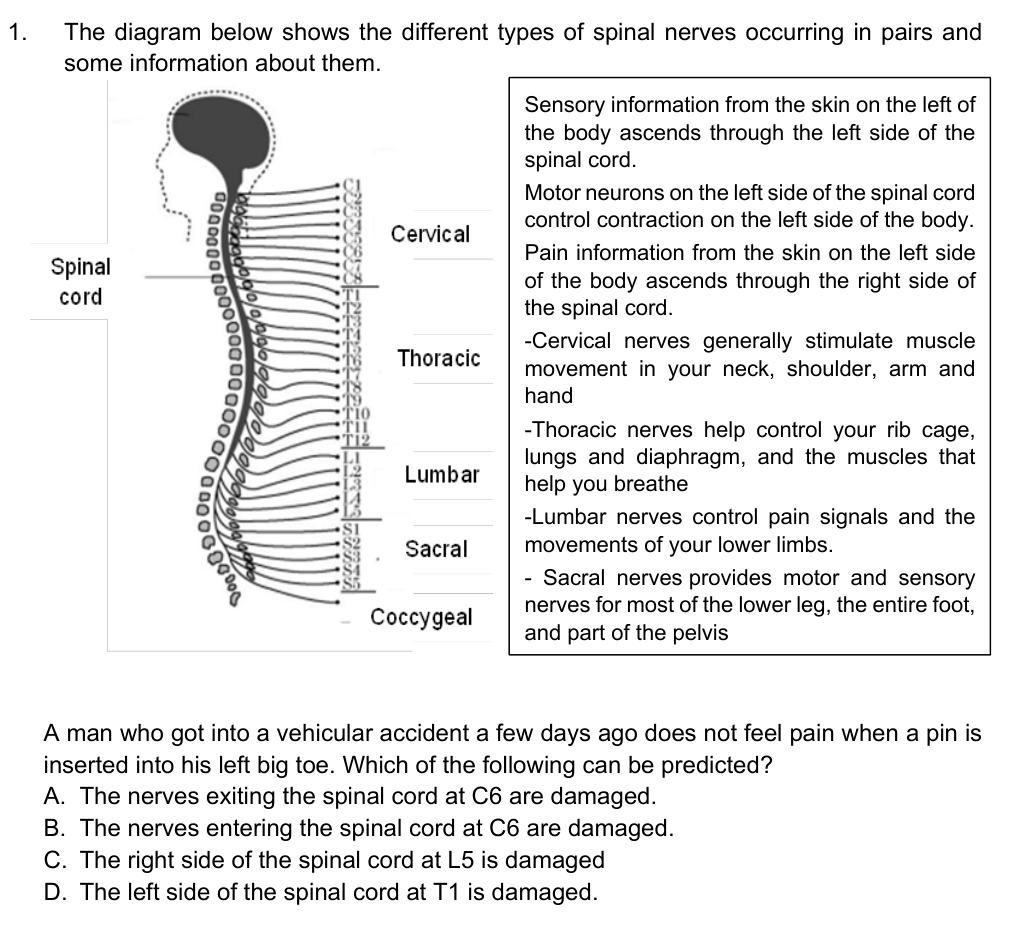
The diagram below shows the different types of spinal nerves occurring in pairs and
some information about them.

Sensory information from the skin on the left of
the body ascends through the left side of the
spinal cord.
Motor neurons on the left side of the spinal cord
control contraction on the left side of the body.
Pain information from the skin on the left side
of the body ascends through the right side of
the spinal cord.
-Cervical nerves generally stimulate muscle
movement in your neck, shoulder, arm and
hand
-Thoracic nerves help control your rib cage,
lungs and diaphragm, and the muscles that
help you breathe
-Lumbar nerves control pain signals and the
movements of your lower limbs.
- Sacral nerves provides motor and sensory
nerves for most of the lower leg, the entire foot,
and part of the pelvis


A man who got into a vehicular accident a few days ago does not feel pain when a pin is
inserted into his left big toe. Which of the following can be predicted?
A. The nerves exiting the spinal cord at C6 are damaged.
B. The nerves entering the spinal cord at C6 are damaged.
C. The right side of the spinal cord at L5 is damaged
D. The left side of the spinal cord at T1 is damaged.
Question illustration

Question 2

Original source text (layout and all choices are preserved in the source panel below):

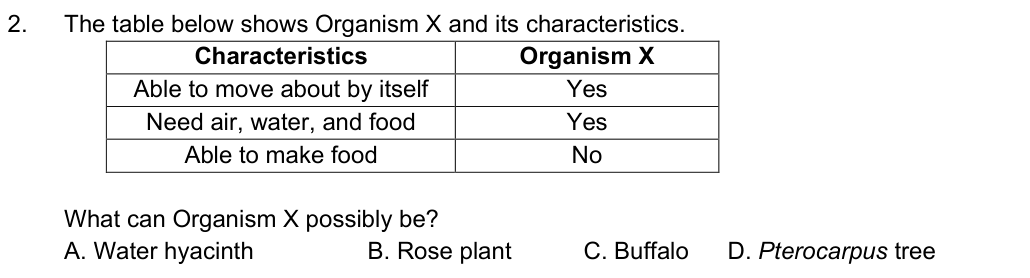
The table below shows Organism X and its characteristics.
Characteristics Organism X
Able to move about by itself Yes
Need air, water, and food Yes
Able to make food No

What can Organism X possibly be?
A. Water hyacinth B. Rose plant C. Buffalo D. Pterocarpus tree

Question illustration
  1. Water hyacinth
  2. Rose plant
  3. Buffalo
  4. Pterocarpus tree

Question 3

Original source text (layout and all choices are preserved in the source panel below):

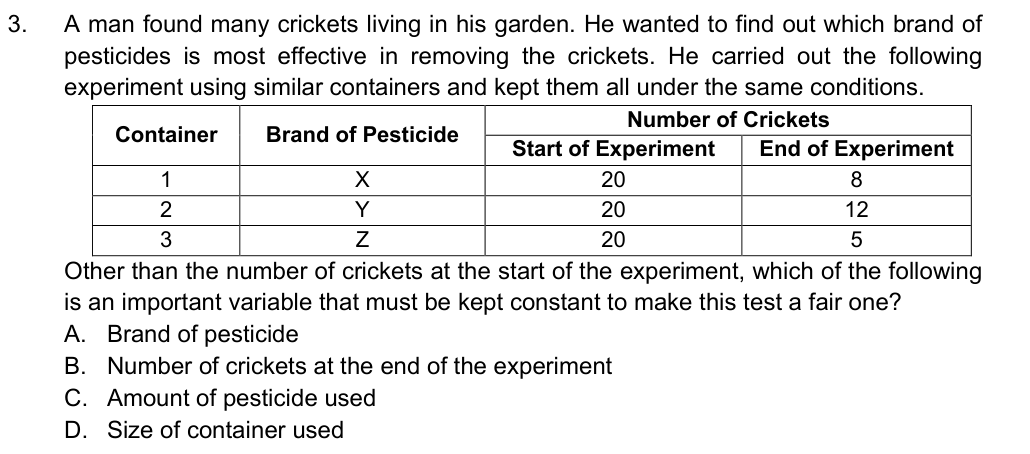
A man found many crickets living in his garden. He wanted to find out which brand of
pesticides is most effective in removing the crickets. He carried out the following
experiment using similar containers and kept them all under the same conditions.
Number of Crickets
Container Brand of Pesticide
Start of Experiment End of Experiment
1 X 20 8
2 Y 20 12
3 Z 20 5
Other than the number of crickets at the start of the experiment, which of the following
is an important variable that must be kept constant to make this test a fair one?
A. Brand of pesticide
B. Number of crickets at the end of the experiment
C. Amount of pesticide used
D. Size of container used

Question illustration
  1. Brand of pesticide
  2. Number of crickets at the end of the experiment
  3. Amount of pesticide used
  4. Size of container used

Question 4

Original source text (layout and all choices are preserved in the source panel below):

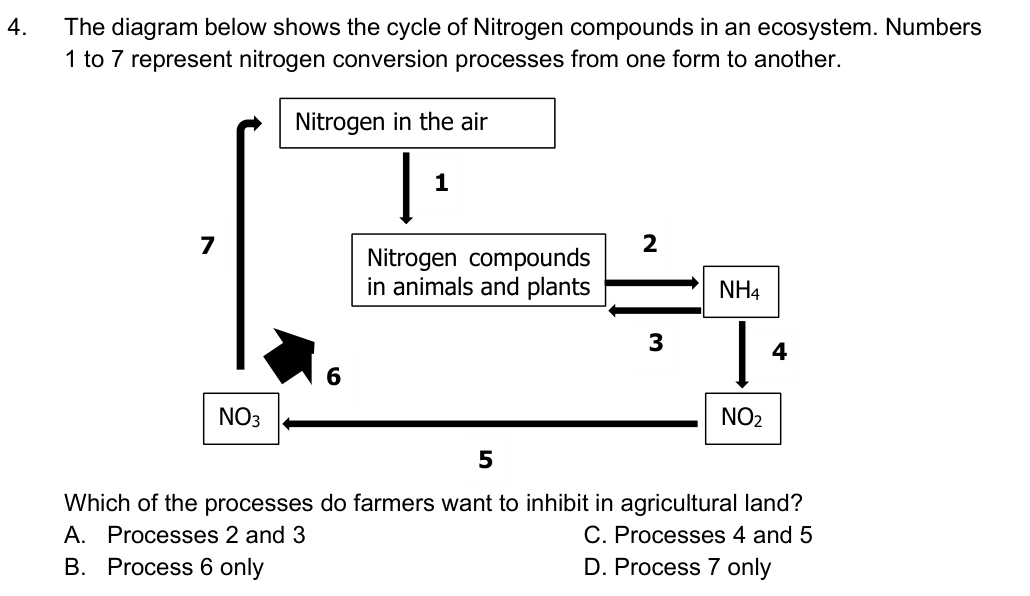
The diagram below shows the cycle of Nitrogen compounds in an ecosystem. Numbers
1 to 7 represent nitrogen conversion processes from one form to another.

Nitrogen in the air

1

7 2 Nitrogen compounds
in animals and plants NH4

3 4
6
NO3 NO2
5

Which of the processes do farmers want to inhibit in agricultural land?
A. Processes 2 and 3 C. Processes 4 and 5
B. Process 6 only D. Process 7 only

Question illustration
  1. Processes 2 and 3
  2. Process 6 only
  3. Processes 4 and 5
  4. Process 7 only

Question 5

Original source text (layout and all choices are preserved in the source panel below):

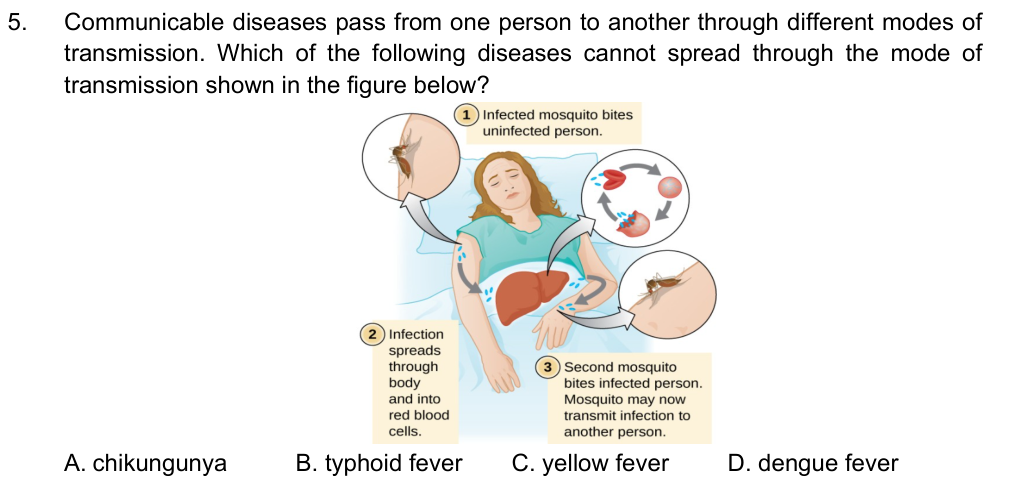
Communicable diseases pass from one person to another through different modes of
transmission. Which of the following diseases cannot spread through the mode of
transmission shown in the figure below?


A. chikungunya B. typhoid fever C. yellow fever D. dengue fever

Question illustration
  1. chikungunya
  2. typhoid fever
  3. yellow fever
  4. dengue fever

Question 6

Original source text (layout and all choices are preserved in the source panel below):

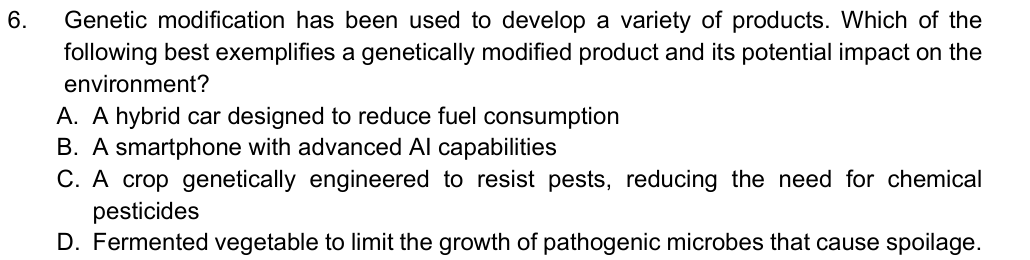
Genetic modification has been used to develop a variety of products. Which of the
following best exemplifies a genetically modified product and its potential impact on the
environment?
A. A hybrid car designed to reduce fuel consumption
B. A smartphone with advanced AI capabilities
C. A crop genetically engineered to resist pests, reducing the need for chemical
pesticides
D. Fermented vegetable to limit the growth of pathogenic microbes that cause spoilage.

Question illustration
  1. A hybrid car designed to reduce fuel consumption
  2. A smartphone with advanced AI capabilities
  3. A crop genetically engineered to resist pests, reducing the need for chemical pesticides
  4. Fermented vegetable to limit the growth of pathogenic microbes that cause spoilage.

Question 7

Original source text (layout and all choices are preserved in the source panel below):

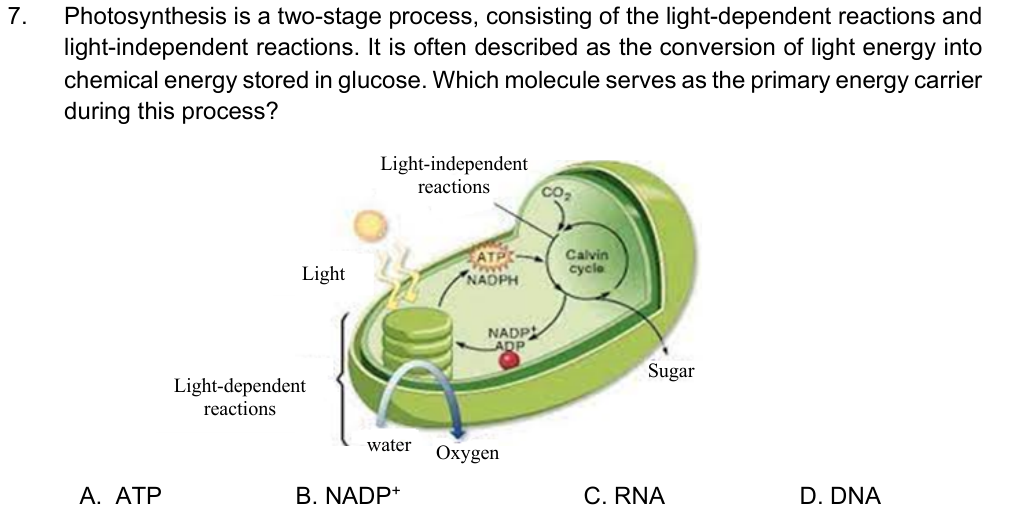
Photosynthesis is a two-stage process, consisting of the light-dependent reactions and
light-independent reactions. It is often described as the conversion of light energy into
chemical energy stored in glucose. Which molecule serves as the primary energy carrier
during this process?

Light-independent
reactions


Light


Sugar
Light-dependent
reactions

water Oxygen

A. ATP B. NADP+ C. RNA D. DNA

Question illustration
  1. ATP
  2. NADP⁺
  3. RNA
  4. DNA

Question 8

Original source text (layout and all choices are preserved in the source panel below):

Analogous structures are traits found in distinct species that share similar functions,
even though they may not have the same underlying structure or a common ancestral
origin. These traits have evolved independently in response to comparable
environmental pressures. Among the options below, which pair represents analogous
structures?
A. The front leg of a horse to a human arm
B. The front leg of a frog and a bat wing.
C. The front flipper of a tortoise and a human arm.
D. The wing of a bird and a butterfly wing.

Question illustration
  1. The front leg of a horse to a human arm
  2. The front leg of a frog and a bat wing.
  3. The front flipper of a tortoise and a human arm.
  4. The wing of a bird and a butterfly wing.

Question 9

Original source text (layout and all choices are preserved in the source panel below):

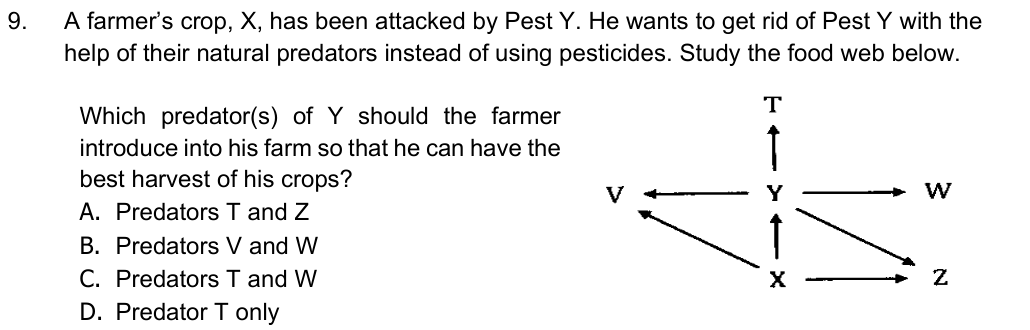
A farmer’s crop, X, has been attacked by Pest Y. He wants to get rid of Pest Y with the
help of their natural predators instead of using pesticides. Study the food web below.

Which predator(s) of Y should the farmer
introduce into his farm so that he can have the
best harvest of his crops?
A. Predators T and Z
B. Predators V and W
C. Predators T and W
D. Predator T only

Question illustration
  1. Predators T and Z
  2. Predators V and W
  3. Predators T and W
  4. Predator T only

Question 10

Original source text (layout and all choices are preserved in the source panel below):

A group of scientists discovered a new species of Nepenthes plant deep in the
rainforest. This plant has leaves with a unique adaptation. The leaves are shaped like
funnels, and they have a sweet-smelling nectar at the base. Insects are often seen
trapped inside these funnels. What could be the most likely reason for this plant's unique
leaf adaptation?
A. The plant is trying to hide from herbivores.
B. The funnels trap insects for the plant's nutrition.
C. The plant uses the funnels to collect rainwater.
D. The sweet-smelling nectar attracts pollinators.

Question illustration
  1. The plant is trying to hide from herbivores.
  2. The funnels trap insects for the plant's nutrition.
  3. The plant uses the funnels to collect rainwater.
  4. The sweet-smelling nectar attracts pollinators.

Question 11

Original source text (layout and all choices are preserved in the source panel below):

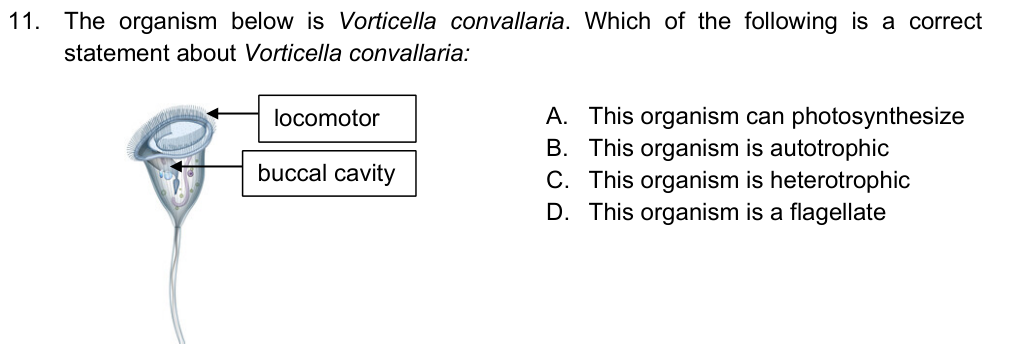
The organism below is Vorticella convallaria. Which of the following is a correct
statement about Vorticella convallaria:

locomotor A. This organism can photosynthesize
B. This organism is autotrophic
buccal cavity C. This organism is heterotrophic
D. This organism is a flagellate

Question illustration
  1. This organism can photosynthesize
  2. This organism is autotrophic
  3. This organism is heterotrophic
  4. This organism is a flagellate

Question 12

Original source text (layout and all choices are preserved in the source panel below):

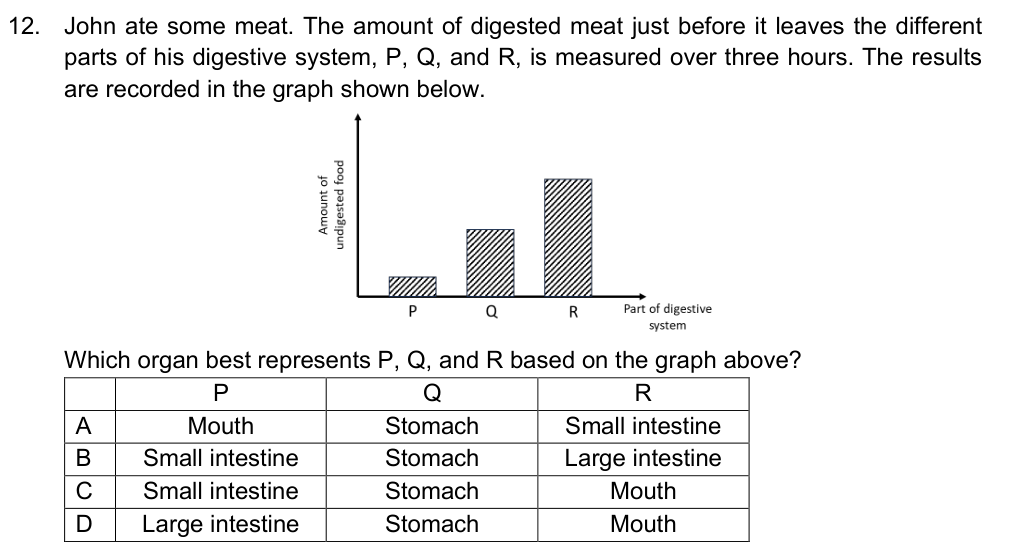
John ate some meat. The amount of digested meat just before it leaves the different
parts of his digestive system, P, Q, and R, is measured over three hours. The results
are recorded in the graph shown below.


Which organ best represents P, Q, and R based on the graph above?
P Q R
A Mouth Stomach Small intestine
B Small intestine Stomach Large intestine
C Small intestine Stomach Mouth
D Large intestine Stomach Mouth

Question illustration

Question 13

Original source text (layout and all choices are preserved in the source panel below):

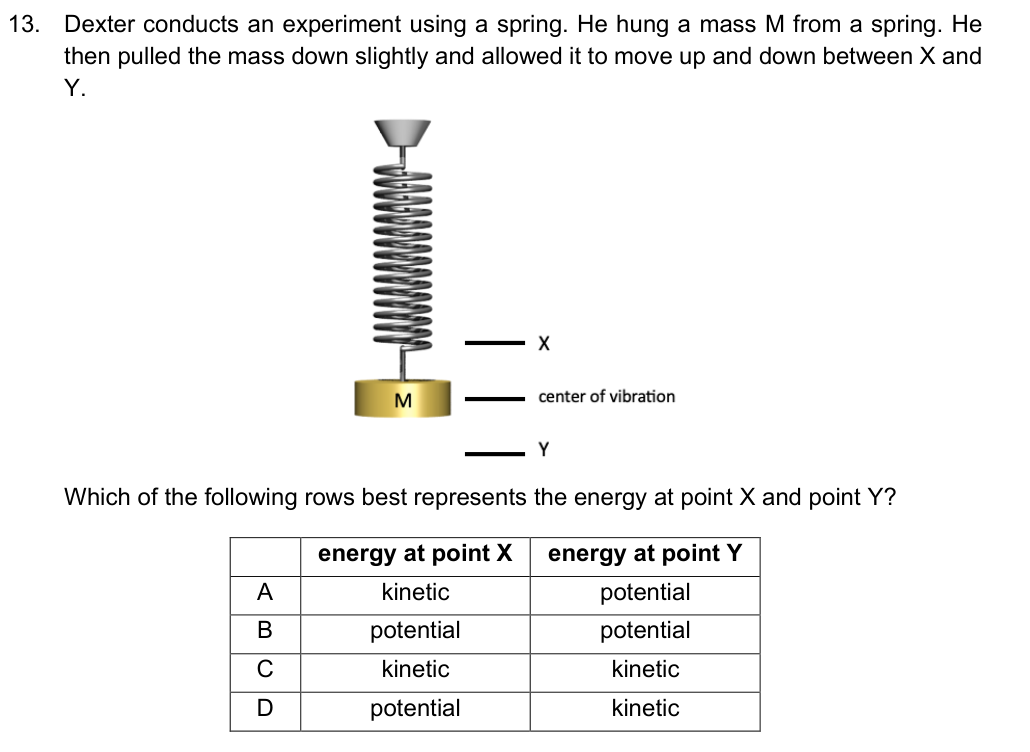
Dexter conducts an experiment using a spring. He hung a mass M from a spring. He
then pulled the mass down slightly and allowed it to move up and down between X and
Y.


Which of the following rows best represents the energy at point X and point Y?

energy at point X energy at point Y
A kinetic potential
B potential potential
C kinetic kinetic
D potential kinetic

Question illustration
  1. kinetic; potential
  2. potential; potential
  3. kinetic; kinetic
  4. potential; kinetic

Question 14

Original source text (layout and all choices are preserved in the source panel below):

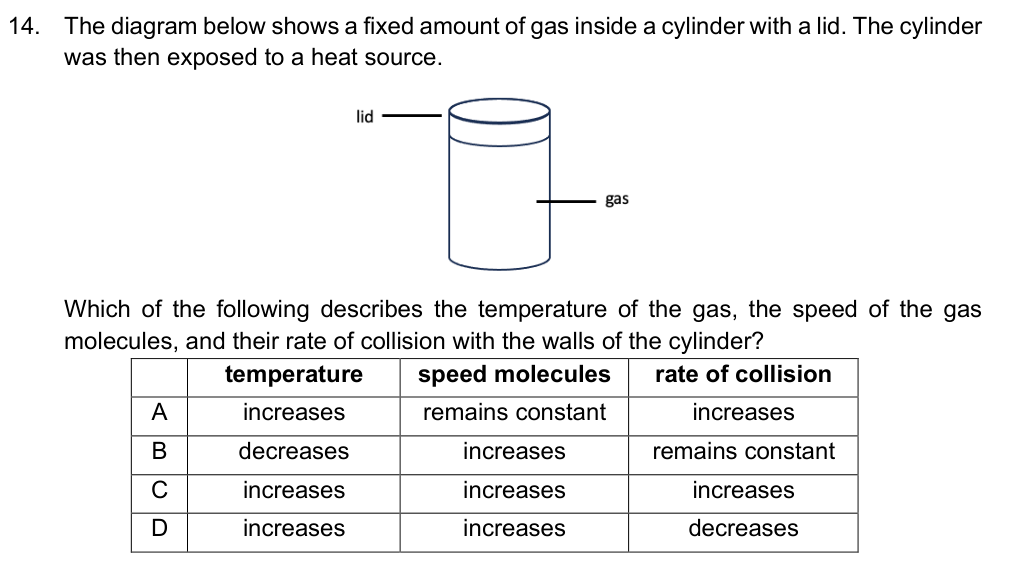
The diagram below shows a fixed amount of gas inside a cylinder with a lid. The cylinder
was then exposed to a heat source.


Which of the following describes the temperature of the gas, the speed of the gas
molecules, and their rate of collision with the walls of the cylinder?
temperature speed molecules rate of collision
A increases remains constant increases
B decreases increases remains constant
C increases increases increases
D increases increases decreases

Question illustration
  1. increases; remains constant; increases
  2. decreases; increases; remains constant
  3. increases; increases; increases
  4. increases; increases; decreases

Question 15

Original source text (layout and all choices are preserved in the source panel below):

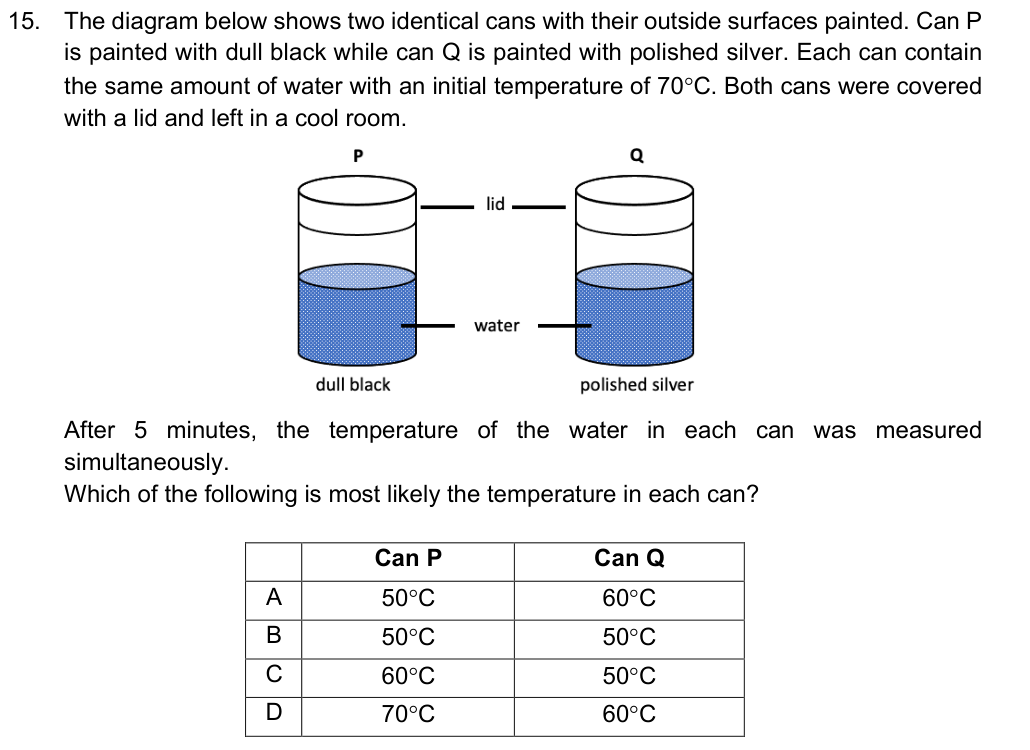
The diagram below shows two identical cans with their outside surfaces painted. Can P
is painted with dull black while can Q is painted with polished silver. Each can contain
the same amount of water with an initial temperature of 70°C. Both cans were covered
with a lid and left in a cool room.


After 5 minutes, the temperature of the water in each can was measured
simultaneously.
Which of the following is most likely the temperature in each can?

Can P Can Q
A 50°C 60°C
B 50°C 50°C
C 60°C 50°C
D 70°C 60°C

Question illustration
  1. 50°C; 60°C
  2. 50°C; 50°C
  3. 60°C; 50°C
  4. 70°C; 60°C

Question 16

Original source text (layout and all choices are preserved in the source panel below):

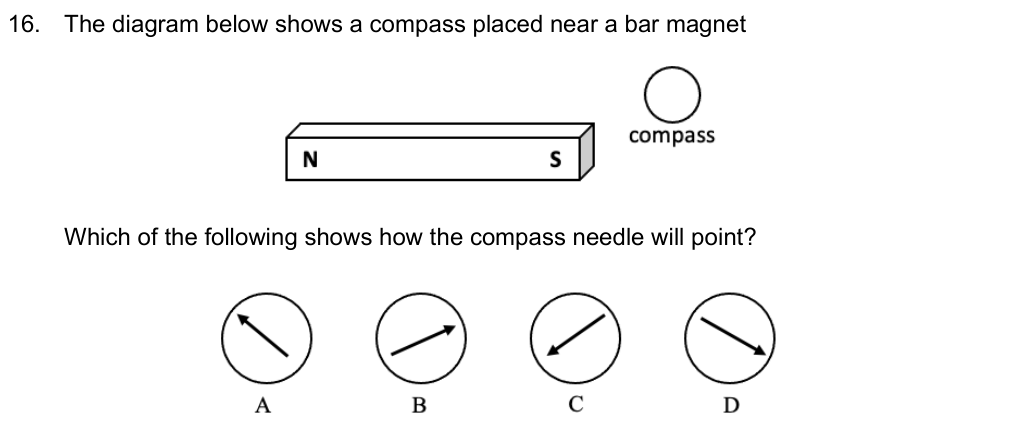
The diagram below shows a compass placed near a bar magnet


Which of the following shows how the compass needle will point?

Question illustration
  1. A (northwest arrow in source)
  2. B (northeast arrow in source)
  3. C (southwest arrow in source)
  4. D (southeast arrow in source)

Question 17

Original source text (layout and all choices are preserved in the source panel below):

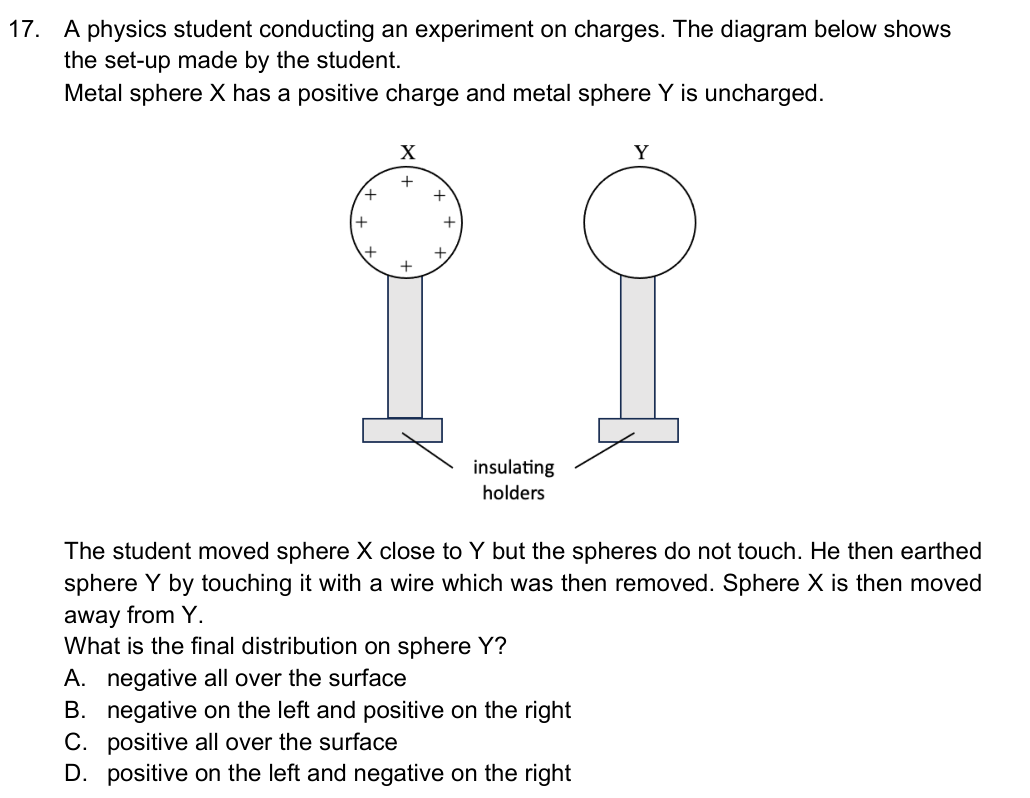
A physics student conducting an experiment on charges. The diagram below shows
the set-up made by the student.
Metal sphere X has a positive charge and metal sphere Y is uncharged.


The student moved sphere X close to Y but the spheres do not touch. He then earthed
sphere Y by touching it with a wire which was then removed. Sphere X is then moved
away from Y.
What is the final distribution on sphere Y?
A. negative all over the surface
B. negative on the left and positive on the right
C. positive all over the surface
D. positive on the left and negative on the right

Question illustration
  1. negative all over the surface
  2. negative on the left and positive on the right
  3. positive all over the surface
  4. positive on the left and negative on the right

Question 18

Original source text (layout and all choices are preserved in the source panel below):

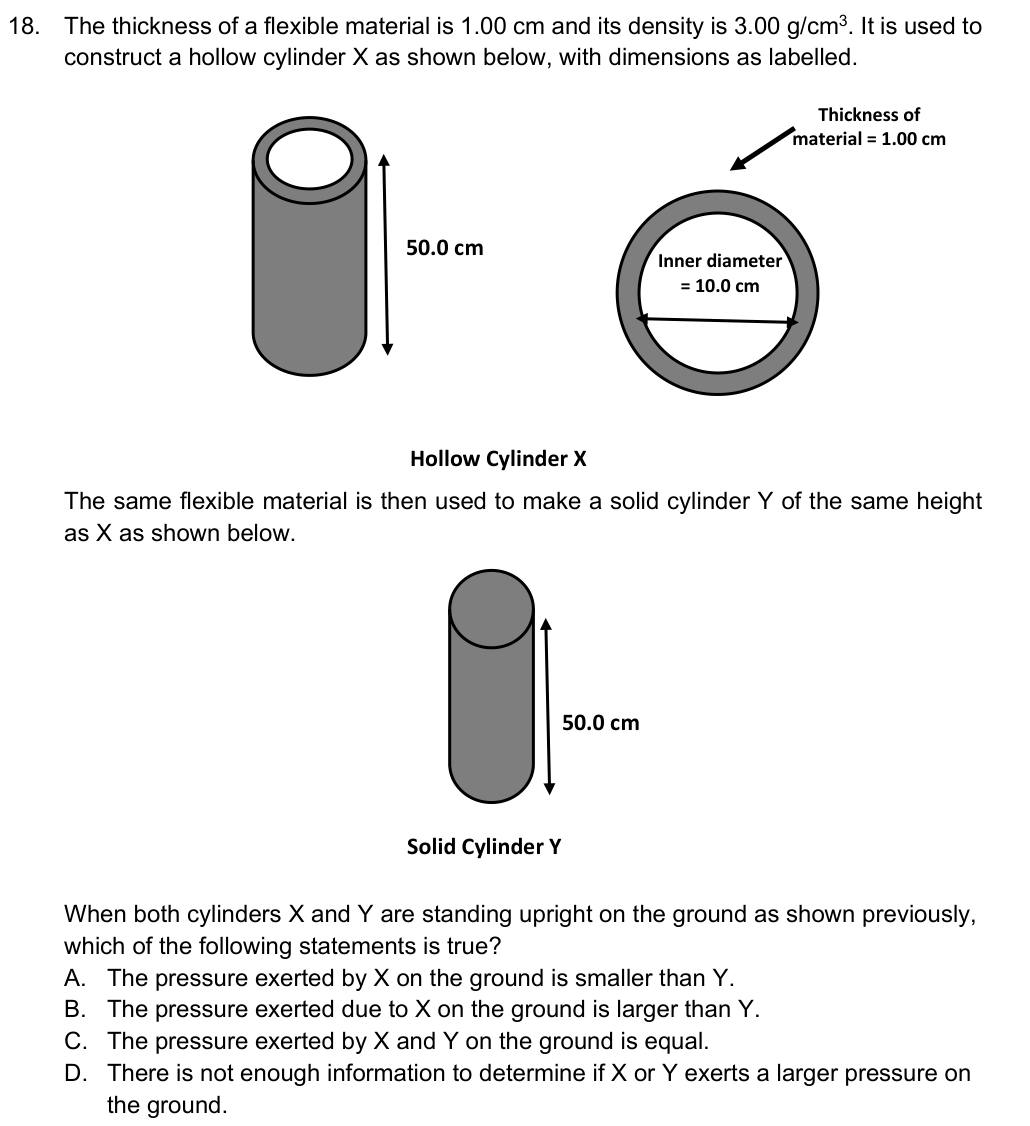
The thickness of a flexible material is 1.00 cm and its density is 3.00 g/cm3. It is used to
construct a hollow cylinder X as shown below, with dimensions as labelled.

Thickness of
material = 1.00 cm


50.0 cm Inner diameter
= 10.0 cm


Hollow Cylinder X

The same flexible material is then used to make a solid cylinder Y of the same height
as X as shown below.


50.0 cm


Solid Cylinder Y

When both cylinders X and Y are standing upright on the ground as shown previously,
which of the following statements is true?
A. The pressure exerted by X on the ground is smaller than Y.
B. The pressure exerted due to X on the ground is larger than Y.
C. The pressure exerted by X and Y on the ground is equal.
D. There is not enough information to determine if X or Y exerts a larger pressure on
the ground.

Question illustration
  1. The pressure exerted by X on the ground is smaller than Y.
  2. The pressure exerted due to X on the ground is larger than Y.
  3. The pressure exerted by X and Y on the ground is equal.
  4. There is not enough information to determine if X or Y exerts a larger pressure on the ground.

Question 19

Original source text (layout and all choices are preserved in the source panel below):

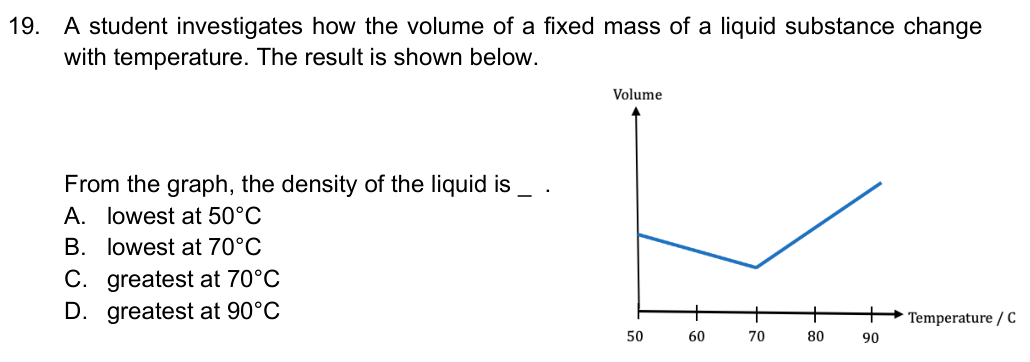
A student investigates how the volume of a fixed mass of a liquid substance change
with temperature. The result is shown below.


From the graph, the density of the liquid is _ .
A. lowest at 50°C
B. lowest at 70°C
C. greatest at 70°C
D. greatest at 90°C

Question illustration
  1. lowest at 50°C
  2. lowest at 70°C
  3. greatest at 70°C
  4. greatest at 90°C

Question 20

Original source text (layout and all choices are preserved in the source panel below):

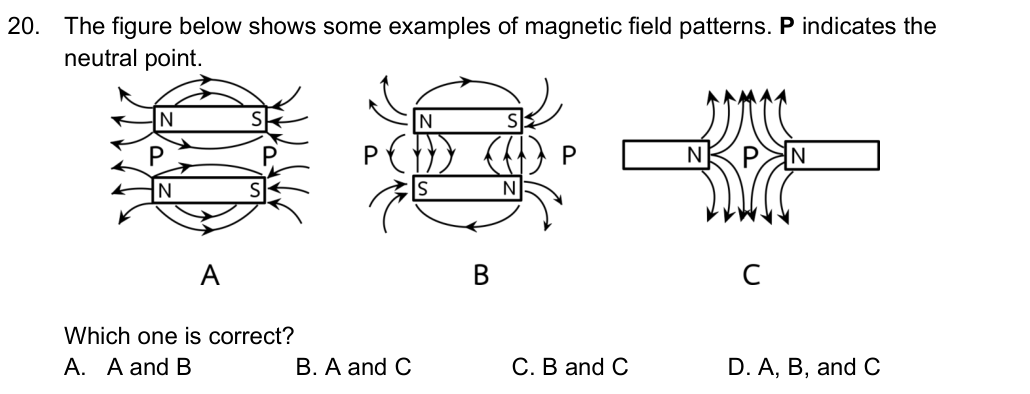
The figure below shows some examples of magnetic field patterns. P indicates the
neutral point.


Which one is correct?
A. A and B B. A and C C. B and C D. A, B, and C

Question illustration
  1. A and B
  2. A and C
  3. B and C
  4. A, B, and C