Question 1
Total time: 120 minutes for both parts together. Printed name: __________ ID: __________.
Instructions: Do not open the test booklet until told to do so. Write your name and ID in the spaces provided. Write answers only on the supplied answer sheet, using blue/black pens or pencils. Diagrams are aids and are not drawn to scale. The invigilator collects all contest papers afterwards.
PART 1: LIGHTING IN THE 21ST CENTURY
The 2014 Nobel Prize in Physics was awarded jointly to three scientists who invented efficient X-color light-emitting diodes (LEDs) in the early 1990s. Their revolutionary inventions transformed lighting technology, enabling bright, energy-saving white light sources. Incandescent bulbs lit the 20th century; LED lamps will light the 21st century. Find out what color X is in this experiment.
THEORY
An LED is a two-lead semiconductor light source. The leads are the anode (A) and cathode (K). It allows forward current from anode to cathode and blocks reverse current. A suitable forward voltage makes the LED emit monochromatic light. The minimum voltage at which it begins to light is its threshold voltage. The source states that wavelength is inversely proportional to threshold voltage.
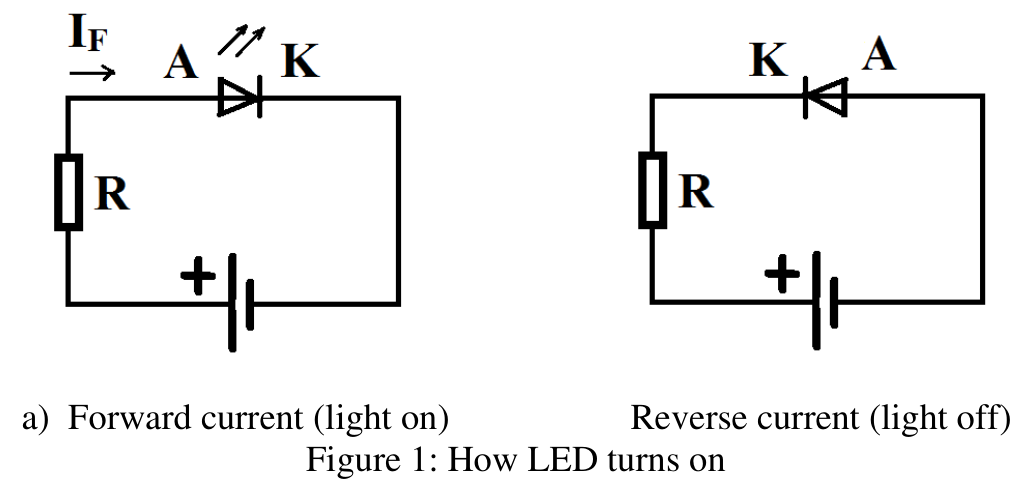
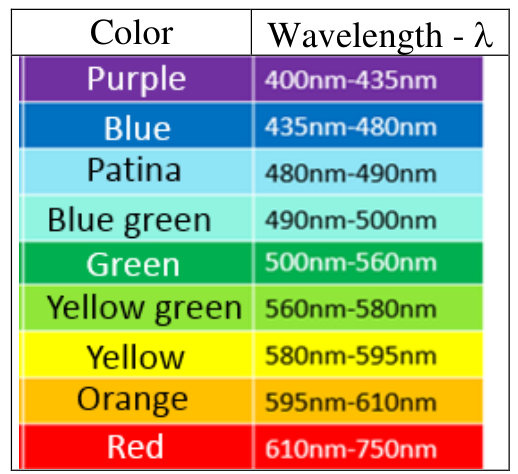
Table 1: Wavelengths of some colors (source labels retained).
| Color | Wavelength (nm) |
| --- | --- |
| Purple | 400–435 |
| Blue | 435–480 |
| Patina | 480–490 |
| Blue green | 490–500 |
| Green | 500–560 |
| Yellow green | 560–580 |
| Yellow | 580–595 |
| Orange | 595–610 |
| Red | 610–750 |
Note: $1\,\mathrm{nm}=10^{-3}\,\mu\mathrm{m}=10^{-9}\,\mathrm{m}$.
White LEDs combine an X-color LED with a yellow phosphor coating in one package. Part of the X-color light passes through the coating; the rest is converted to yellow light. X-color and yellow light combine to make white, so the white LED has the same threshold voltage as the X-color LED.
Objective: Assume $V_{\mathrm{threshold}}=k/\lambda$, with the same constant $k$ for all LED types. Determine X and its wavelength.
Materials: Digital multimeter; a pair of red/black meter leads; LED experiment box; PVC tube to block ambient light if needed.
Attention: Do not look at LED light for too long, to avoid eyestrain.
Procedure:
1\. Set all box switches OFF. Gently turn potentiometer P1 anticlockwise to its end.
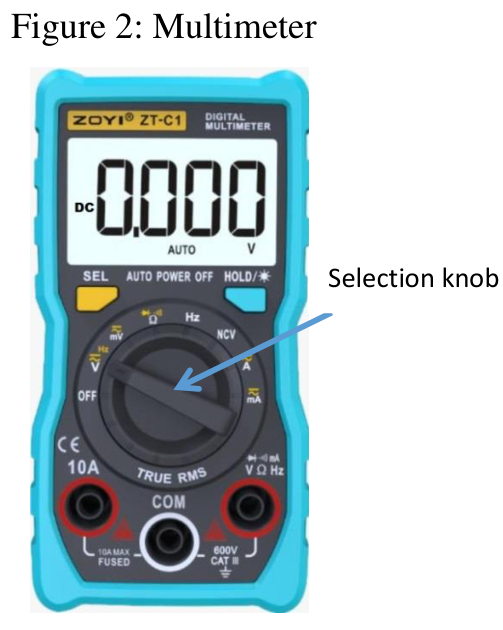
2\. Turn the meter selector clockwise to V. The screen should show DC, AUTO and V as in Figure 2.
3\. Connect the meter leads to the box terminals: red to + and black to −.
4\. Turn S1 ON.
5\. Turn switch A ON.
6\. Gently turn P1 clockwise until LED A lights; record its color in Table 2.
7\. Slowly turn P1 anticlockwise or clockwise to find where the LED just begins emitting light. Record the meter reading in Table 2. Repeat three times. Use the PVC tube to block ambient light if needed.
8\. Turn A OFF and gently return P1 fully anticlockwise.
9\. Repeat steps 5–8 for LEDs B, C, D and E.
At the end, turn all switches OFF, gently return P1 fully anticlockwise and turn off the meter.
I. EXPERIMENT RESULTS
(1) Table 2: Measurement data. Record the color and three threshold readings for each LED. [10 points]
| LED | Color | First Vth (V) | Second Vth (V) | Third Vth (V) |
| --- | --- | --- | --- | --- |
| A | ____ | ____ | ____ | ____ |
| B | ____ | ____ | ____ | ____ |
| C | ____ | ____ | ____ | ____ |
| D | ____ | ____ | ____ | ____ |
| E | ____ | ____ | ____ | ____ |
II. DATA ANALYSIS
(2) Convert wavelength from nm to μm; calculate $1/\lambda$ and the mean measured threshold voltage, rounding both calculated quantities to one decimal place. Complete Table 3. What do you think about the wavelength of LED D light? [6 points]
| LED | λ (nm) | λ (μm) | 1/λ (μm⁻¹) | Mean threshold (V) |
| --- | --- | --- | --- | --- |
| A | 630 | ____ | ____ | ____ |
| B | 590 | ____ | ____ | ____ |
| C | 540 | ____ | ____ | ____ |
| D | x | x | x | ____ |
| E | 410 | ____ | ____ | ____ |
Response about D: ____________________________________
(3) Plot mean threshold voltage on the vertical axis against $1/\lambda$ on the horizontal axis. Draw the straight line of best fit. [4 points]

(4) Explain how you find X. Equivalent wavelength of LED D: ______ unit: ______. The X-color LED is ______. [4 points]
QUESTIONS
(1) If P1 is set so that the meter reads 2 V, which LEDs emit light when you switch each one ON in turn, one at a time? [1 point]
(2) Two LEDs have threshold voltages 1.55 V and 1.2 V. What are their colors? Explain. [2 points]
(3) A pink LED combines a colored LED with a phosphor coating. Its measured threshold is 2.41 V. What combination makes it? (a) LED color: ______ (b) phosphor color: ______. [2 points]
(4) If an ultraviolet LED stimulates a yellow phosphor, what light color will you see? [1 point]
Answer spaces: __________________________________________________
Instructions: Do not open the test booklet until told to do so. Write your name and ID in the spaces provided. Write answers only on the supplied answer sheet, using blue/black pens or pencils. Diagrams are aids and are not drawn to scale. The invigilator collects all contest papers afterwards.
PART 1: LIGHTING IN THE 21ST CENTURY
The 2014 Nobel Prize in Physics was awarded jointly to three scientists who invented efficient X-color light-emitting diodes (LEDs) in the early 1990s. Their revolutionary inventions transformed lighting technology, enabling bright, energy-saving white light sources. Incandescent bulbs lit the 20th century; LED lamps will light the 21st century. Find out what color X is in this experiment.
THEORY
An LED is a two-lead semiconductor light source. The leads are the anode (A) and cathode (K). It allows forward current from anode to cathode and blocks reverse current. A suitable forward voltage makes the LED emit monochromatic light. The minimum voltage at which it begins to light is its threshold voltage. The source states that wavelength is inversely proportional to threshold voltage.
Table 1: Wavelengths of some colors (source labels retained).
| Color | Wavelength (nm) |
| --- | --- |
| Purple | 400–435 |
| Blue | 435–480 |
| Patina | 480–490 |
| Blue green | 490–500 |
| Green | 500–560 |
| Yellow green | 560–580 |
| Yellow | 580–595 |
| Orange | 595–610 |
| Red | 610–750 |
Note: $1\,\mathrm{nm}=10^{-3}\,\mu\mathrm{m}=10^{-9}\,\mathrm{m}$.
White LEDs combine an X-color LED with a yellow phosphor coating in one package. Part of the X-color light passes through the coating; the rest is converted to yellow light. X-color and yellow light combine to make white, so the white LED has the same threshold voltage as the X-color LED.
Objective: Assume $V_{\mathrm{threshold}}=k/\lambda$, with the same constant $k$ for all LED types. Determine X and its wavelength.
Materials: Digital multimeter; a pair of red/black meter leads; LED experiment box; PVC tube to block ambient light if needed.
Attention: Do not look at LED light for too long, to avoid eyestrain.
Procedure:
1\. Set all box switches OFF. Gently turn potentiometer P1 anticlockwise to its end.
2\. Turn the meter selector clockwise to V. The screen should show DC, AUTO and V as in Figure 2.
3\. Connect the meter leads to the box terminals: red to + and black to −.
4\. Turn S1 ON.
5\. Turn switch A ON.
6\. Gently turn P1 clockwise until LED A lights; record its color in Table 2.
7\. Slowly turn P1 anticlockwise or clockwise to find where the LED just begins emitting light. Record the meter reading in Table 2. Repeat three times. Use the PVC tube to block ambient light if needed.
8\. Turn A OFF and gently return P1 fully anticlockwise.
9\. Repeat steps 5–8 for LEDs B, C, D and E.
At the end, turn all switches OFF, gently return P1 fully anticlockwise and turn off the meter.
I. EXPERIMENT RESULTS
(1) Table 2: Measurement data. Record the color and three threshold readings for each LED. [10 points]
| LED | Color | First Vth (V) | Second Vth (V) | Third Vth (V) |
| --- | --- | --- | --- | --- |
| A | ____ | ____ | ____ | ____ |
| B | ____ | ____ | ____ | ____ |
| C | ____ | ____ | ____ | ____ |
| D | ____ | ____ | ____ | ____ |
| E | ____ | ____ | ____ | ____ |
II. DATA ANALYSIS
(2) Convert wavelength from nm to μm; calculate $1/\lambda$ and the mean measured threshold voltage, rounding both calculated quantities to one decimal place. Complete Table 3. What do you think about the wavelength of LED D light? [6 points]
| LED | λ (nm) | λ (μm) | 1/λ (μm⁻¹) | Mean threshold (V) |
| --- | --- | --- | --- | --- |
| A | 630 | ____ | ____ | ____ |
| B | 590 | ____ | ____ | ____ |
| C | 540 | ____ | ____ | ____ |
| D | x | x | x | ____ |
| E | 410 | ____ | ____ | ____ |
Response about D: ____________________________________
(3) Plot mean threshold voltage on the vertical axis against $1/\lambda$ on the horizontal axis. Draw the straight line of best fit. [4 points]
(4) Explain how you find X. Equivalent wavelength of LED D: ______ unit: ______. The X-color LED is ______. [4 points]
QUESTIONS
(1) If P1 is set so that the meter reads 2 V, which LEDs emit light when you switch each one ON in turn, one at a time? [1 point]
(2) Two LEDs have threshold voltages 1.55 V and 1.2 V. What are their colors? Explain. [2 points]
(3) A pink LED combines a colored LED with a phosphor coating. Its measured threshold is 2.41 V. What combination makes it? (a) LED color: ______ (b) phosphor color: ______. [2 points]
(4) If an ultraviolet LED stimulates a yellow phosphor, what light color will you see? [1 point]
Answer spaces: __________________________________________________