Skip to content / Đến nội dung
ThichHocToan.com

IMSO 2018 Science International - Theory I

Question 1

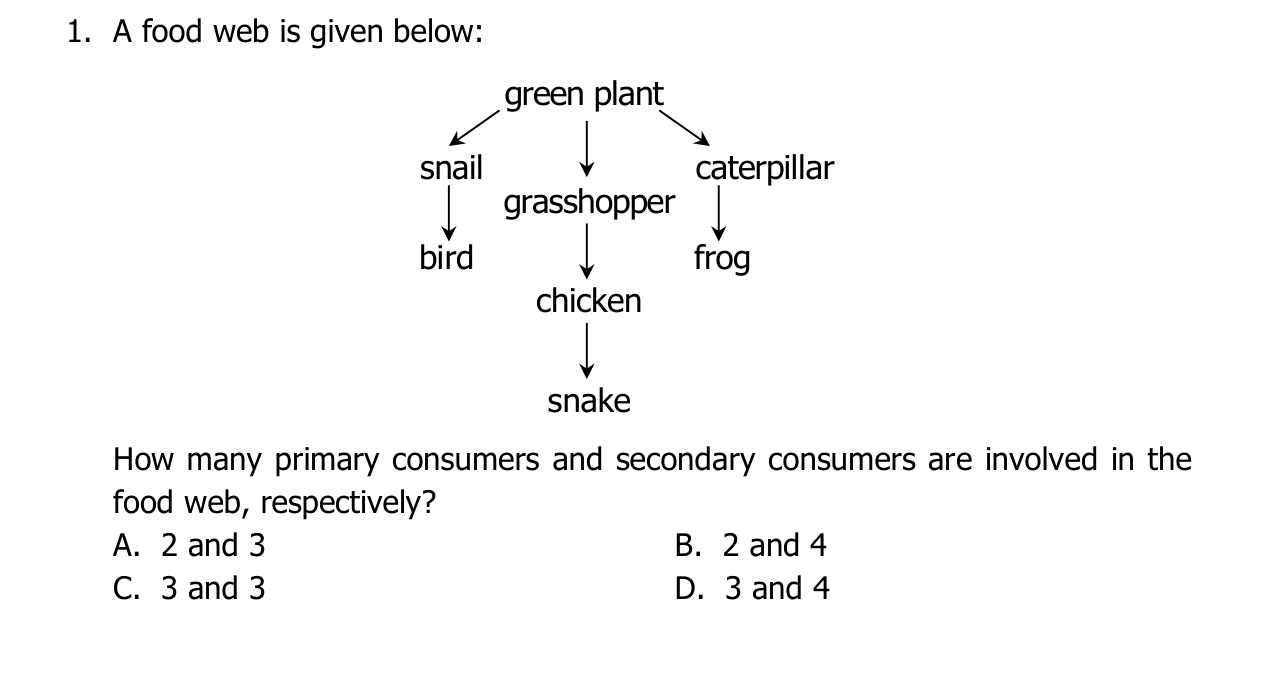
A food web is given below:
How many primary consumers and secondary consumers are involved in the
food web, respectively?
A. 2 and 3
B. 2 and 4
C. 3 and 3
D. 3 and 4
green plant
caterpillar
snail
grasshopper
chicken
frog
bird
snake

Question illustration
  1. 2 and 3
  2. 2 and 4
  3. 3 and 3
  4. 3 and 4

Question 2

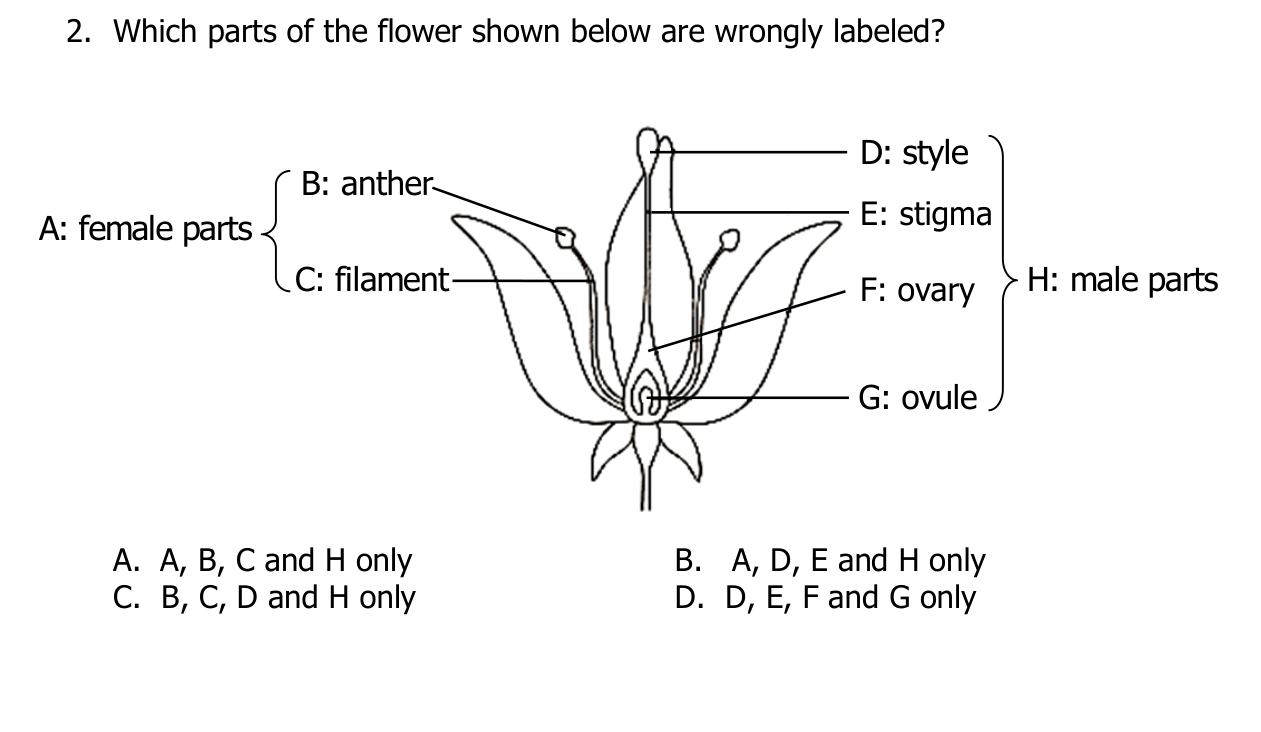
Which parts of the flower shown below are wrongly labeled?
A. A, B, C and H only
B. A, D, E and H only
C. B, C, D and H only
D. D, E, F and G only
D: style
E: stigma
F: ovary
G: ovule
H: male parts
B: anther
C: filament
A: female parts

Question illustration
  1. A, B, C and H only
  2. A, D, E and H only
  3. B, C, D and H only
  4. D, E, F and G only

Question 3

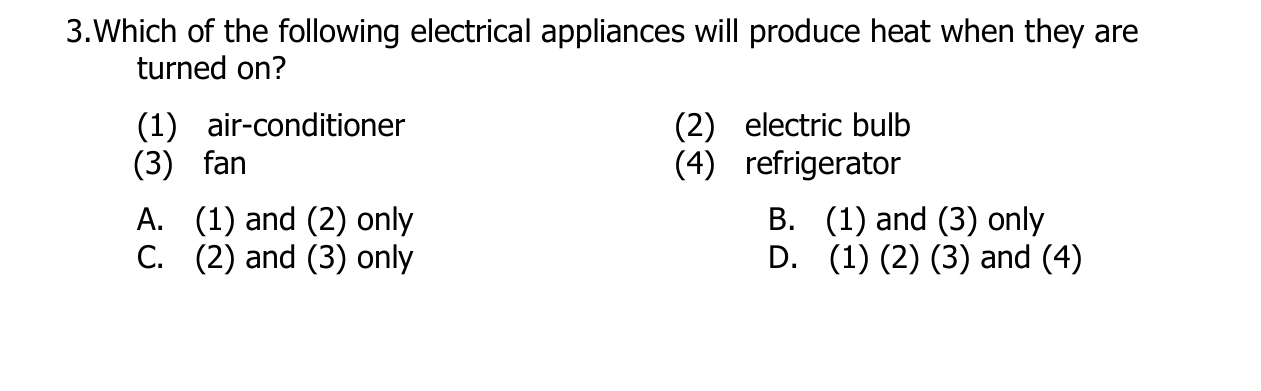
Which of the following electrical appliances will produce heat when they are
turned on?
(1) air-conditioner
(2) electric bulb
(3) fan
(4) refrigerator
A. (1) and (2) only
B. (1) and (3) only
C. (2) and (3) only
D. (1) (2) (3) and (4)

Question illustration
  1. (1) and (2) only
  2. (1) and (3) only
  3. (2) and (3) only
  4. (1) (2) (3) and (4)

Question 4

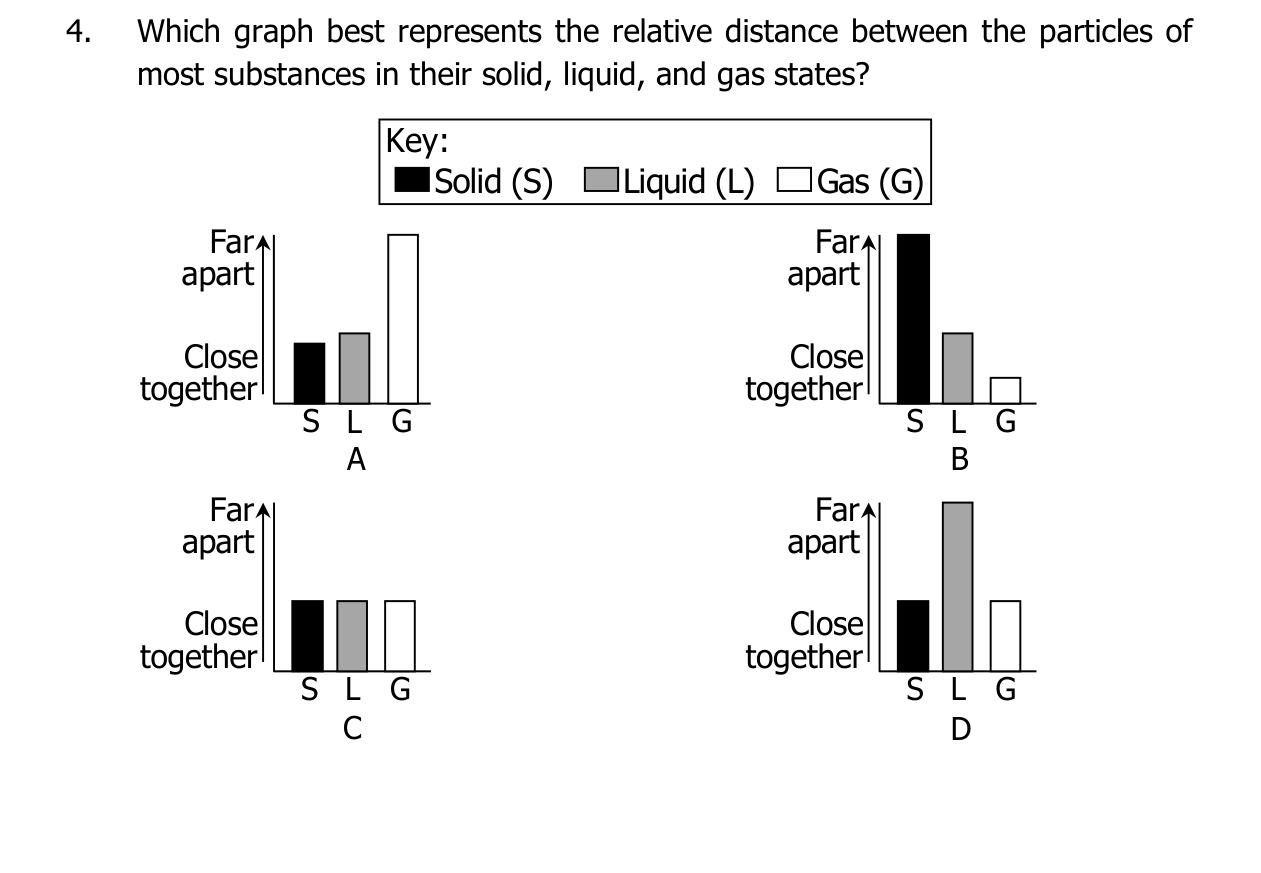
Which graph best represents the relative distance between the particles of
most substances in their solid, liquid, and gas states?
A
S
L
G
Far
apart
Close
together
C
S
L
G
Far
apart
Close
together
D
S
L
G
Far
apart
Close
together
B
S
L
G
Far
apart
Close
together
Key:
Solid (S)
Liquid (L)
Gas (G)

Question illustration
  1. Graph A
  2. Graph B
  3. Graph C
  4. Graph D

Question 5

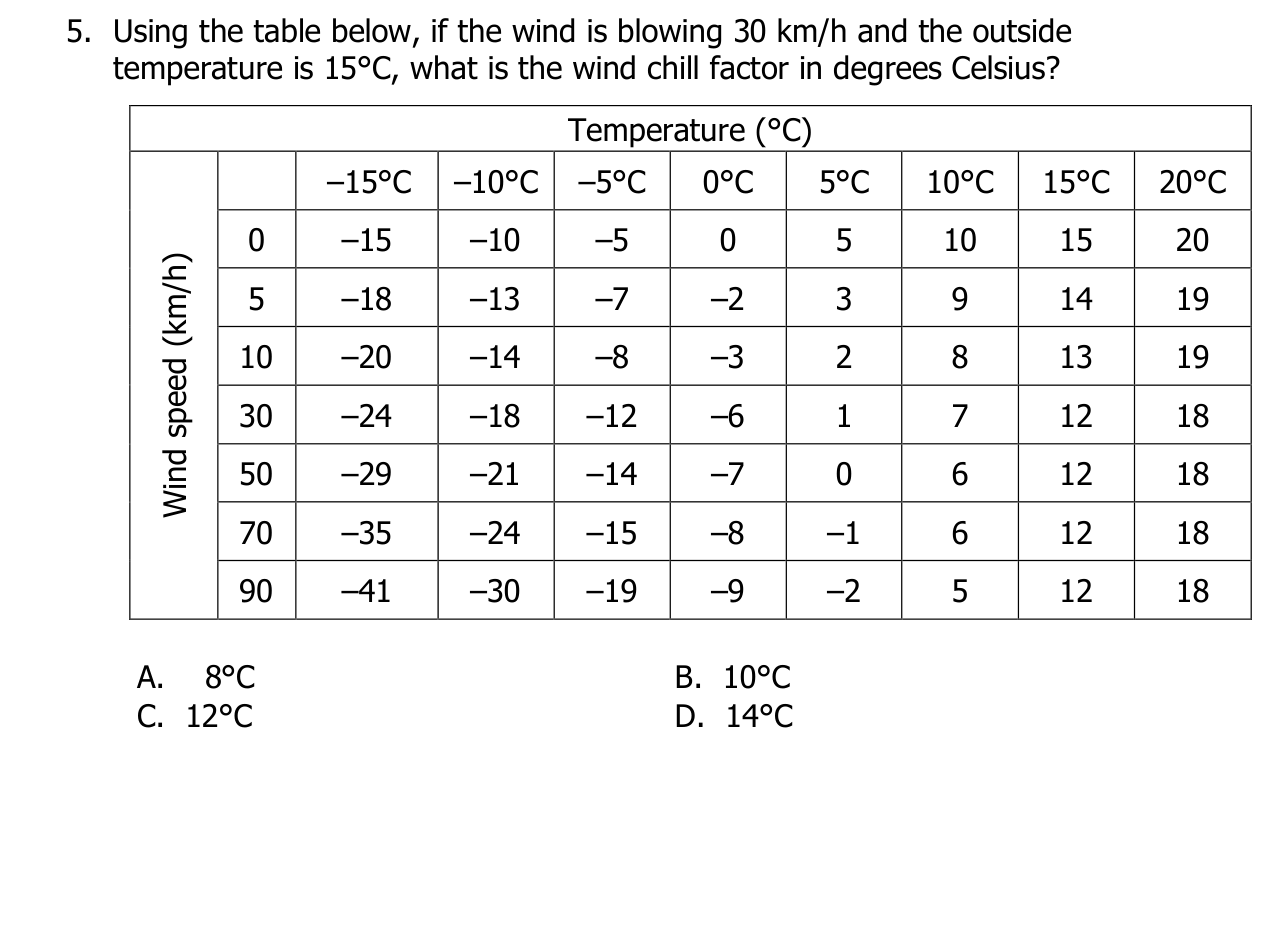
Using the table below, if the wind is blowing 30 km/h and the outside
temperature is 15°C, what is the wind chill factor in degrees Celsius?
Temperature (°C)
Wind speed (km/h)
–15°C
–10°C
–5°C
0°C
5°C
10°C
15°C
20°C
0
–15
–10
–5
0
5
10
15
20
5
–18
–13
–7
–2
3
9
14
19
10
–20
–14
–8
–3
2
8
13
19
30
–24
–18
–12
–6
1
7
12
18
50
–29
–21
–14
–7
0
6
12
18
70
–35
–24
–15
–8
–1
6
12
18
90
–41
–30
–19
–9
–2
5
12
18
A. 8°C
B. 10°C
C. 12°C
D. 14°C

Question illustration
  1. 8°C
  2. 10°C
  3. 12°C
  4. 14°C

Question 6

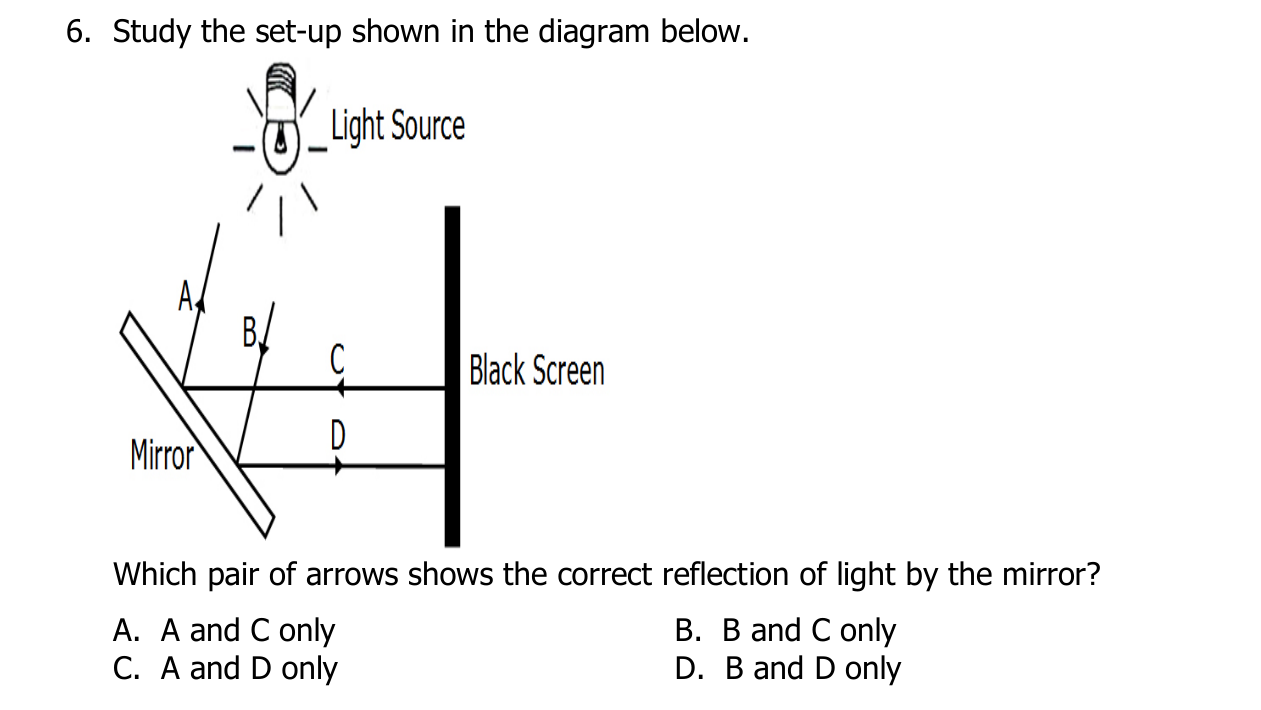
Study the set-up shown in the diagram below.
Which pair of arrows shows the correct reflection of light by the mirror?
A. A and C only
B. B and C only
C. A and D only
D. B and D only

Question illustration
  1. A and C only
  2. B and C only
  3. A and D only
  4. B and D only

Question 7

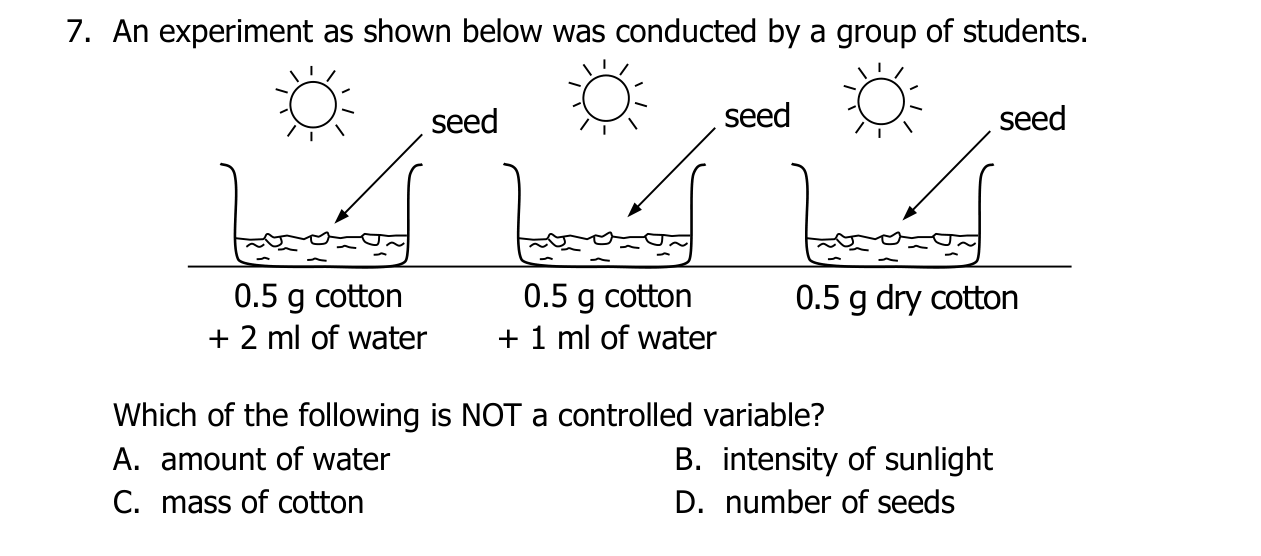
An experiment as shown below was conducted by a group of students.
Which of the following is NOT a controlled variable?
A. amount of water
B. intensity of sunlight
C. mass of cotton
D. number of seeds
0.5 g cotton
+ 2 ml of water
0.5 g dry cotton
0.5 g cotton
+ 1 ml of water
seed
seed
seed

Question illustration
  1. amount of water
  2. intensity of sunlight
  3. mass of cotton
  4. number of seeds

Question 8

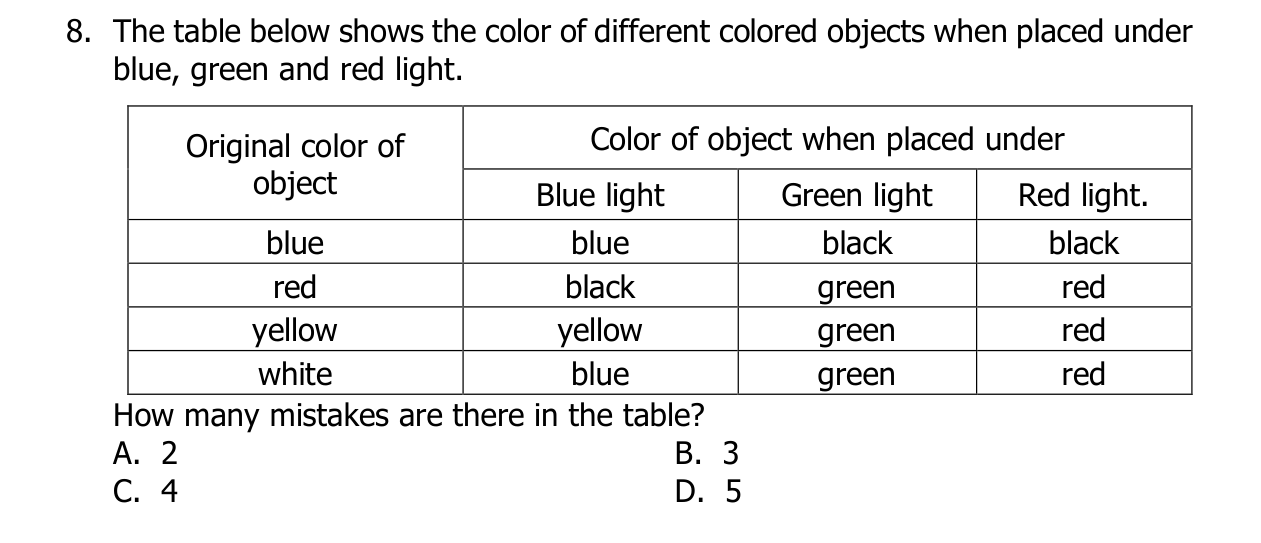
The table below shows the color of different colored objects when placed under
blue, green and red light.
Original color of
object
Color of object when placed under
Blue light
Green light
Red light.
blue
blue
black
black
red
black
green
red
yellow
yellow
green
red
white
blue
green
red
How many mistakes are there in the table?
A. 2
B. 3
C. 4
D. 5

Question illustration
  1. 2
  2. 3
  3. 4
  4. 5

Question 9

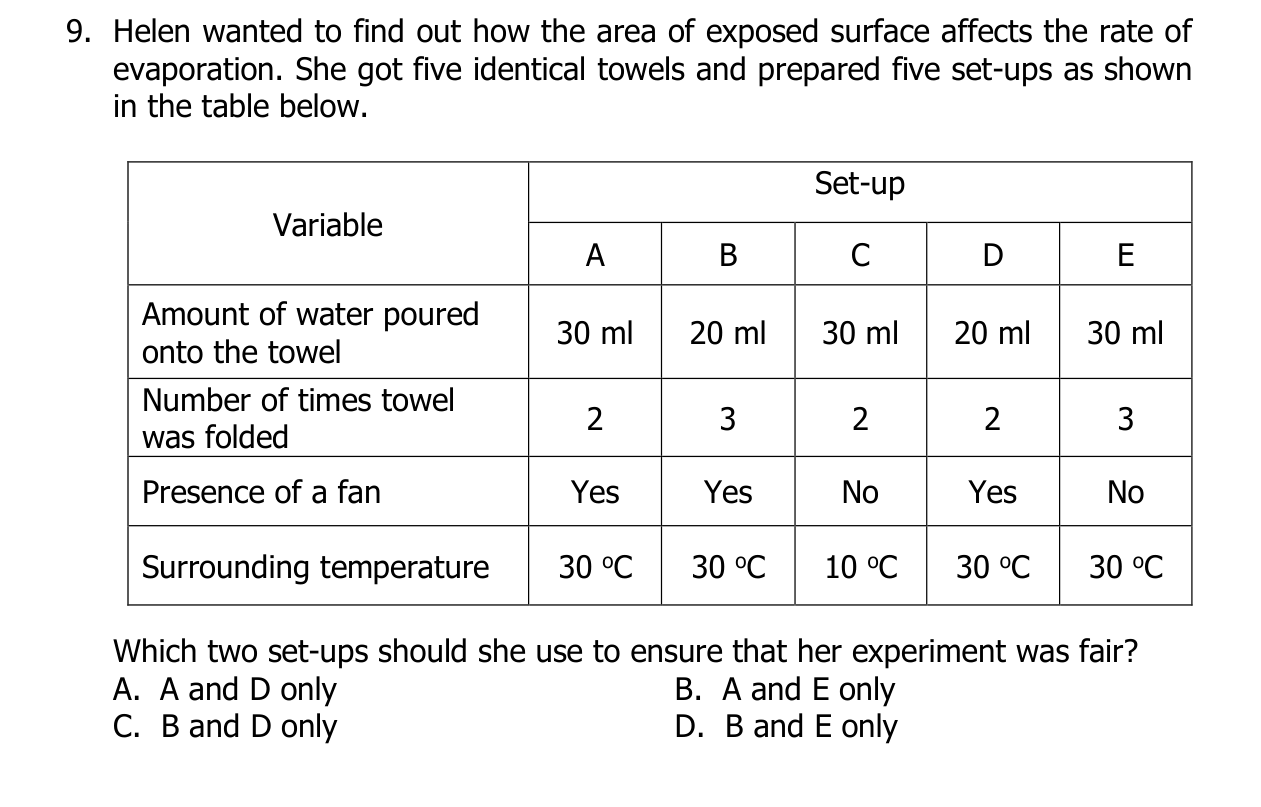
Helen wanted to find out how the area of exposed surface affects the rate of
evaporation. She got five identical towels and prepared five set-ups as shown
in the table below.
Variable
Set-up
A
B
C
D
E
Amount of water poured
onto the towel
30 ml
20 ml
30 ml
20 ml
30 ml
Number of times towel
was folded
2
3
2
2
3
Presence of a fan
Yes
Yes
No
Yes
No
Surrounding temperature
30 oC
30 oC
10 oC
30 oC
30 oC
Which two set-ups should she use to ensure that her experiment was fair?
A. A and D only
B. A and E only
C. B and D only
D. B and E only

Question illustration
  1. A and D only
  2. A and E only
  3. B and D only
  4. B and E only

Question 10

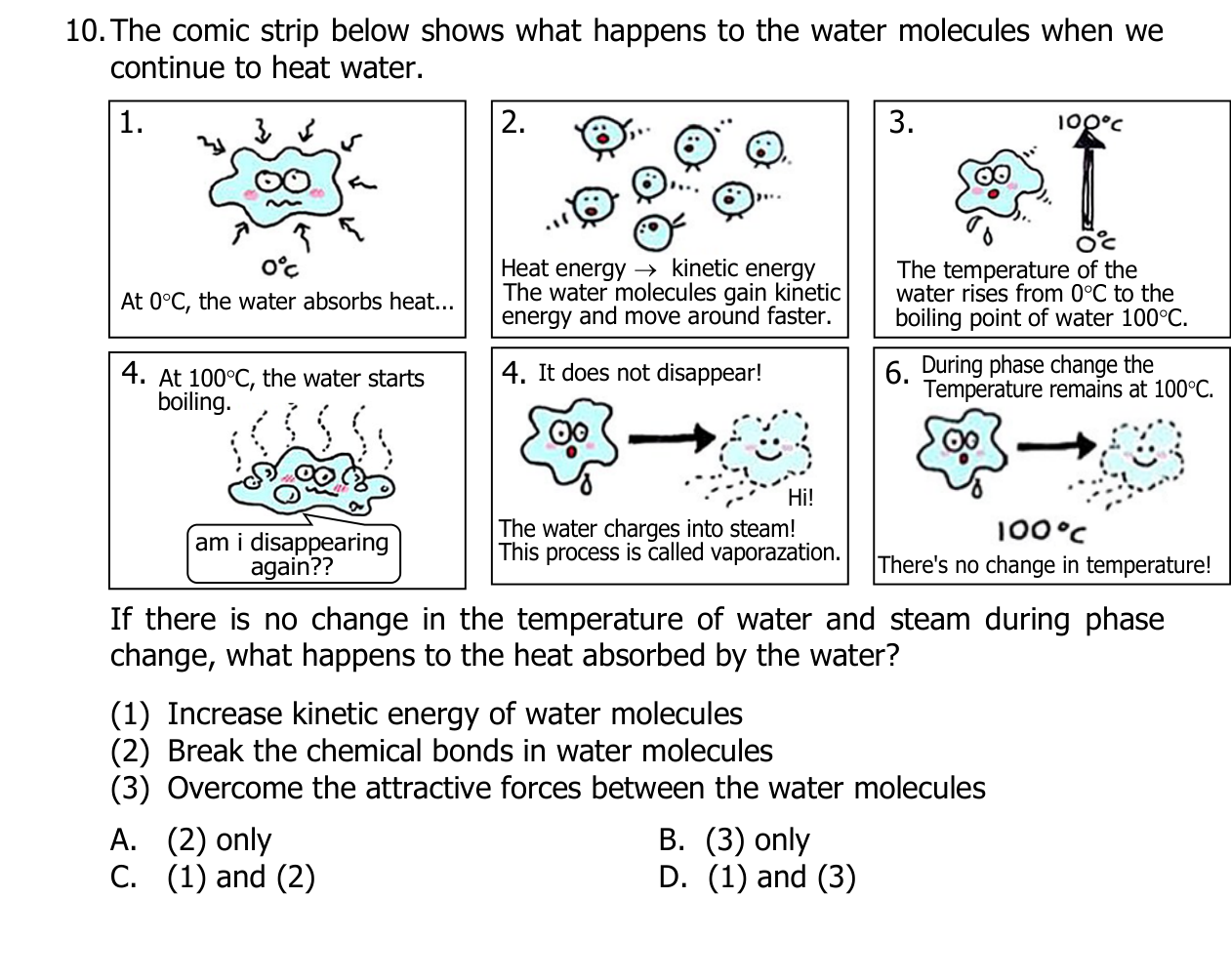
The comic strip below shows what happens to the water molecules when we
continue to heat water.
If there is no change in the temperature of water and steam during phase
change, what happens to the heat absorbed by the water?
(1) Increase kinetic energy of water molecules
(2) Break the chemical bonds in water molecules
(3) Overcome the attractive forces between the water molecules
A. (2) only
B. (3) only
C. (1) and (2)
D. (1) and (3)
1.
At 0 C, the water absorbs heat...
°
2.
Heat energy
kinetic energy
The water molecules gain kinetic
energy and move around faster.
®
3.
The temperature of the
water rises from 0 C to the
boiling point of water 100 C.
°
°
4. At 100 C, the water starts
boiling.
°
am i disappearing
again??
4. It does not disappear!
The water charges into steam!
This process is called vaporazation.
Hi!
6. During phase change the
Temperature remains at 100 C.
°
There's no change in temperature!
Question illustration
  1. (2) only
  2. (3) only
  3. (1) and (2)
  4. (1) and (3)

Question 11

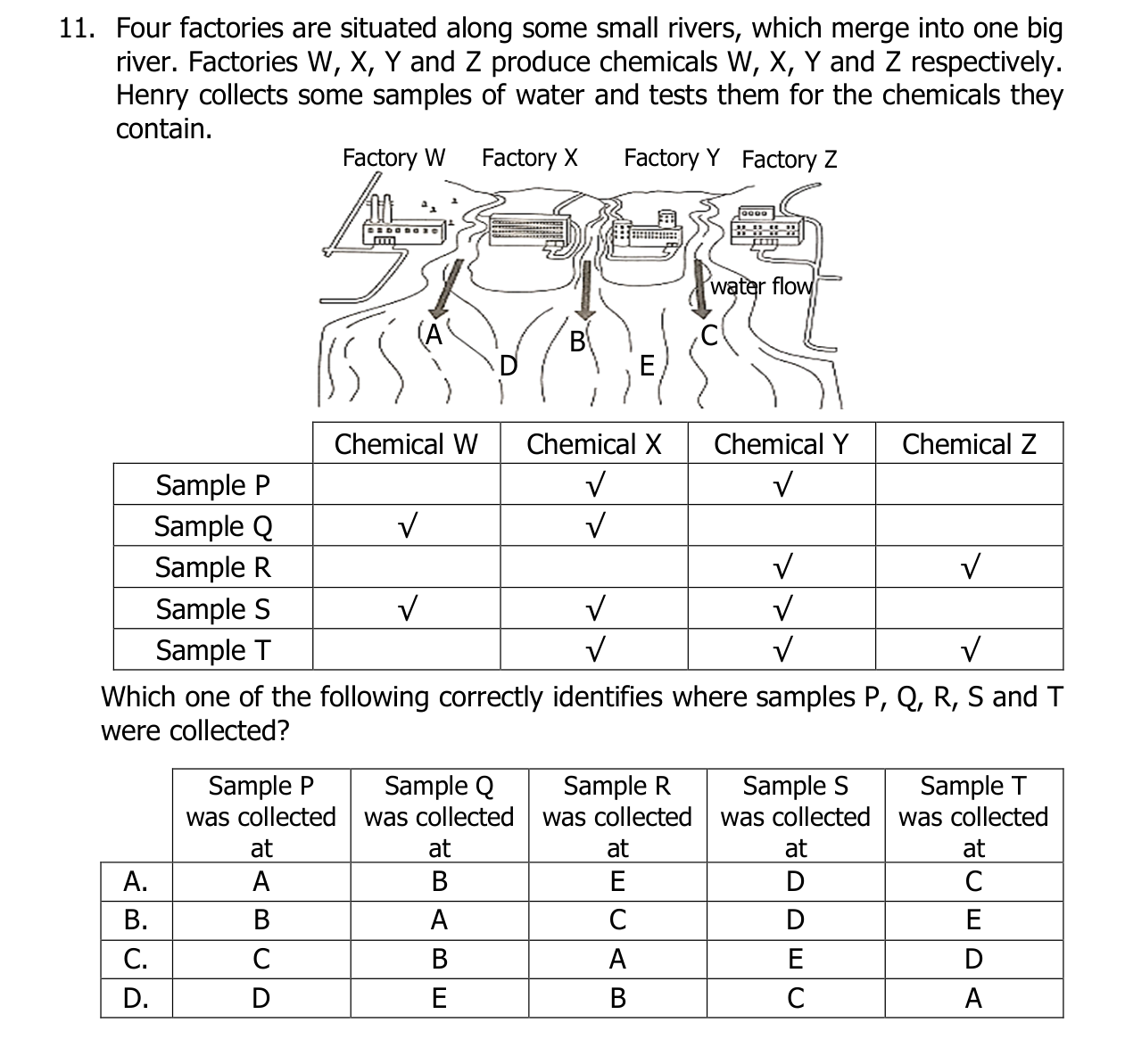
Four factories are situated along some small rivers, which merge into one big
river. Factories W, X, Y and Z produce chemicals W, X, Y and Z respectively.
Henry collects some samples of water and tests them for the chemicals they
contain.
Chemical W
Chemical X
Chemical Y
Chemical Z
Sample P
√
√
Sample Q
√
√
Sample R
√
√
Sample S
√
√
√
Sample T
√
√
√
Which one of the following correctly identifies where samples P, Q, R, S and T
were collected?
Sample P
was collected
at
Sample Q
was collected
at
Sample R
was collected
at
Sample S
was collected
at
Sample T
was collected
at
A.
A
B
E
D
C
B.
B
A
C
D
E
C.
C
B
A
E
D
D.
D
E
B
C
A
Factory W
Factory X
Factory Y
Factory Z
A
D
B
C
E
water flow

Question illustration
  1. A, B, E, D, C
  2. B, A, C, D, E
  3. C, B, A, E, D
  4. D, E, B, C, A

Question 12

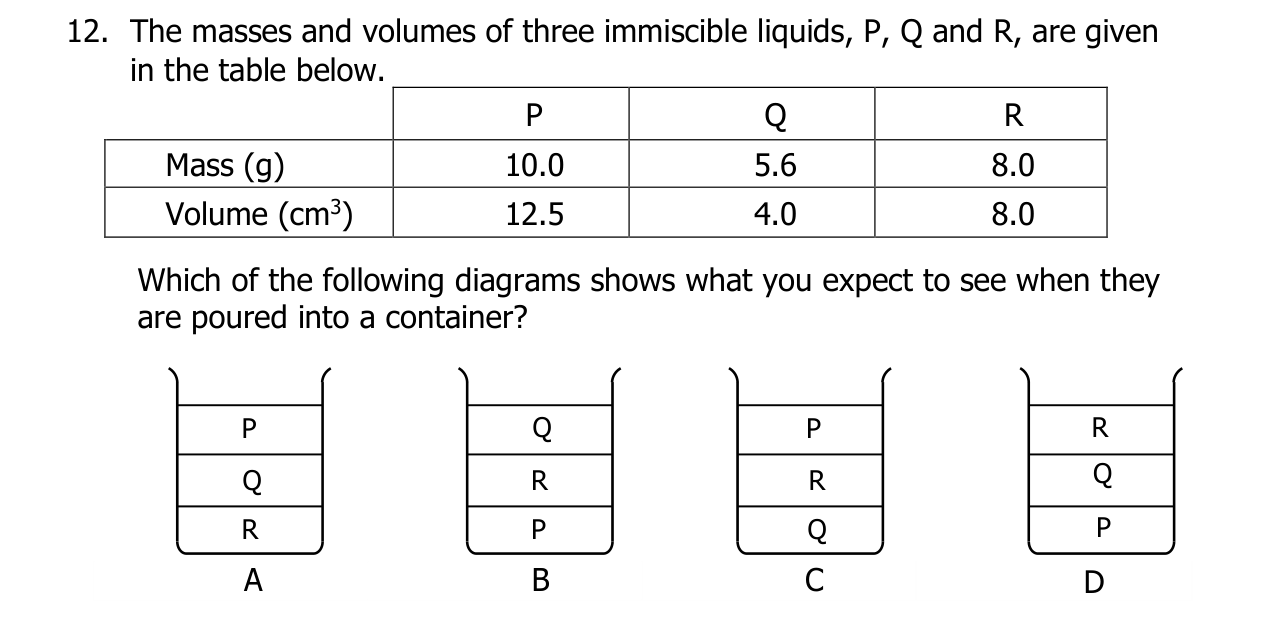
The masses and volumes of three immiscible liquids, P, Q and R, are given
in the table below.
P
Q
R
Mass (g)
10.0
5.6
8.0
Volume (cm3)
12.5
4.0
8.0
Which of the following diagrams shows what you expect to see when they
are poured into a container?
D
P
Q
R
Q
R
P
P
R
Q
R
Q
P
A
B
C

Question illustration
  1. P, Q, R
  2. Q, R, P
  3. P, R, Q
  4. R, Q, P

Question 13

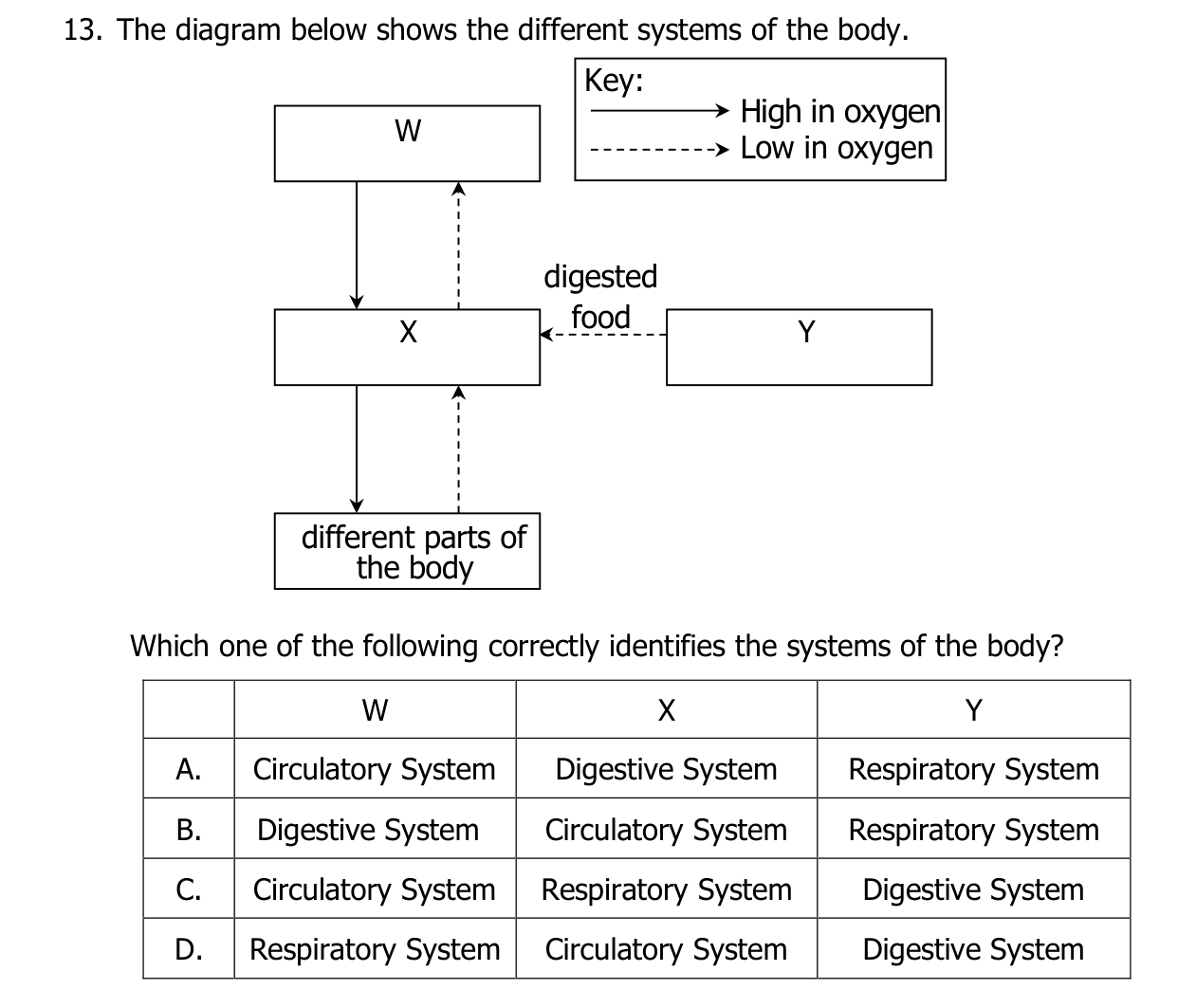
The diagram below shows the different systems of the body.
Which one of the following correctly identifies the systems of the body?
W
X
Y
A.
Circulatory System
Digestive System
Respiratory System
B.
Digestive System
Circulatory System
Respiratory System
C.
Circulatory System
Respiratory System
Digestive System
D.
Respiratory System
Circulatory System
Digestive System
Key:
High in oxygen
Low in oxygen
W
X
Y
digested
food
will digested
food
different parts of
the body

Question illustration
  1. Circulatory; Digestive; Respiratory
  2. Digestive; Circulatory; Respiratory
  3. Circulatory; Respiratory; Digestive
  4. Respiratory; Circulatory; Digestive

Question 14

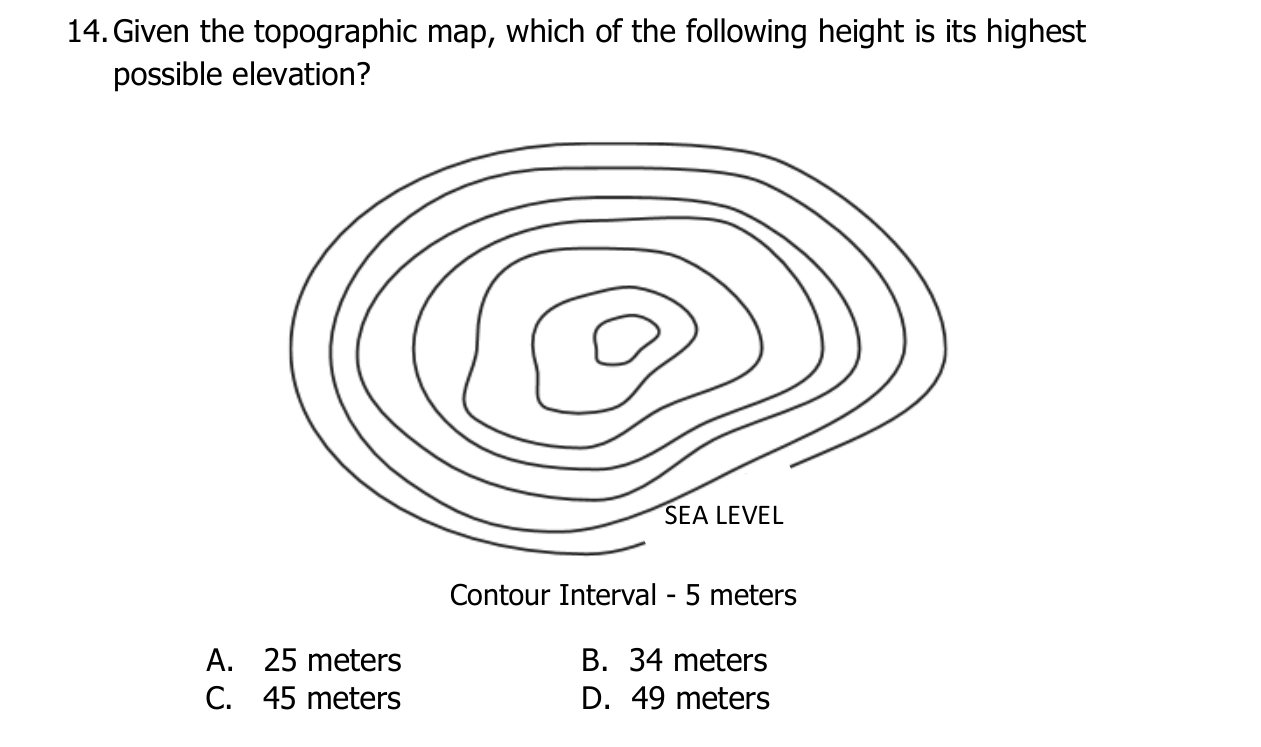
Given the topographic map, which of the following height is its highest
possible elevation?
A. 25 meters
B. 34 meters
C. 45 meters
D. 49 meters
Contour Interval - 5 meters
SEA LEVEL

Question illustration
  1. 25 meters
  2. 34 meters
  3. 45 meters
  4. 49 meters

Question 15

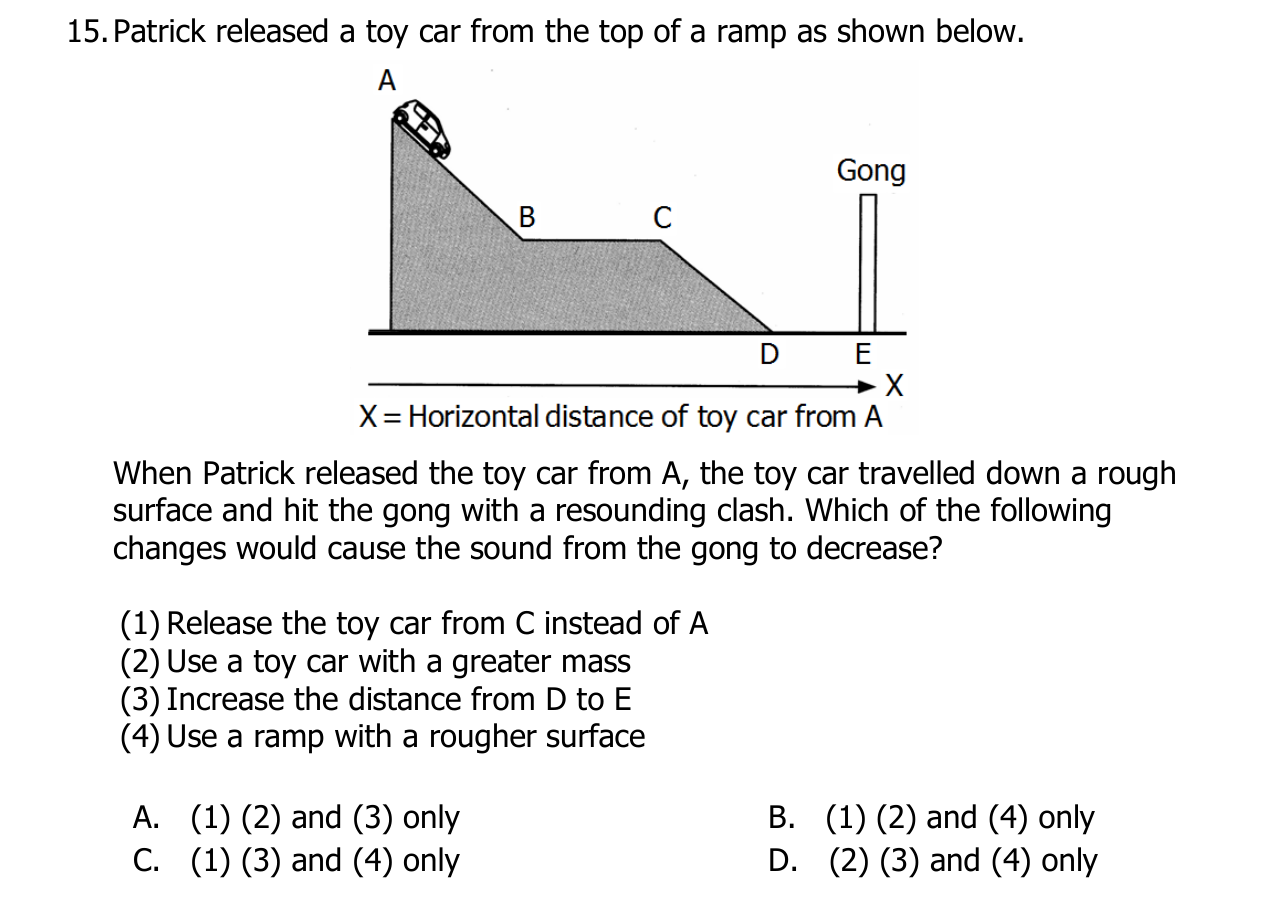
Patrick released a toy car from the top of a ramp as shown below.
When Patrick released the toy car from A, the toy car travelled down a rough
surface and hit the gong with a resounding clash. Which of the following
changes would cause the sound from the gong to decrease?
(1) Release the toy car from C instead of A
(2) Use a toy car with a greater mass
(3) Increase the distance from D to E
(4) Use a ramp with a rougher surface
A. (1) (2) and (3) only
B. (1) (2) and (4) only
C. (1) (3) and (4) only
D. (2) (3) and (4) only

Question illustration
  1. (1) (2) and (3) only
  2. (1) (2) and (4) only
  3. (1) (3) and (4) only
  4. (2) (3) and (4) only

Question 16

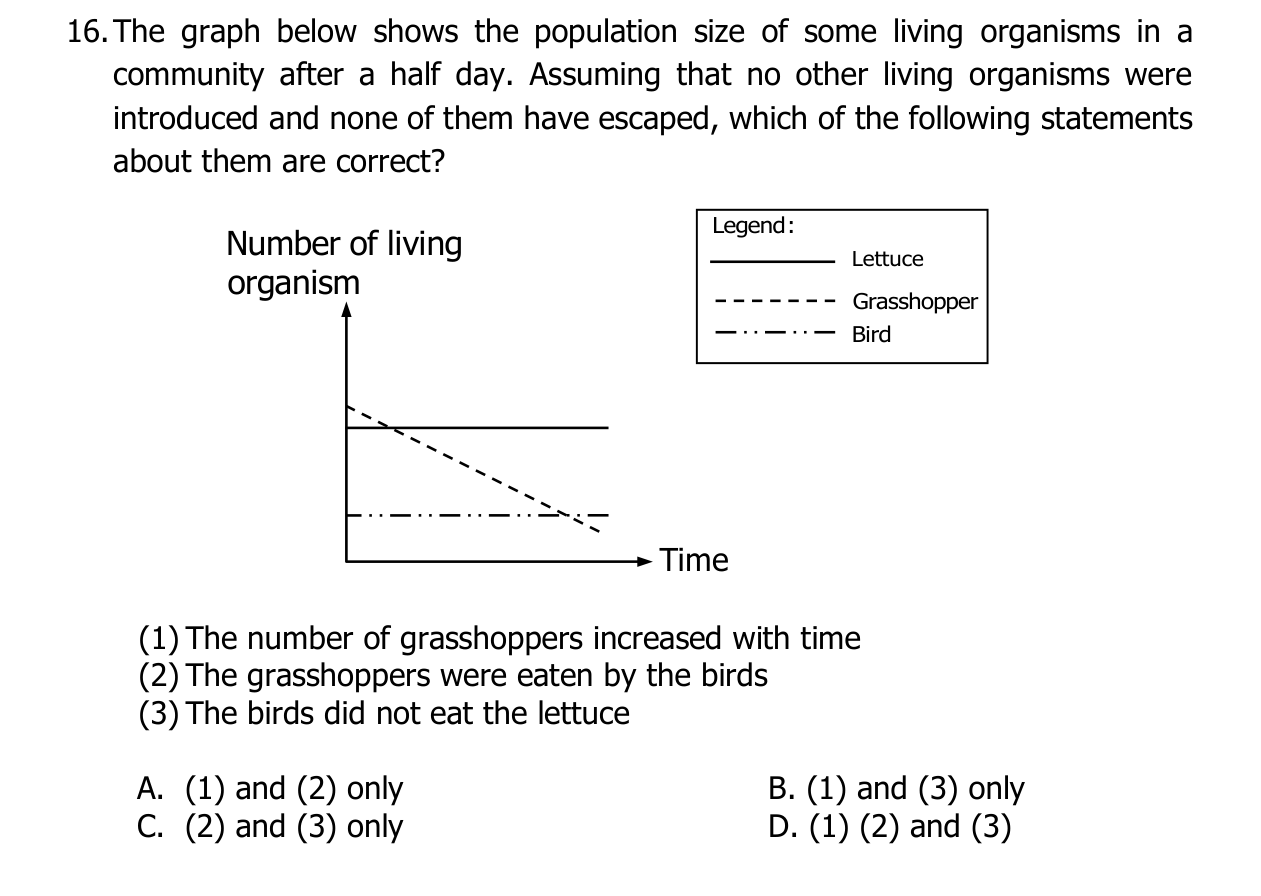
The graph below shows the population size of some living organisms in a
community after a half day. Assuming that no other living organisms were
introduced and none of them have escaped, which of the following statements
about them are correct?
(1) The number of grasshoppers increased with time
(2) The grasshoppers were eaten by the birds
(3) The birds did not eat the lettuce
A. (1) and (2) only
B. (1) and (3) only
C. (2) and (3) only
D. (1) (2) and (3)
Legend:
Lettuce
Grasshopper
Bird
Number of living
organism
Time

Question illustration

Question 17

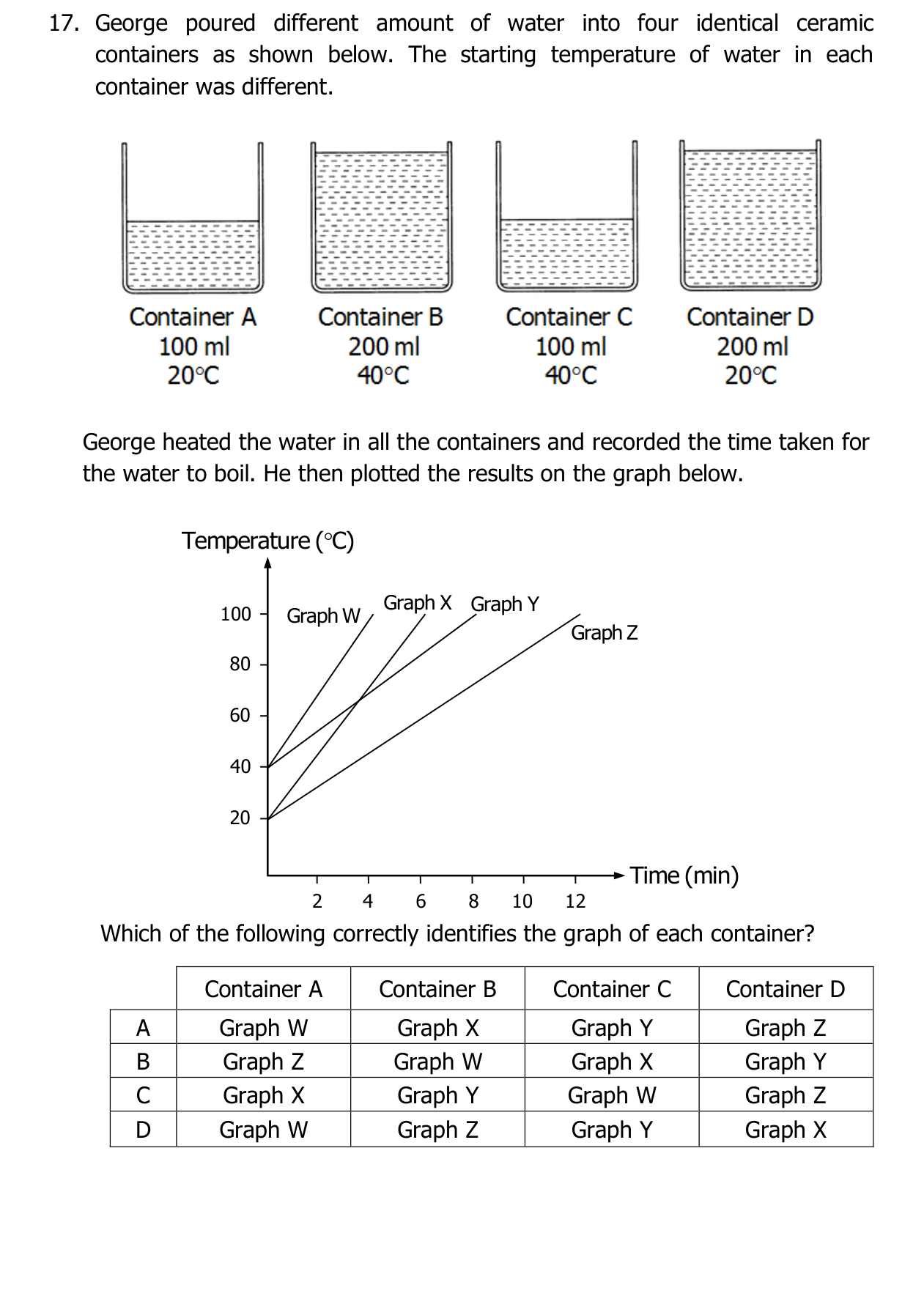
George poured different amount of water into four identical ceramic
containers as shown below. The starting temperature of water in each
container was different.
George heated the water in all the containers and recorded the time taken for
the water to boil. He then plotted the results on the graph below.
Which of the following correctly identifies the graph of each container?
Container A
Container B
Container C
Container D
A
Graph W
Graph X
Graph Y
Graph Z
B
Graph Z
Graph W
Graph X
Graph Y
C
Graph X
Graph Y
Graph W
Graph Z
D
Graph W
Graph Z
Graph Y
Graph X
°
Temperature ( C)
Graph W
Graph X
Graph Y
Graph Z
100
80
60
40
20
Time (min)
2
4
6
8
10
12

Question illustration
  1. W, X, Y, Z
  2. Z, W, X, Y
  3. X, Y, W, Z
  4. W, Z, Y, X

Question 18

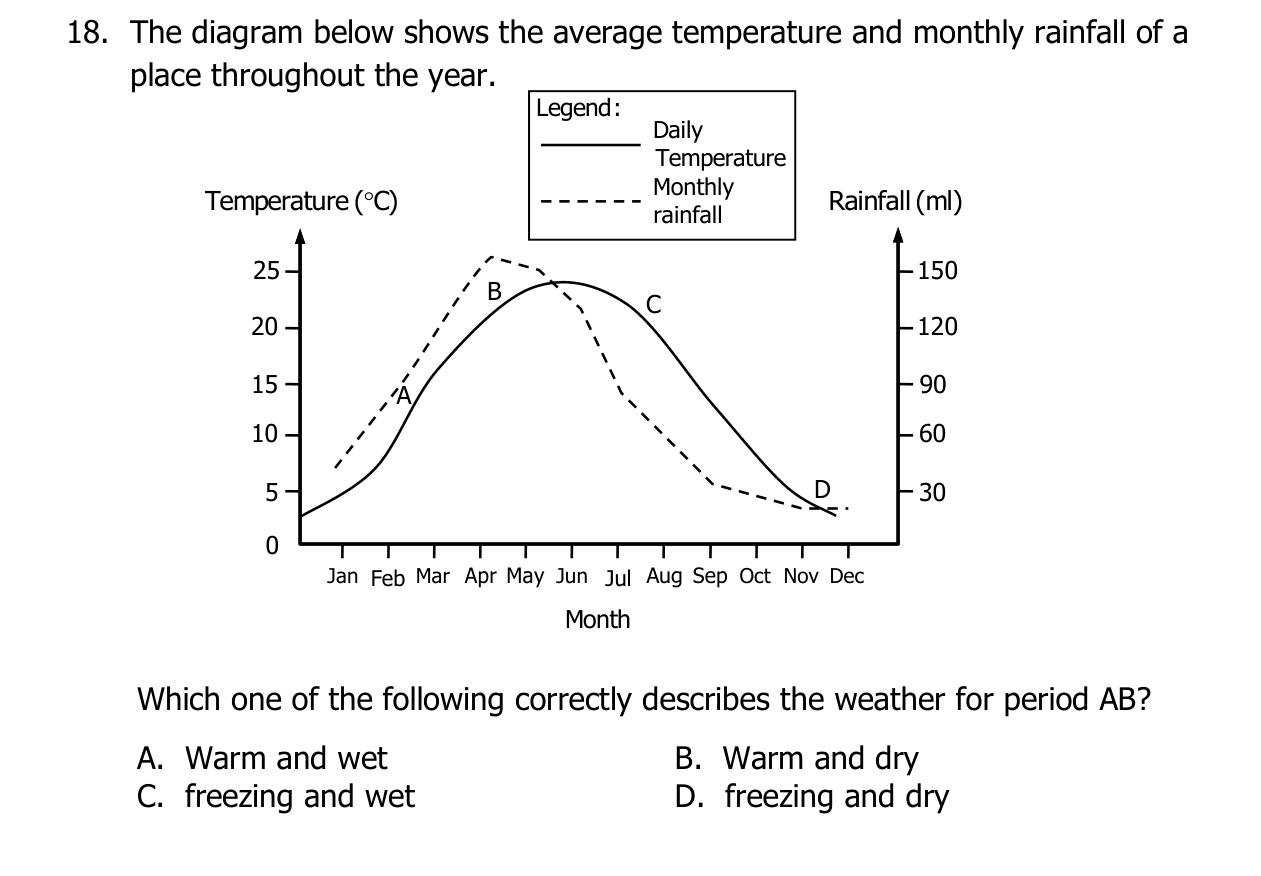
The diagram below shows the average temperature and monthly rainfall of a
place throughout the year.
Which one of the following correctly describes the weather for period AB?
A. Warm and wet
B. Warm and dry
C. freezing and wet
D. freezing and dry
°
Temperature ( C)
Rainfall (ml)
25
20
15
10
5
0
Jan Feb Mar Apr May Jun Jul Aug Sep Oct Nov Dec
150
120
90
60
30
Month
Legend:
Daily
Temperature
Monthly
rainfall
A
B
C
D

Question illustration
  1. Warm and wet
  2. Warm and dry
  3. freezing and wet
  4. freezing and dry

Question 19

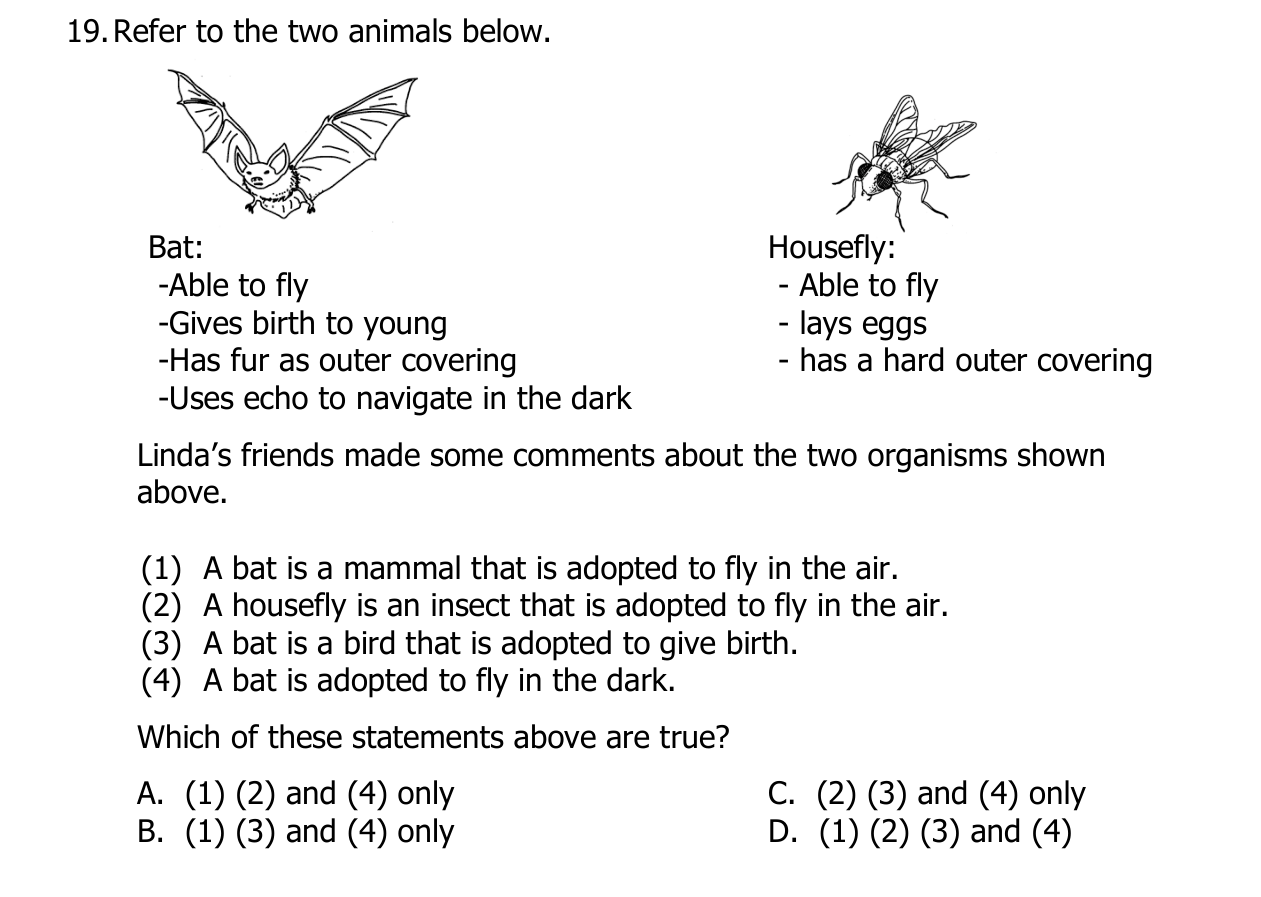
Refer to the two animals below.
Bat:
Housefly:
-Able to fly
- Able to fly
-Gives birth to young
- lays eggs
-Has fur as outer covering
- has a hard outer covering
-Uses echo to navigate in the dark
Linda’s friends made some comments about the two organisms shown
above.
(1) A bat is a mammal that is adopted to fly in the air.
(2) A housefly is an insect that is adopted to fly in the air.
(3) A bat is a bird that is adopted to give birth.
(4) A bat is adopted to fly in the dark.
Which of these statements above are true?
A. (1) (2) and (4) only
C. (2) (3) and (4) only
B. (1) (3) and (4) only
D. (1) (2) (3) and (4)

Question illustration
  1. (1) (2) and (4) only
  2. (1) (3) and (4) only
  3. (2) (3) and (4) only
  4. (1) (2) (3) and (4)

Question 20

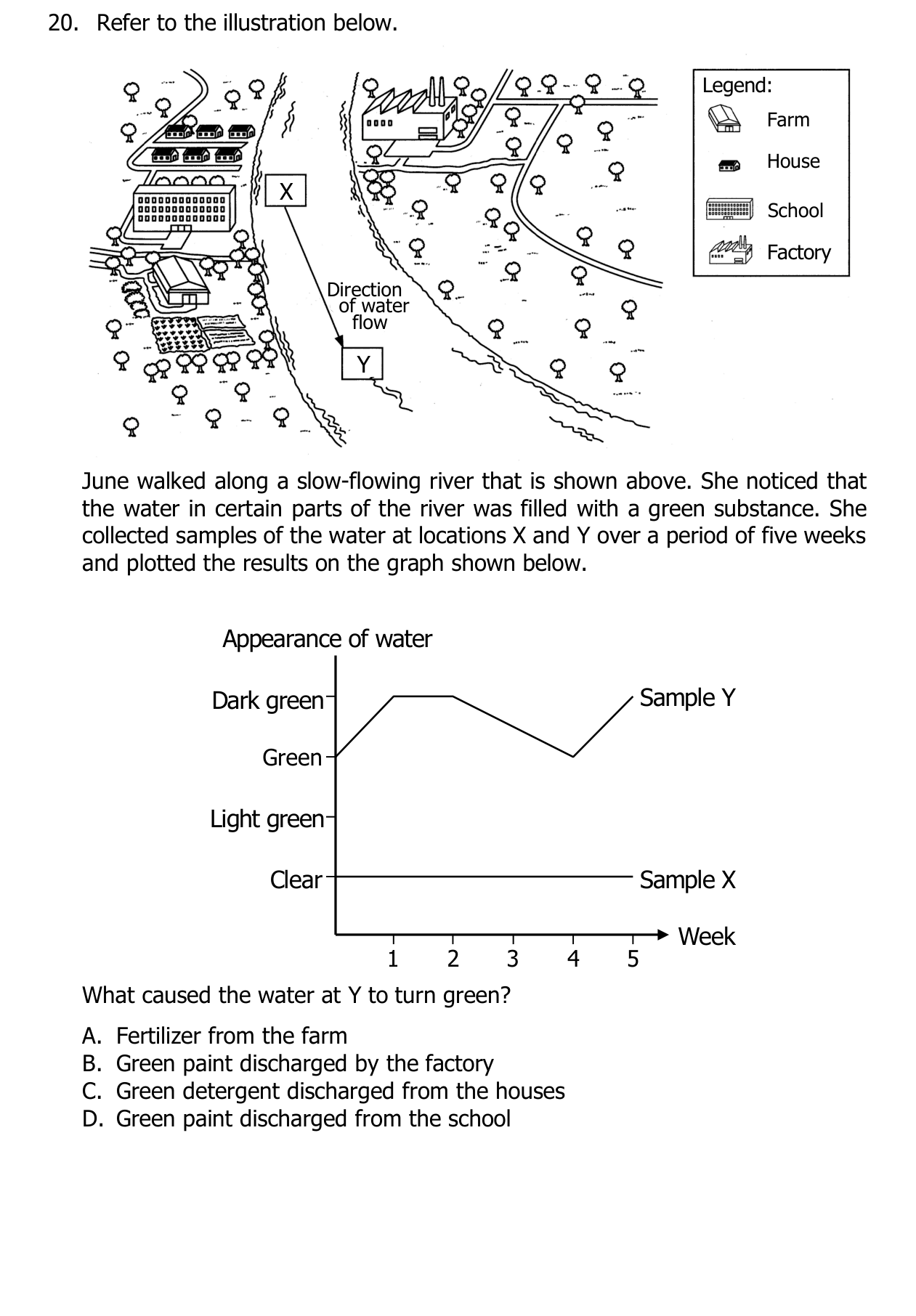
Refer to the illustration below.
June walked along a slow-flowing river that is shown above. She noticed that
the water in certain parts of the river was filled with a green substance. She
collected samples of the water at locations X and Y over a period of five weeks
and plotted the results on the graph shown below.
What caused the water at Y to turn green?
A. Fertilizer from the farm
B. Green paint discharged by the factory
C. Green detergent discharged from the houses
D. Green paint discharged from the school
Appearance of water
Dark green
Green
Light green
Clear
Sample Y
Sample X
Week
1
2
3
4
5
X
Y
of water
flow
Direction
Legend:
Farm
House
School
Factory

Question illustration
  1. Fertilizer from the farm
  2. Green paint discharged by the factory
  3. Green detergent discharged from the houses
  4. Green paint discharged from the school