Skip to content / Đến nội dung
ThichHocToan.com

IMSO 2017 Science International - Theory II

Question 1

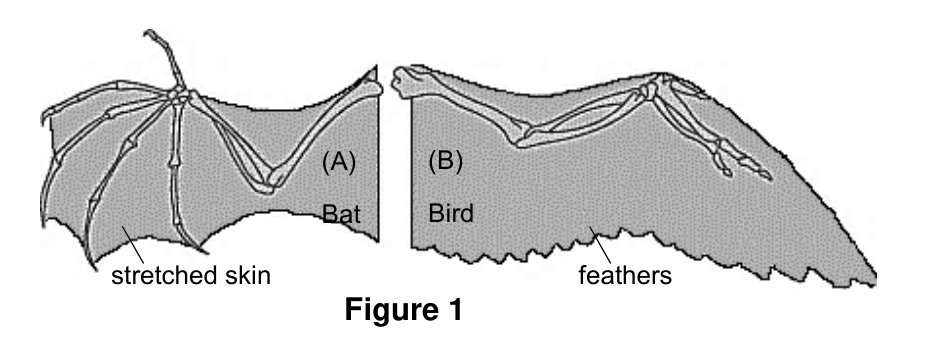
Both bats and birds are animals and have wings that enable them to fly. Figure 1 shows the wings of a bat (A) and a bird (B) with the bone structures supporting the wings. With reference to Figure 1, state two reasons why bats are not closely related to birds although they both have wings and can fly.
Question illustration

Question 2

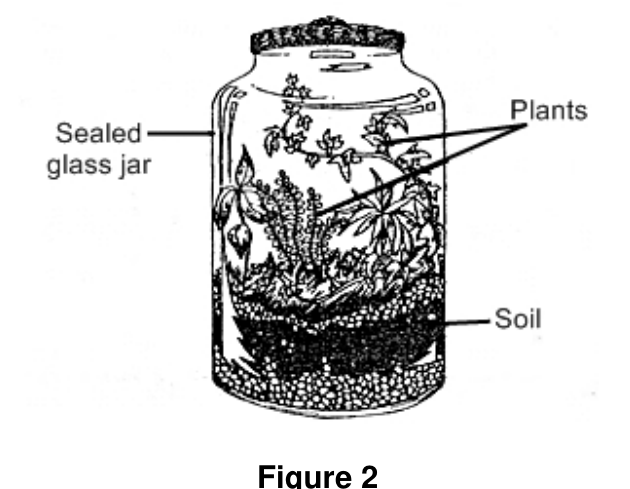
Figure 2 shows a terrarium. It is a sealed transparent container in which plants are grown.

(a) Explain why the terrarium container must be transparent for the plants to survive.

(b) Explain why the plants in a terrarium can live for a long time without water and air from the outside world?

Question illustration

Question 3

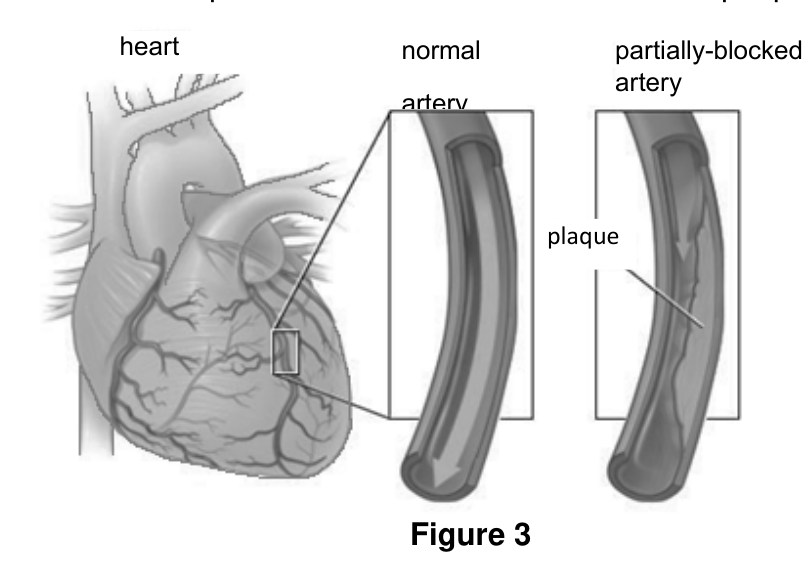
Figure 3 shows how the arteries around the heart can get blocked. Cholesterol builds up and hardens in the arteries to form plaque.

(a) How does plaque affect the flow of blood in an artery?

(b) When blood vessels supplying blood to the heart become totally blocked, what could happen to the heart?

(c) Why do doctors ask people who have partially-blocked arteries in the heart not to get angry easily?

Question illustration

Question 4

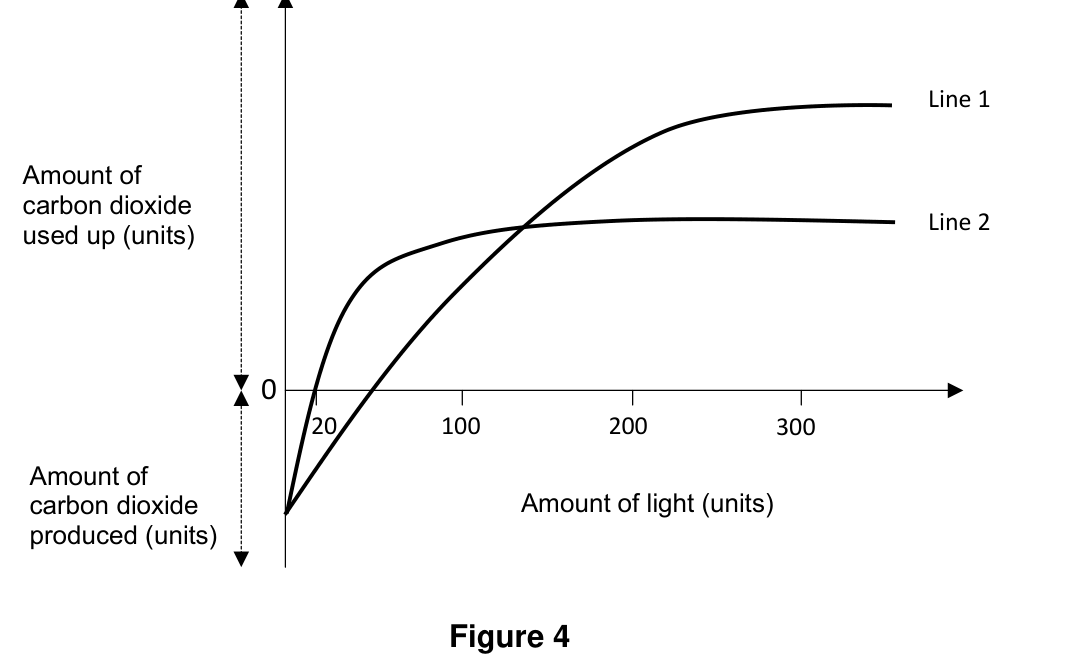
Figure 4 shows the amount of carbon dioxide used up or produced in two types of green plants, Plant A and Plant B. Plant A is adapted to make the most food under bright light while Plant B is adapted to make the most food under dim or low light conditions.

(a) What can you deduce about the rate of photosynthesis and respiration in the plants when line 1 and line 2 are below the horizontal axis?

(b) Which line on the graph represents Plant A? Explain using the graph.

(c) What two adaptations are most likely to be found in Plant B? Tick the correct options in the Answer Booklet: single layer of leaves; multiple layers of leaves; low density of chloroplasts; high density of chloroplasts.

Question illustration

Question 5

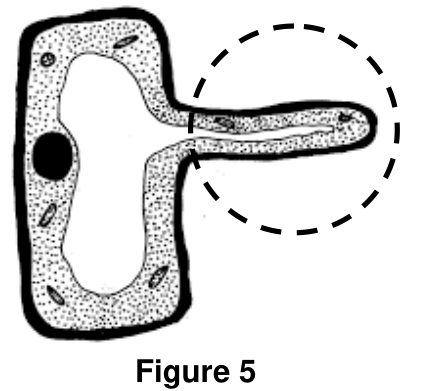
Figure 5 shows a root hair cell.

(a) How does the shape of the root hair cell in the circle help it to perform its function?

(b) Certain structures in the small intestine also have a similar adaptation as root hair cells. Identify one such structure.

(c) Mr X had part of his small intestine removed in a surgery to cure intestinal cancer. When he eats a pizza with tomato and cheese, how will this affect his digestion of the carbohydrates, proteins and fats in the pizza, and his absorption of food and water?

Question illustration

Question 6

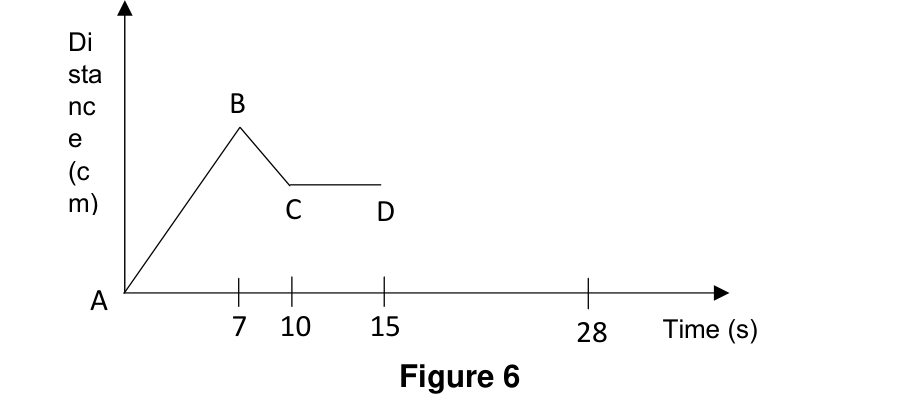
Figure 6 shows the movement of a toy car along a straight race track.

(a) Which section of the graph indicates that the object is: (i) at rest (stationary); (ii) moving backwards at a constant speed?

(b) After point D, the car moves forward and accelerates at a constant rate. Complete the graph in the Answer Booklet to show the movement of the car from 15 to 28 seconds.

Question illustration

Question 7

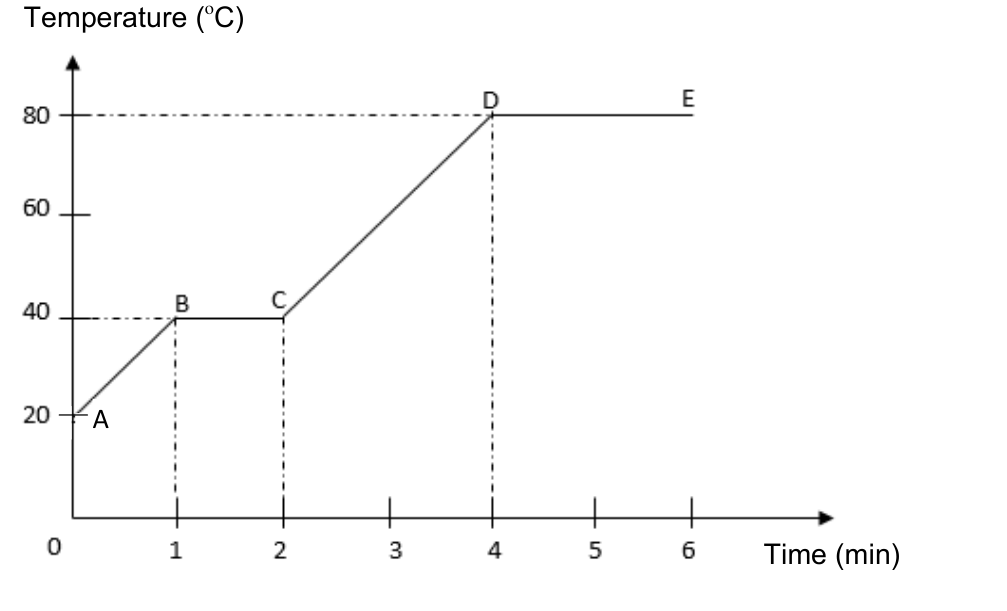
Figure 7 shows how the temperature of 10 g of wax changes as it is being heated with a constant heat source.

(a) Name the process occuring from point D to E.

(b) Explain why the time taken for BC is shorter than DE.

In a second experiment, the same heat source is used to heat 5 g of wax. The initial temperature of the wax is also 20°C.

(c) Sketch on the graph in the Answer Booklet, a line to show how the temperature of the wax changes with time in the second experiment. You may ignore heat loss to the surroundings.

Question illustration

Question 8

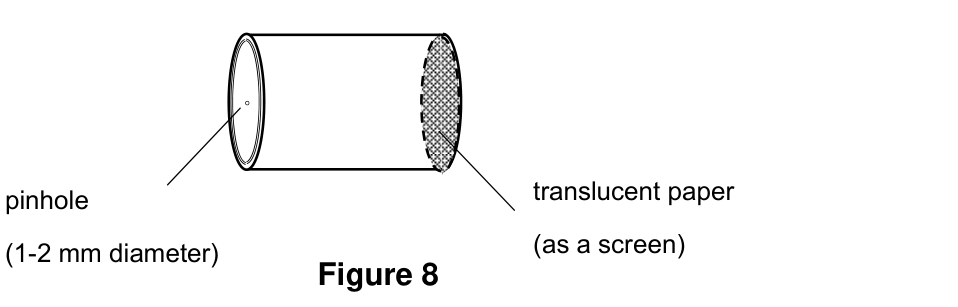
In the past, Italian painters used an instrument called a pinhole camera to trace the image of an object on paper. Sam made a simple pinhole camera as shown in Figure 8. Sam pointed the pinhole camera at a distant tree and observed that an image of the tree was formed on the translucent paper.

(a) On the figure in the Answer Booklet, draw two light rays from the tree to the screen to show how an image of the tree may be formed on the screen.

(b) State two properties of the image.

Question illustration

Question 9

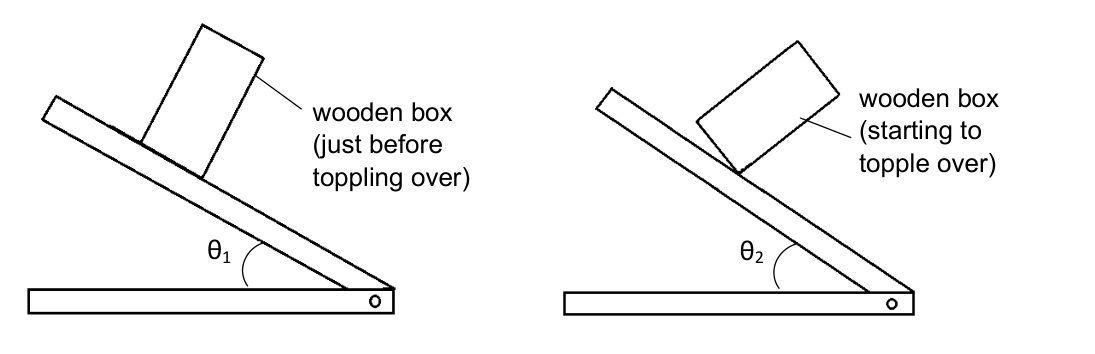
The ramp with a uniform wooden box is tilted and reaches a maximum angle of θ₁ (as shown in Figure 9(a)) before the box topples over at a slightly larger angle, θ₂ as shown in Figure 9(b).

(a) On the figure in the Answer Booklet, draw arrows to represent the forces acting on the box. Label your arrows with the names of the forces.

(b) Explain why the box in Figure 9(a) topples over if the angle of inclination θ₁ increases further.

(c) Explain why the box in Figure 9(a) will slide down the ramp when oil is spilled down from the top of the ramp.

Question illustration

Question 10

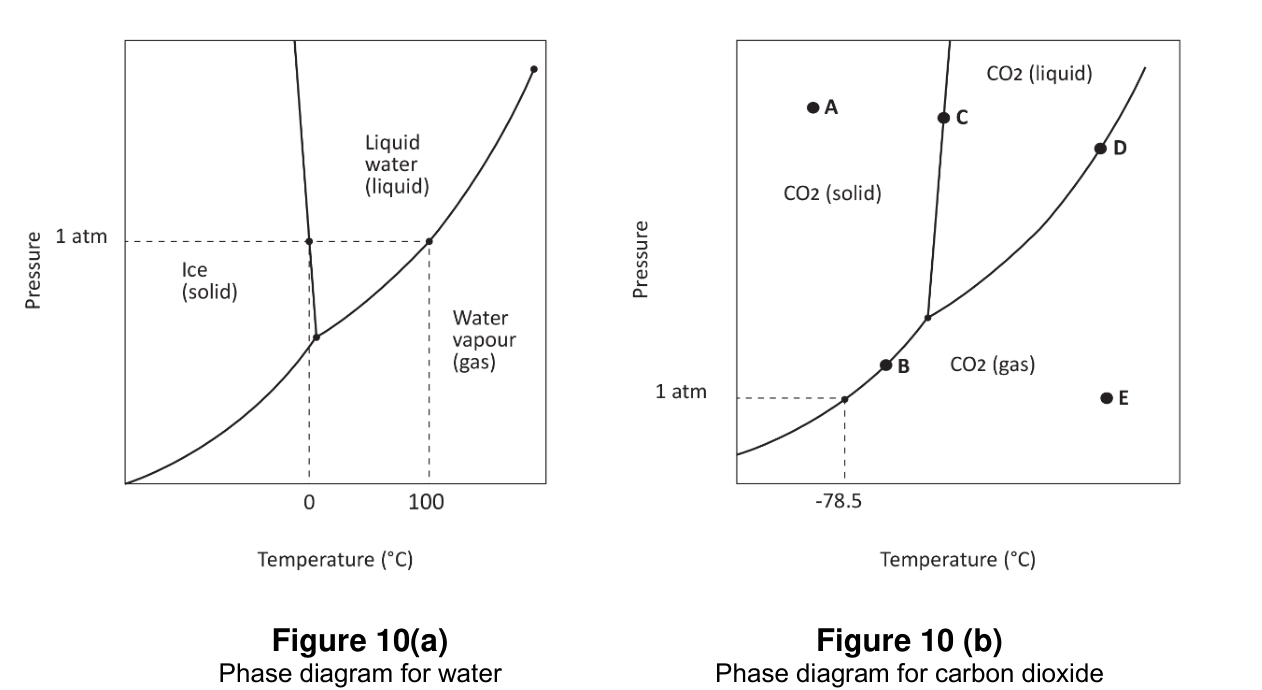
Under normal atmospheric pressure (i.e. 1 atm), water melts at 0°C and boils at 100°C. Unlike water, CO₂ (carbon dioxide) in its solid state does not melt under normal atmospheric pressure. It changes straight to its gaseous state at −78.5°C. The phase diagrams, Figures 10(a) and 10(b), show the states of water and carbon dioxide at various temperatures and pressures.

(a) Name the process in which ice changes directly into water vapour.

(b) What happens to the particles in the CO₂ when it changes from solid to gas?

(c) Which of the following points (A, B, C, D or E) in Figure 10(b) represents the condition that would allow CO₂ to change from solid to liquid state?

(d) Draw a line on the graph in the Answer Booklet to show how the temperature of CO₂ changes over time as it is heated at a constant rate from −90°C to 30°C at 1 atm. Label the states clearly.

Question illustration

Question 11

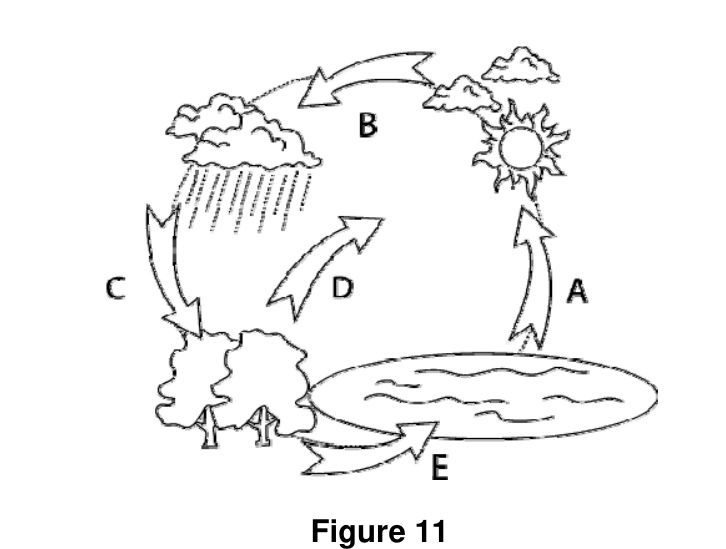
Figure 11 below shows the processes in the water cycle, labelled A through E.

(a) In which process in the water cycle, A, B, C, D or E, does (i) condensation and (ii) precipitation take place?

(b) What roles does the sun play in the water cycle?

(c) Which two processes in the water cycle, A, B, C, D or E, are affected by deforestation? Explain your answers.

(d) List two ways in which global warming affects the water cycle.

Question illustration