(2 points) A river is polluted due to a leakage of pesticides from a nearby agricultural area. Explain why tertiary consumers (such as kingfishers) that feed on secondary consumers (omnivorous fishes feeding on other smaller fishes and invertebrates) will accumulate higher concentration of pesticides compared to the secondary consumer!
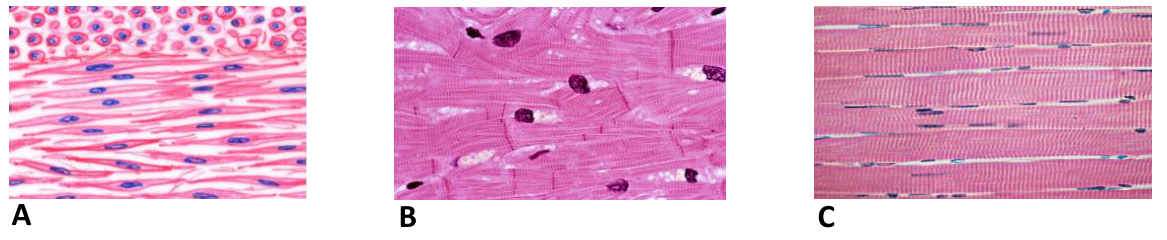
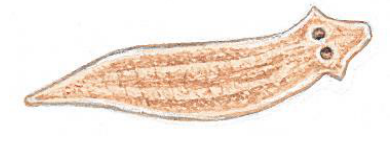
There are 3 main types of muscles which can be found in the human body. Explain the three kinds of muscles from the pictures above!
A. ______________________________________________________
B. ______________________________________________________
C. ______________________________________________________
(2.5 points) Fill in the blanks in the following table with the correct characteristics of muscles!
| ___________ Muscle Cells | ___________ Muscle Cells | Cardiac Muscle Cells |
| --- | --- | --- |
| _______________________ | Not Striated: Fewer myofibrils of varying lengths | _______________________ |
| Under control of nervous system | _______________________ | Under control of nervous and endocrine systems and various chemicals |
| _______________________ | _______________________ | Doesn’t fatigue |
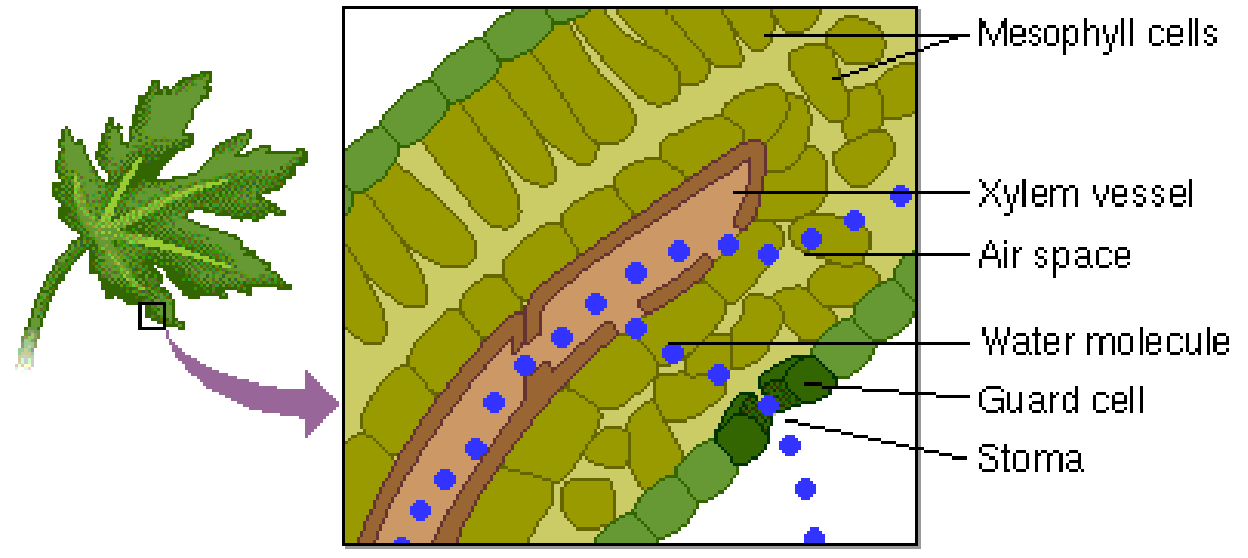
A. There are hundreds of stomata in the epidermis of a leaf. These stomata have a role in plant transpiration. Each stoma allows the carbon dioxide necessary for photosynthesis to enter, while water evaporates through each one in transpiration. Explain why most of the stomata are located in the lower epidermis!
B. Mention and explain the various conditions in a plant’s environment that affect the high rate of transpiration!
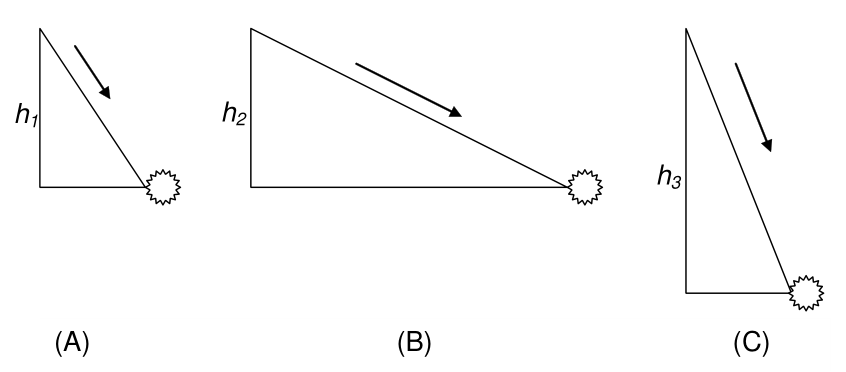
(2.5 points) A waterfall is flown through a big pipe to rotate an electric turbine. The pipe was put on an inclined plane, and at the bottom of pipe, the electric turbine was placed, as shown in the pictures below. According to the pictures, $h_1=h_2<h_3$ ($h$= height)
A. Determine which turbine that has the biggest velocity of rotation!
(3 points) It is well known that intensity of sound is proportional to minus square of the distance or $(I\approx1/r^2)$. Sound intensity at radius $r=40$ m is 9 Watt/m². Calculate the intensity of sound at the distance of 60 m!
(3 points) A fish is being yanked vertically out of the water using a fishing line that breaks when the tension reaches 180 N. The string snaps when the acceleration of the fish is observed to be at 8 m/s². What is the mass of the fish? ($g=10$ m/s²)
(5 points) There are two forces that act on a rest block of mass of 2 kg. The block is put on frictionless floor. The forces of 75 N act rightward and 45 N act leftward.
A. How many forces act on the block?
B. Calculate the acceleration of the block!
C. Calculate the block’s velocity 10 seconds after the forces act?
(4 points) Each time the heart beats, changes in electrical potential occur on its surface that can be detected using metal contacts, which are attached to the skin.
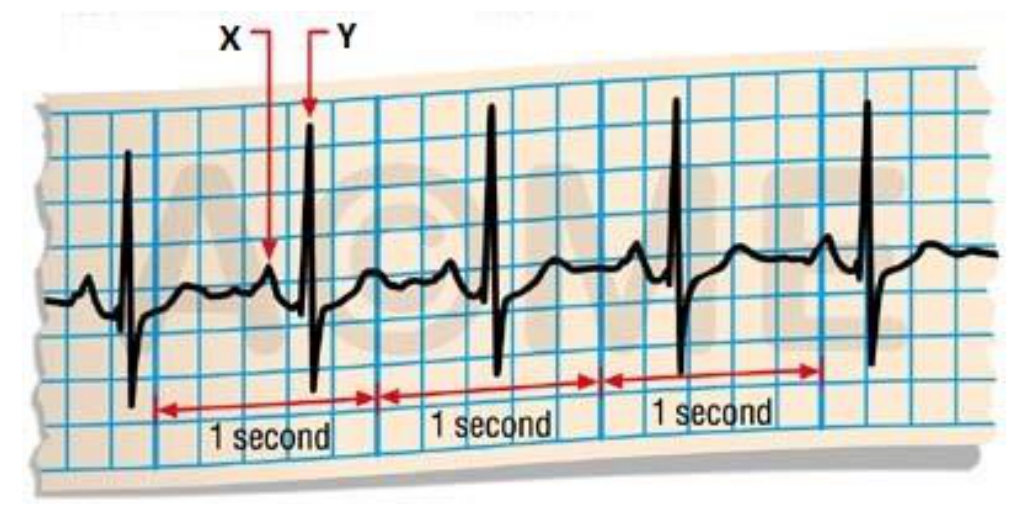
The changes in potential are small, on the order of milivolts (mV) and must be amplified. The record of the potential changes for a given person’s heart is called an electrocardiogram (EKG or ECG) see a diagram belows. Just before the contraction of heart muscles, changes occur in the cell wall so that positive ions on the exterior of the cell are able to pass through the wall and neutralize those on the inside, or even make the inside surface slighty positive campared to the exterior. This depolarization, starts at one end of the cell and progresses toward the opposite end, until the whole muscle is depolarized. The muscle then slowly repolarizes to its original state. This whole process requires less than a second.
A. The equal but opposite charges on the two sides of a cell wall can be considered as a set of _________________
B. The metal contacts that are used to detect electrical potential changes are called as________________________________
C. What are X and Y marker in the EKG responding to the heart activities?______________________________
D. According to the diagram, how many beat per minute does the heart activity?_________________________________
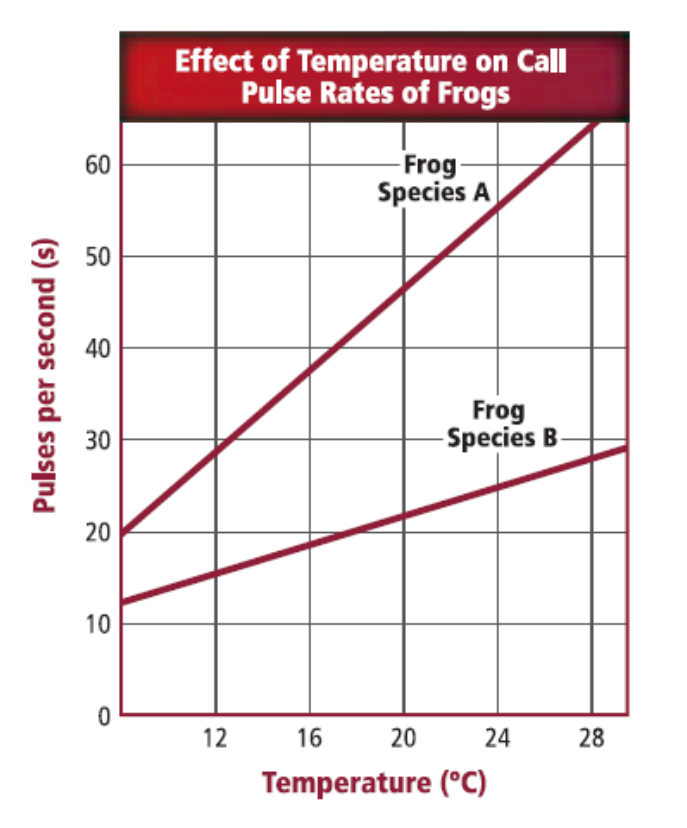
(4 points) Male tree frogs make call that female can identify easily based on the rate of the sound pulses in the call. Figure below shows number of pulses per second from different species and environmental temperature.
A. What is correlation between number of pulses and temperature?_______________________________
B. Why is it important that the two species of frogs do not have the same number of pulses at the same temperature? _________________________
C. In night time a sound like frog pulses can be heard more far away rather than at day time. Explain why it be happened!_____________________________
D. Environmental temperature associated with body temperature of frog. What group of animal that has the phenomenon?___________________________