Section B: answer in the spaces provided. Printed total 40 marks and 50 minutes are confirmed by the supplied key. Four points per parent question and subpart allocations are editorial; no individual scores are printed.
Fluid pressure causes a force on each surface of an immersed object. The pressure on the lower surface is greater than on the upper surface, so the upward force on the bottom exceeds the downward force on the top. The net upward force is the ______ force.
Section B: answer in the spaces provided. Printed total 40 marks and 50 minutes are confirmed by the supplied key. Four points per parent question and subpart allocations are editorial; no individual scores are printed.
When exactly 1 cup of sugar is dissolved in exactly 1 cup of water, does exactly 2 cups of solution result? Explain.
Section B: answer in the spaces provided. Printed total 40 marks and 50 minutes are confirmed by the supplied key. Four points per parent question and subpart allocations are editorial; no individual scores are printed.
Section B: answer in the spaces provided. Printed total 40 marks and 50 minutes are confirmed by the supplied key. Four points per parent question and subpart allocations are editorial; no individual scores are printed.
As a result of photosynthesis, green plants use sunlight energy to convert ______ into ______.
Section B: answer in the spaces provided. Printed total 40 marks and 50 minutes are confirmed by the supplied key. Four points per parent question and subpart allocations are editorial; no individual scores are printed.
(1) Tamara sorted organisms into two groups using one physical characteristic. What characteristic was most likely used? Hints: number of legs; body size; foot shape; type of body covering.
| Group 1 | Group 2 |
|---|---|
| alligator | bat |
| goldfish | deer |
| snake | mouse |
| tuna | rabbit |
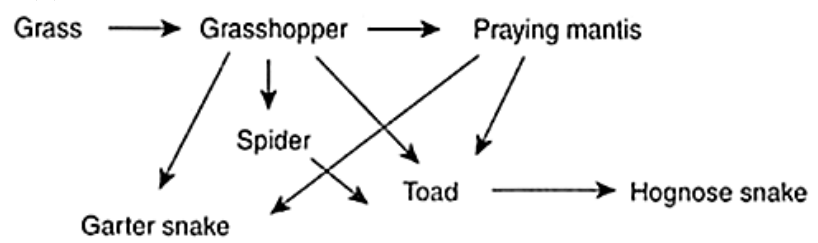
(2) Look at the original food web. Which organism will immediately decrease in population if grasshopper is removed?
Section B: answer in the spaces provided. Printed total 40 marks and 50 minutes are confirmed by the supplied key. Four points per parent question and subpart allocations are editorial; no individual scores are printed.
Mark put soil in a glass jar, added water, covered it and left it on a table for several weeks. A green substance grew on the jar wall. He wrote, “The soil may contain some algae.” Under a microscope he found microorganisms with chloroplasts. Comparing their shapes with book pictures, he found some were Chlorella.
Use these keywords: generalization; method; calculation; hypothesis; conclusion; observation.
(a) “The soil may contain some algae” is a ______.
(b) Examining the green substance under a microscope and finding organisms with chloroplasts is ______.
(c) Identifying some organisms as Chlorella is a ______.
Section B: answer in the spaces provided. Printed total 40 marks and 50 minutes are confirmed by the supplied key. Four points per parent question and subpart allocations are editorial; no individual scores are printed.
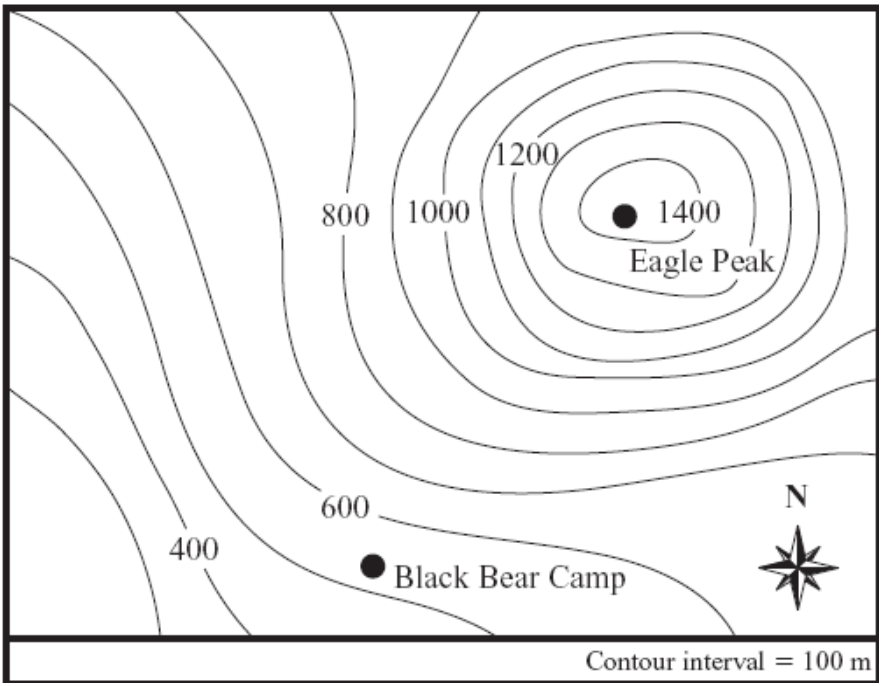
Use the contour map to estimate the elevation difference between Black Bear Camp and Eagle Peak. The source says “which of the following” but supplies no answer choices.
Section B: answer in the spaces provided. Printed total 40 marks and 50 minutes are confirmed by the supplied key. Four points per parent question and subpart allocations are editorial; no individual scores are printed.
In what two ways does vascular tissue help seed plants live on land? First way: ______. Second way: ______.
Section B: answer in the spaces provided. Printed total 40 marks and 50 minutes are confirmed by the supplied key. Four points per parent question and subpart allocations are editorial; no individual scores are printed.
List the levels of organization in the human body, starting with the smallest unit. (a) ____ (b) ____ (c) ____ (d) ____.
Section B: answer in the spaces provided. Printed total 40 marks and 50 minutes are confirmed by the supplied key. Four points per parent question and subpart allocations are editorial; no individual scores are printed.
Match each function to a flower part.
| Function | Flower parts |
|---|---|
| 1. Male reproductive parts | a. petals |
| 2. Protect the developing flower | b. sepals |
| 3. Female reproductive parts | c. stamens |
| 4. Colorful structures that attract insects | d. pistils |