IMSO 2008 Science International - Theory II Next → When we use a towel to dry something, the most significant phenomenon involved is …?
Adhesion
Evaporation
Absorption
Cohesion
Transpiration
Which one of the following statements is true for a rainbow?
From the list below, which pair of plant and animal parts is most alike in function?
Flower and hair
Leaf and ear
Phloem and blood vessel
Xylem and liver
Seed and head
If a hibiscus plant is pollinated by an orchid, what is most likely to happen?
The offspring will look like an orchid.
The offspring will look like a hibiscus.
No offspring will be produced.
The offspring will die.
The offspring will look like both flowers.
If we travel in a plane at the same speed as the rotation of the Earth, in which direction should we fly so that we feel time “stop”?
From north to south
From west to east
From east to west
From south to north
Along the equator
In bungee jumping, which component of the equipment absorbs energy?
The helmet has great air resistance, so it produces great friction.
The jacket is very light and produces an Archimedes upward force in air.
The cord behaves like a spring and stores potential energy.
The safety harness must be set so that it slows down the jumper.
The shoes behave like a spring so that the jumper’s feet remain clean.
How can an acrobat walk on a narrow tightrope using a balancing pole?
The acrobat can reduce the gravitational force.
The balancing pole can “hold” the air to support the acrobat.
The balancing pole helps the acrobat set the centre of mass on the string.
The balancing pole can levitate the acrobat.
The soles of the acrobat’s shoes are sticky.
We smell something because the source of the smell …
Radiates its presence through the air and we catch the signal.
Evaporates some smell in gas form and our nose detects it.
Sends an electromagnetic signal to our brain, which tells our nose to pretend a smell is present.
Creates a kind of noise.
Sends an ultrasonic wave to our nose.
Linda wants to investigate whether pumpkin seeds grow better in light or darkness. You could suggest that she put the seeds on pieces of …
In the hydrological cycle, which sequence is correct?
Condensation of water vapour in clouds, then evaporation from the ocean, then precipitation as rain.
Precipitation as rain, then condensation of water vapour in clouds, then evaporation from the ocean.
Evaporation from the ocean, then condensation of water vapour in clouds, then precipitation as rain.
Evaporation from the ocean, then precipitation as rain, then condensation of water vapour in clouds.
Condensation of water vapour in rain, then precipitation in clouds, then evaporation from the ocean.
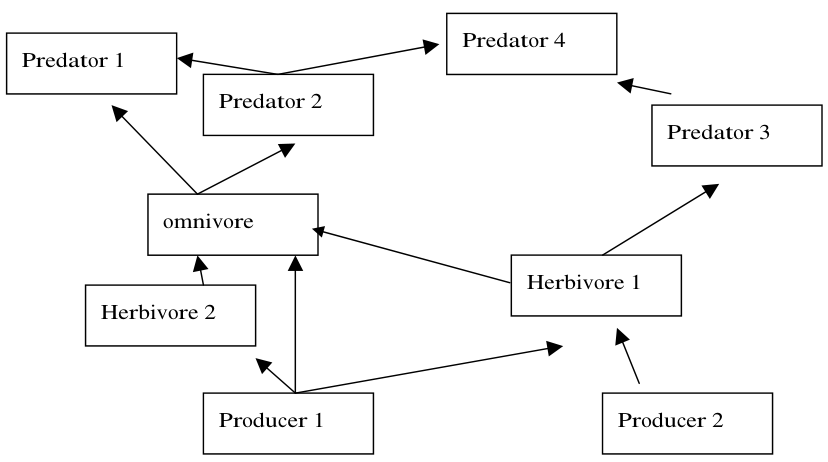
Analyse the diagram. If the population of predator 3 severely decreases because of a disease, which statement is most likely to occur immediately?
Labels: Predator 1–4; omnivore; Herbivore 1–2; Producer 1–2.
Herbivore 2 will increase in number.
Predator 1 will increase in number.
Herbivore 1 will decrease in number.
Producer 2 will decrease in number.
The omnivore will increase in number.
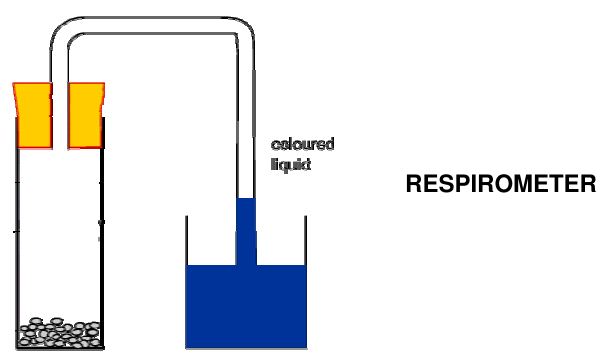
Ahmad investigates the respiration rate of 35 grams of bean sprouts using a respirometer with coloured liquid. The table shows his observations.
Figure labels: coloured liquid; RESPIROMETER.
| No. | Observation time (minutes) | Displacement of coloured liquid (ml) | Mean respiration rate (ml/minute) |
|---|---|---|---|
| 0 | 0 | 0 | |
| 1 | 5 | 1.5 | |
| 2 | 10 | 3 | 1.5 ml/5 minutes |
| 3 | 15 | 4.5 | |
| 4 | 20 | 6 | |
A. Predict the displacement of coloured liquid at the 25th minute. (1 point)
a) 6.5
b) 7
c) 7.5
d) 8
e) 8.5
B. Using the data above, draw a line graph of displacement against time. (2 points)
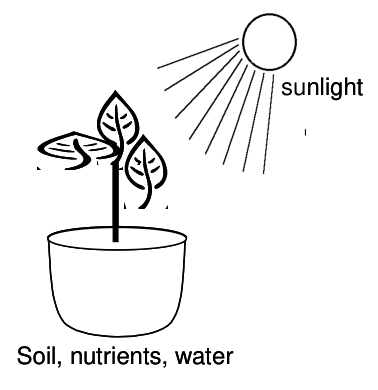
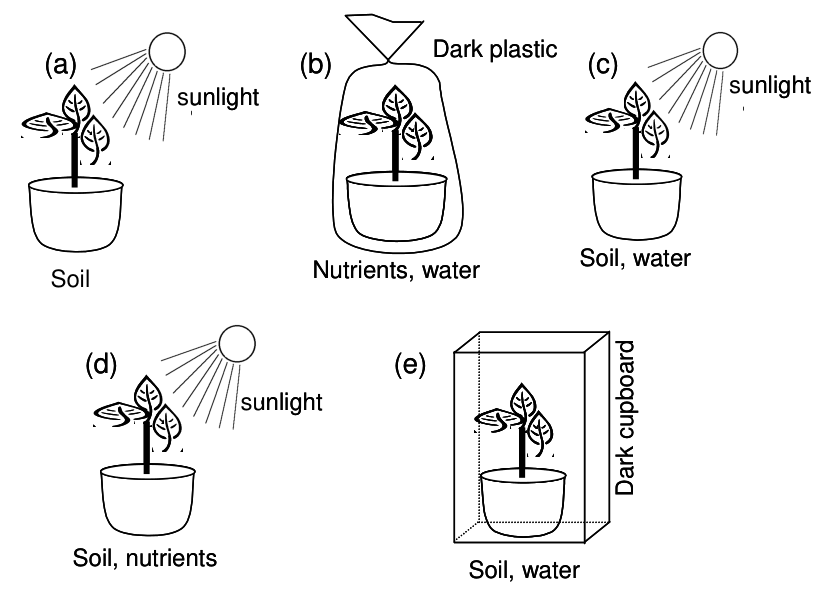
Fany wants to show that plants need nutrients in the soil for healthy growth. She uses two pots of plants. One pot is set up as shown. Which ONE of the following should she use for the second pot?
First-pot labels: sunlight; soil, nutrients, water.
Sunlight; soil.
Dark plastic cover; nutrients, water.
Sunlight; soil, water.
Sunlight; soil, nutrients.
Dark cupboard; soil, water.
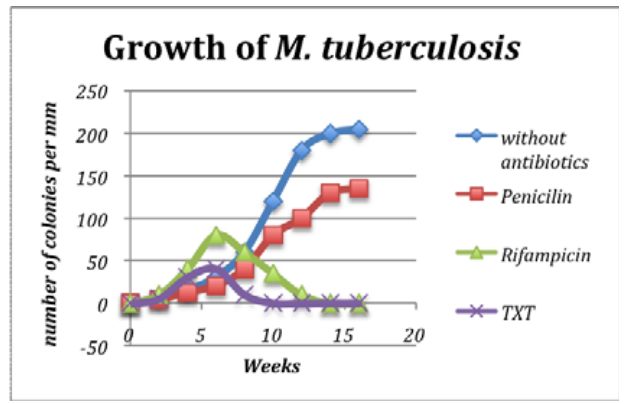
The graph represents the growth of Mycobacterium tuberculosis in different media containing particular antibiotics.
Graph labels: Growth of M. tuberculosis; number of colonies per mm; Weeks; without antibiotics; Penicillin; Rifampicin; TXT.
a) Write down the most potent antibiotic against Mycobacterium tuberculosis to be used in humans. (2 points)
b) For at least how many weeks should rifampicin be used to treat Mycobacterium tuberculosis effectively? (2 points)
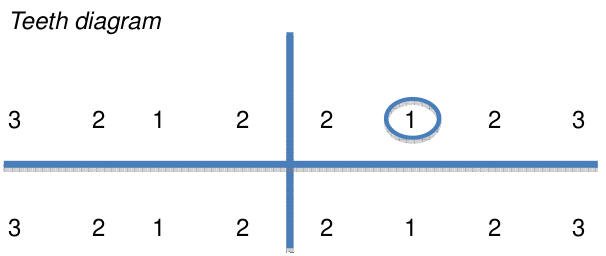
The diagram shows the arrangement of your teeth. The dentist has circled a tooth with a cavity. Write down its type.
Label: Teeth diagram.
Smoking is not acceptable because cigarettes contain toxins. List three risks for a person who smokes.
During the first few weeks, a corn seedling uses its cotyledon to supply nutrients for growth before the root can absorb water and nutrients from the ground. Which part of a fertilised chicken egg has a similar function to the cotyledon?
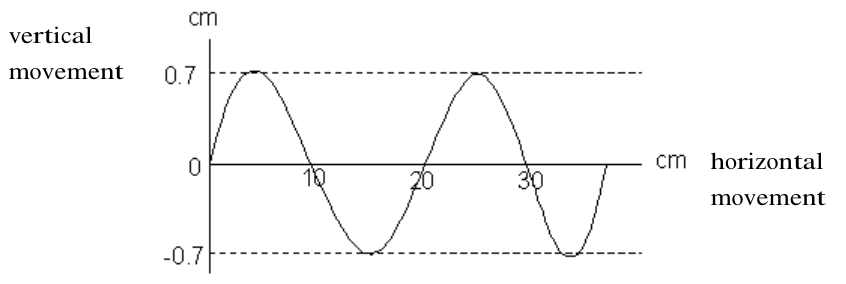
The diagram shows the outline of a wave on the water surface.
Labels: vertical movement (cm); horizontal movement (cm).
a) Determine the wavelength. (1 point)
b) Determine the amplitude. (1 point)
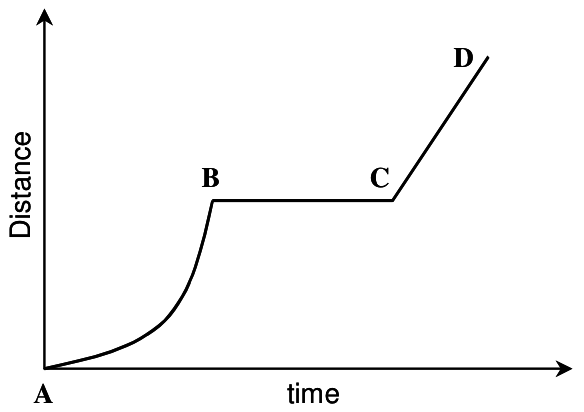
Look at the distance–time graph. Which section indicates that the object is:
Graph labels: Distance; time; A, B, C, D.
a) Moving with constant speed? (1 point)
b) At rest? (1 point)
The melting and boiling points of six substances, A–F, are listed below.
Next →