Randy collected soil and put it into a glass jar. He added some water, covered it and left it on the table for a few weeks. He noticed that green substance has grown on the wall of the jar. He then wrote, “The soil may contain some algae.” Then he placed the green substance under a microscope. He found some microorganisms with chloroplasts. Finally, he compared the shape of the organism with a picture in the book. He found out that some of the organisms are called Chlorella.
Use the following keywords to answer the questions: a generalization; a hypothesis; a conclusion; an observation.
a. “The soil may contain some algae.” This statement is best described as … (Score: 1)
b. Then he placed the green substance under a microscope. He found some microorganisms with chloroplasts. This activity is called … (Score: 1)
c. He found out that some of the organisms are called Chlorella. This statement is best described as … (Score: 1)
Explain why crocodile is classified as a reptile and orangutan is a mammal. Write your explanation based on the differences in their methods of reproduction. (Score: 2)
Explain how the oxygen is transported throughout our body. Your explanation must include the kind of blood cell responsible for this process and how the lungs function in this process. (Score: 2)
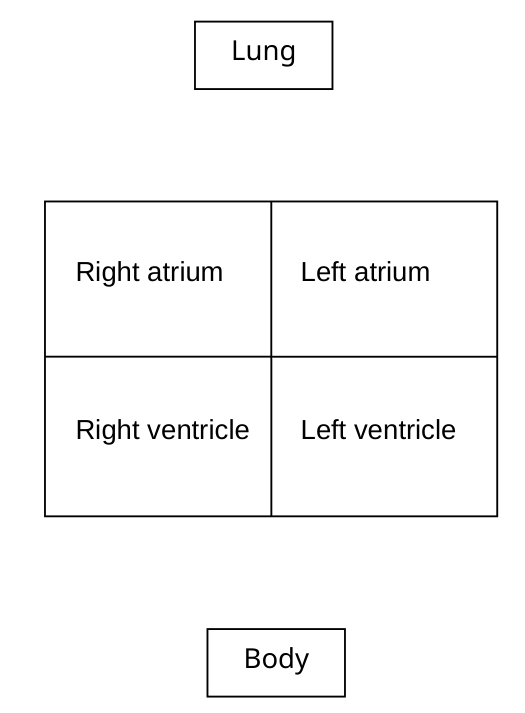
Draw arrows in the diagram showing the pathway of this circulation process. (Score: 2)
Most animals can move to avoid disasters such as forest burning but the plants can not. Explain the plants strategies to avoid such disaster based on plant reproduction system. (Score: 3)
The avian influenza or bird flu is a very dangerous disease that can be transmitted from animals such as chicken and pig to human. What do you think people should do if one area is found to be infected by such disease? (Score: 2)
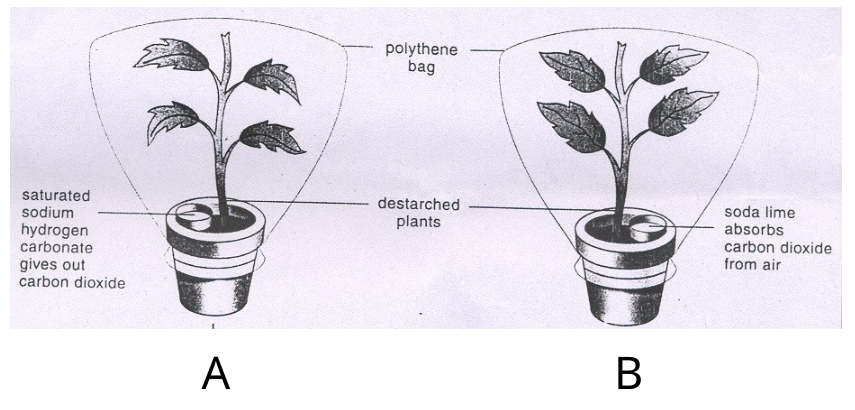
Suppose you have two similar plants, each of them is placed into large closed transparent bottles under the sun. Gas supplied in bottle A is only carbon dioxide while in bottle B is only oxygen.
a. Which plant may survive if other environmental factors are controlled? (Score: 1)
b. Which plant will produce less carbohydrate? Explain your answer. (Score: 2)
c. If both bottles are placed in complete darkness, which plant cannot respire? Explain your answer. (Score: 2)
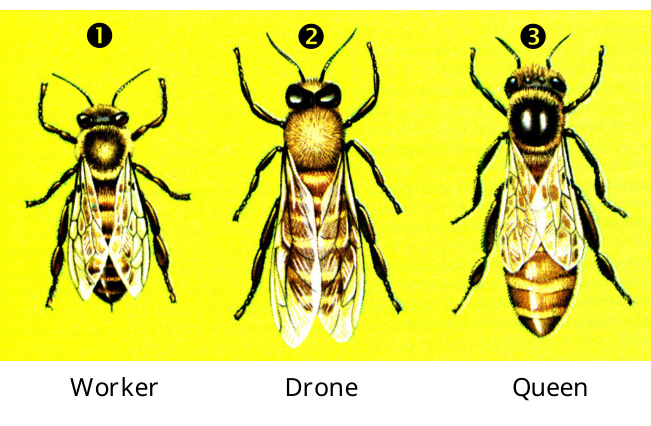
Look at the following picture. Study the individual characteristic in population of the honey bees (Apis indica), according to the illustration above. Check the correct answer by putting the tick (√). (Score: 5)
1: Worker; 2: Drone; 3: Queen.
| Characteristic | 1 | 2 | 3 |
| --- | --- | --- | --- |
| Which one is a fertile male? | □ | □ | □ |
| Which one is a reproductive female? | □ | □ | □ |
| Which one is honey collector from flowers? | □ | □ | □ |
| Which one keeps staying in the nest? | □ | □ | □ |
| Which one lays eggs? | □ | □ | □ |
Transpiration is influenced by weather factors. One of the factors is humidity. Compare the rate of transpiration in plants during the dry and wet seasons. Explain your answer. (Score: 2)
In some countries, people separate their wastes into different categories. So that the waste can be recycled, reused or decomposed. This type of waste management can give some advantages to our community. Write three advantages of waste management. (Score: 3)
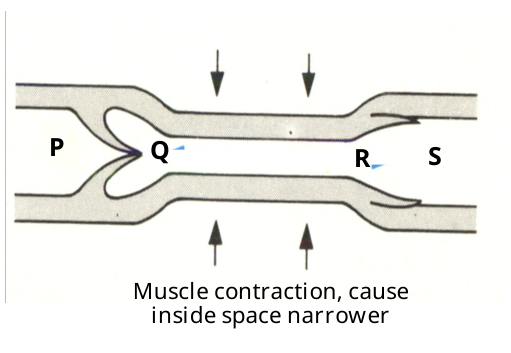
The figure below is a blood vessel diagram. In addition to the heart pumping, the blood flow is also caused by a rhythmic contraction of blood vessel muscle.
When the muscle contracts, which part of blood vessel will undergo a pressure changing? (Score: 5)
Suppose you are provided with five different irregular shaped stones, which are collected from different parts of the world. You are asked to design an experiment to estimate the mass of the earth. Firstly, you have to measure the density of each stone.
a. List the apparatus and materials that you need to conduct this experiment. (Score: 1)
b. Explain the function of each apparatus and material that you use in the experiment. (Score: 2)
c. Describe how you would conduct the experiment. (Score: 2.5)
d. Describe how to calculate the average density of the stones. (Score: 2)
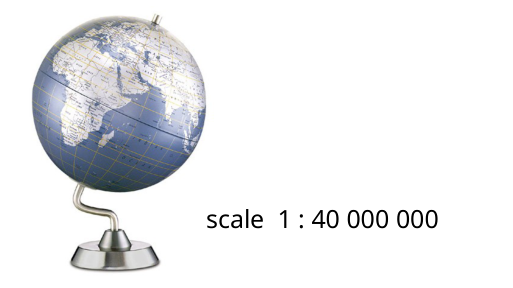
e. If it is assumed that the average density of the stones equals to density of the earth, we can estimate the mass of the earth. If you are given a globe (model of the earth) with the circumference of 1 m, describe how you estimate the mass of the earth. (Score: 3)
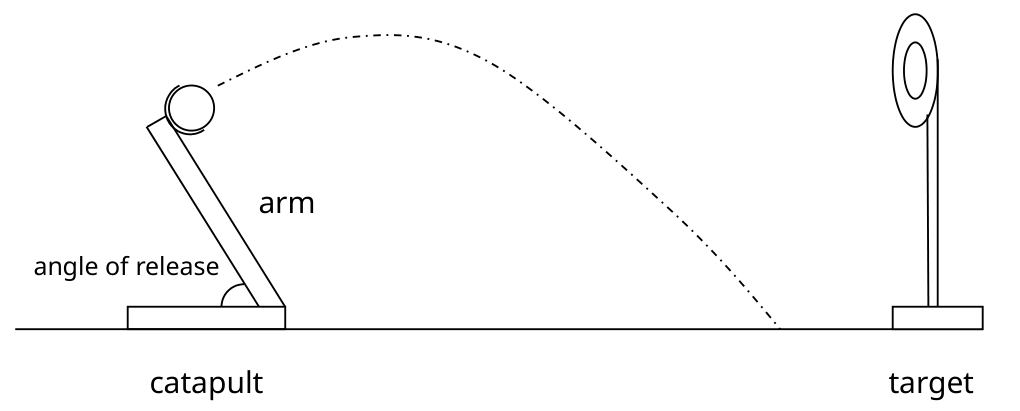
Benny made a catapult as shown in the diagram below. He launched a ball to hit the target placed at a certain distance away but he failed to do so. The dotted line shows the path of the ball. The position of the target is fixed.
What should he do to increase his chance of hitting the target for his second launch? (Score: 1)
You have two cubes made of the same material. One is a 56 g solid cube with the side length of 2 cm and the other is a 700 g cube with side length of 10 cm and has empty space inside.
a. Calculate the density of the material of the cube. (Score: 1)
b. Calculate the volume of the empty space inside the cube. (Score: 2)
c. Does the 700 g cube sink or float in the water? Explain your answer. (Score: 2)
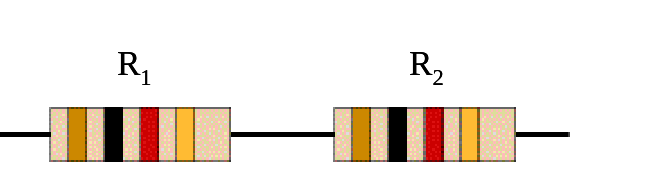
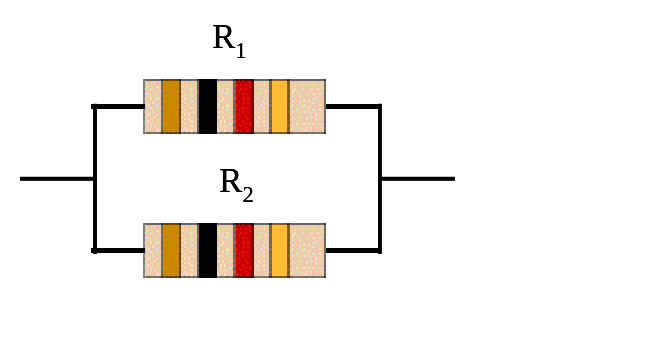
Look at the following figures. If two resistors, $R_1$ and $R_2$, are connected in series, the total resistance is given by $R_s=R_1+R_2$.
However, if these two resistances are connected in parallel, the total resistance satisfies $R_p=R_1R_2/(R_1+R_2)$.
A teacher gives you three resistors, $R_1=R_2=R_3=30$ ohm. You are asked to arrange these resistors into all possible arrangements. Draw all arrangements and calculate their corresponding total resistances. (Score: 6)
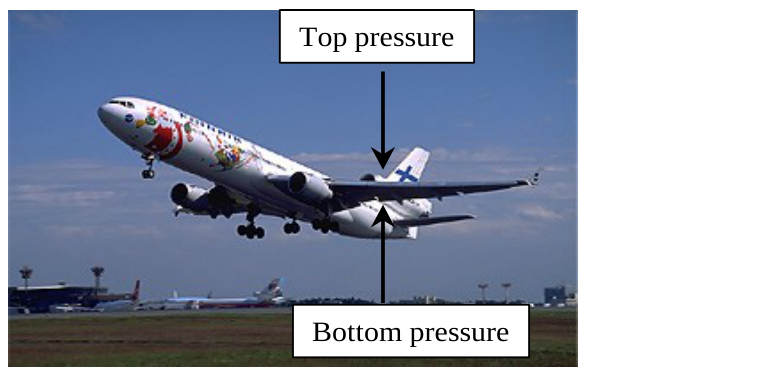
Levitation force acting on a plane is a result of the presence of the difference in pressure between the bottom and the top sides of the wings. The difference in pressure increases when the speed of the plane increases. Explain why during take off and landing, a pilot opens the wing area as wide as possible, while during cruising, the area of the wings is reduced as much as possible. (Score: 2)
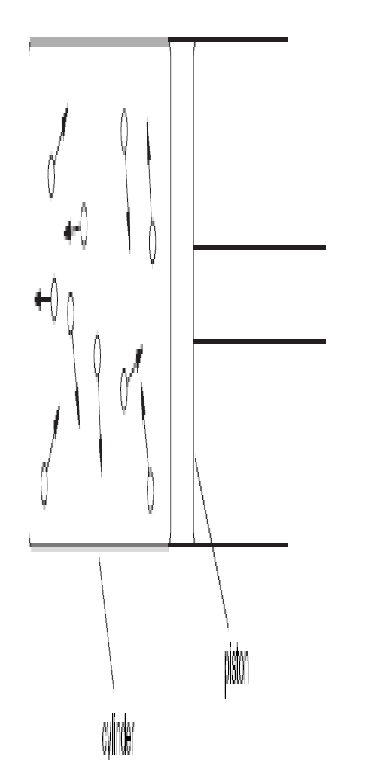
The picture below shows a way of indicating the position and direction of movement of some molecules in a gas at one instant. As the cylinder is heated, the piston will be pushed upwards.
Describe how you would use this behavior to set up an apparatus to measure temperature. (Score: 4)