Skip to content / Đến nội dung
ThichHocToan.com

IMSO 2005 Science International — Experiment

Question 1

Experiment 1 (15 points)

Observe the aquarium in front of you carefully. Answer the questions based on your observation.


**1.** Which of the following statements is true of the aquarium?


**a.** Fresh water ecosystem


**b.** Fresh water community


**c.** Fresh water population


**d.** Terrestrial ecosystem


**e.** Terrestrial community


**f.** Terrestrial population


**2.** This aquarium is …


**a.** A natural ecosystem


**b.** An artificial ecosystem


**c.** A natural community


**d.** An artificial community


**3.** How many populations can you find in this aquarium?


**a.** One


**b.** Three


**c.** Five


**d.** Seven


**e.** Nine


**f.** Fifteen


**4.** State the biotic and abiotic factors that support life in this aquarium.


**a.** Abiotics: …


**b.** Biotics: …


**5.** Write down two advantages of having the plants in the aquarium.


**6.** What will happen to the following if the aquarium is moved to the dark room for a month?


**a.** plants: …


**b.** fishes: …


**c.** water: …


**7.** If all of the fishes are herbivorous what will happen to biotic components of the aquarium?
Question 2

Experiment 2 — Distance of Planet (20 points)

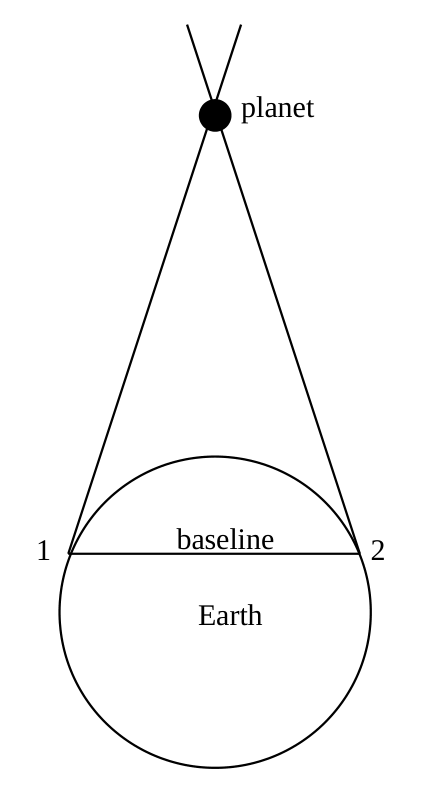
Basic concept: The small shift in the observed position of a planet when viewed from two separated sites, positions 1 and 2, can be used to calculate the distance of the planet from Earth.

Purpose: To determine distance of planet.

Materials: Telescope; scale; artificial planets (Mars, Jupiter, Saturn). Planet Mars, Jupiter and Saturn are located at certain distances from you.

Procedure — For observing Mars:


**1.** Stand at a fixed distance on position 1.


**2.** Using the telescope, look at planet Mars, and then adjust the focus of the telescope to obtain a sharp image of Mars. Adjust the telescope such that the image is at the center of your view. Without moving the telescope, write down the scale.


**3.** Move to position 2.


**4.** Repeat step 2.

For observing Jupiter and Saturn:


**5.** Repeat steps 1 to 4 for Jupiter and Saturn.

Results:

| Planet | Scale viewed from position 1 | Scale viewed from position 2 | Scale difference |
| --- | --- | --- | --- |
| Planet Mars | … | … | … |
| Planet Jupiter | … | … | … |
| Planet Saturn | … | … | … |

Write your conclusion(s).

Question illustration

Question 3

Experiment 3 — Refractive Index of Fluids (30 points)

Basic concept — Snell's law: The quantitative law of refraction, called Snell's law, was first worked out in 1621 by W. Snell, a Dutch astronomer and mathematician. The law can be expressed as

$$n_1\frac{B}{R_1}=n_2\frac{D}{R_2}.$$

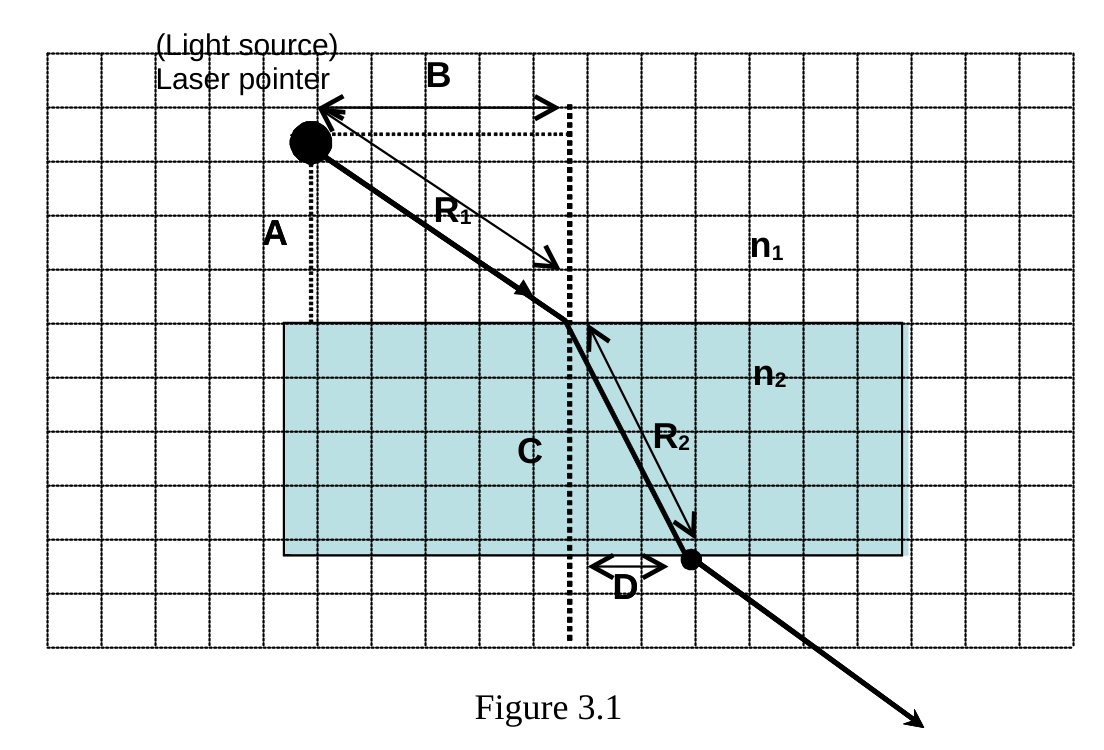
Here $n_1$ and $n_2$ are the indices of refraction of the incident and refracting media, respectively, while $R_1$ and $R_2$ are the paths of the incident and refracted light, respectively. $B$ and $D$ can be seen in Figure 3.1. The source also writes $n=BR_2/(DR_1)$.

Purpose: To determine refractive indices of fluids. The refractive index affects the speed of light in a material.

Materials: Fluids — water, Telon Oil, Yellow Palm Oil.

Devices: Laser pointer; ruler; plastic box; sheets of paper; graph paper.

Procedure:


**1.** Place the plastic box on the graph paper (see Figure 3.1).


**2.** Fill the plastic box with water.


**3.** Fix the position of the pointer and then direct the laser into the fluid in the plastic box. Measure $B$ and $R_1$, then measure $D$ and $R_2$. Write down the measurements in the table below.


**4.** Once finished, empty the plastic box, then clean it using wet tissue.


**5.** Repeat steps 1, 2, 3 for the other fluids.


**6.** Calculate the relative refractive indices using the equation shown in the table.

| No. | Type of fluid | $B$ (mm) | $R_1$ (mm) | $D$ (mm) | $R_2$ (mm) | Relative index $n_2/n_1=BR_2/(DR_1)$ |
| --- | --- | --- | --- | --- | --- | --- |
| 1 | Water | … | … | … | … | … |
| 2 | Telon Oil | … | … | … | … | … |
| 3 | Yellow Palm Oil | … | … | … | … | … |

Answer the following questions:


**1.** The refractive index of air is $n_1$, which equals 1. From your results, is there any refractive index less than the refractive index of air?


**2.** Based on your experiment, which fluid has the highest refractive index?

Question illustration

Question 4

Experiment 4 — Alternative way to measure the density of liquid (35 points)

In this experiment you will measure density of water containing dissolved sugar at various concentrations without using laboratory instruments.

Apparatus: (1) A drinking glass; (2) a small plastic bottle; (3) a ruler; (4) a spoon; (5) three sachets of sugar; (6) drinking water; (7) graph paper.

Procedures

A) Measuring the mass of a filled plastic bottle


**1.** Measure the inner diameter of the glass. Note it as $D$ (in cm). $D=\ldots$


**2.** Fill the plastic bottle with a small amount of drinking water (approximately $1/5$ of its volume), and then close tightly.


**3.** Pour drinking water in the glass until the water level reaches around half of the glass.


**4.** Measure the height of the water level in the glass using a ruler. Note it as $H_1$ (in cm). $H_1=\ldots$


**5.** Place gently the plastic bottle into the glass containing water and measure the height of the water level in the glass. Note it as $H_2$ (in cm). $H_2=\ldots$


**6.** Calculate the volume of water displaced by the plastic bottle. Answer: …


**7.** Calculate the mass of water displaced by the plastic bottle using the density of pure water of 1 g/cm³. The mass of the filled plastic bottle is equal to the mass of the displaced water. Answer: …

B) Measuring the density of water containing dissolved sugar at various concentrations


**8.** Take out the plastic bottle from the glass.


**9.** Pour one sachet of sugar into the glass containing water and stir until the sugar dissolves completely.


**10.** Repeat steps 4 to 6.


**11.** The mass of displaced liquid is equal to the mass of the filled plastic bottle. Then calculate the density of liquid ($P_1$) using the following formula:

$$P_1=\frac{\text{mass of the bottle}}{\text{volume of displaced liquid}}=\ldots$$


**12.** Increase the concentration of the sugar solution by adding the second sachet of sugar and repeat steps 8 to 11.


**13.** Continue to increase the concentration of the sugar solution by adding the last sachet of sugar and repeat steps 8 to 11.


**14.** Fill the following table:

| Sachets of sugar | Density of liquid (g/cm³) |
| --- | --- |
| 0 | … |
| 1 | … |
| 2 | … |
| 3 | … |


**15.** Plot a graph based on your data using the graph paper provided. The horizontal axis is the number of sachets and the vertical axis is the density of liquid.

Answer the following questions: Predict the density of liquid if you pour 1.5 sachets of sugar. What is the density if you pour 3.5 sachets of sugar into the same volume of water as used in the experiment above? Assume that the sugar can be dissolved completely.