Skip to content / Đến nội dung
ThichHocToan.com

IMSO 2004 Science International - Experiment 1

Question 1

ALTITUDE OF STARS


Objectives:

To determine the altitude of stars from the horizon


Materials:


1\. Pipe


2\. Protactor


3\. Masking tape


4\. String


5\. Heavy bolt


6\. Artificial stars


Procedure:


1\. Construct an equipment using the available materials for determining the altitude of stars

from the horizon.


2\. Estimate the altitude of 3 stars

a. Look through the pipe (keeping one eye closed) at star 1. Read the degrees on the

protactor.

b. Look through the pipe (keeping one eye closed) at star 2. Read the degrees on the

protactor.

c. Look through the pipe (keeping one eye closed) at star 3. Read the degrees on the

protactor.


Results and conclusion:

Write down your results and conclusion
Question 2

MAKE YOUR OWN KEY TO IDENTIFY FRUITS


Plants and animals are useful to humankind. We need plants for food and medicine, to supply the

atmosphere with oxygen, to help water conservation, etc. It is important to identify the plants to

know its’ usefulness. One way to identify plants or animals is using keys. One of example is the

following keys that can be used to identify nuts and beans. You may try to use the keys.


Objectives:

In this experiment you will identify some fruits based on a key you made using known beans and

nuts.


Materials:


1\. Small bags


2\. Various kinds of beans

a. Red beans

b. soy beans,

c. coffee beans

d. cashew nuts

e. peanuts


3\. Baby carrot (15 kg)


4\. Passion fruit (15 kg)


5\. Zalacca (10 kg)


6\. Mangosteen (10 kg)


7\. Baby radish (15 kg)


8\. Radish (5 kg)


Procedure:

Creating your own keys

Observe five different beans and nuts available on your desk, use the following keys and put the

beans on little plastic bags available inside a red color code bag.


Use the following keys to identify the object


1\. Is the beans smells coffee? If yes ………………..Coffee bean

If not …………………………………………….. go to no 2


2\. Is the beans has black spot ? ……………………. Soy bean

If not …………………………………………….. go to no 3


3\. Is the beans has red color? …………………….. Red bean

If not …………………………………………….. go to no 4


4\. Is the beans longer than 4 cm ……………… Cashew nut

If not ……………………………………………. Peanut


Questions:


1\. Keys are made based on a range of biological character such as shape, color etc. Create

keys as many as you can to identify the following objects available on the bucket.


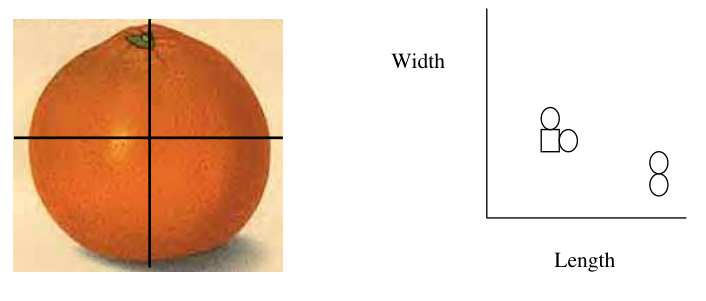
2\. With your ruler measure the dimension of those objects and plot your measurement in the

following graph. Use the axis of each object to measure the length and width see the example


3\. Keys are made based on a range of biological character such as shape, color etc. Create

keys as many as you can to identify the following objects available on the bucket. Remember

each item (number) maximum contain only two statements.


4\. With your ruler measure the dimension of those objects and plot your measurement in the

following graph. Use the axis of each object to measure the length and width see the example

Question illustration

Question 3

ELECTRICAL RESISTANCES OF METAL WIRES


Every material is characterized by its electrical resistance. If a metal wire is connected to a

battery, electrical current will flow through the wire. By reading the voltage difference between

the ends of the wire and the current flowing through the wire, the resistance of the wire can be

calculated.


Objectives:

In this experiment you will determine the resistances of materials.


Materials:

Electrical circuit board

Four batteries 1.5 V


Procedure:


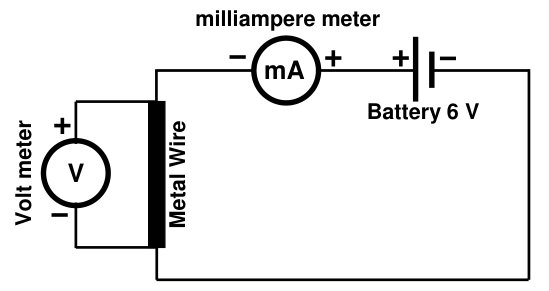
1\. Arrange the following electrical circuit using an electrical board and electrical

jumpers/connectors provided:

milliampere meter

mA

Battery 6 V
meter Wire V
Volt Metal


2\. The dependence of resistance on the length of a metal wire is investigated. Use a metal
wire with the cross-section area A1 of 0.1 mm2 and the length (L) of 5 cm. Read the

electrical current (I) flowing through the wire and the voltage (V) across the wire, which

are displayed by a milliampere meter and a volt meter, respectively.


3\. Repeat the measurement for the length (L) of 10 cm, 15 cm, and 20 cm.


4\. Calculate resistance (R) of the wire using the relation R=V/I.


5\. Make a table for the measurement and calculated resistance.


6\. Make a graph describing resistance (R) as a function of wire’s length (L) from the table.


7\. Now, resistance as a function of wire’s cross-section area is investigated. Use a metal
wire with the length of 20 cm and the area A1 of 0.1 mm2. Read the electrical current (I)

flowing through the wire and the voltage (V) across the wire.


8\. Repeat the measurement for the area A2, A3, and A4.


9\. Calculate resistance (R) of the wire using the relation R=V/I.


10\. Make a table for the measurement and calculated resistance.


11\. Make a graph describing the dependence of resistance (R) on 1/A from the table.


Question:

What are your conclusions from the two graphs.

Question illustration