Skip to content / Đến nội dung
ThichHocToan.com

IMSO 2025 — Mathematics Exploration

Question 1

A tangram is a seven-piece puzzle cut from a square: two large right isosceles triangles, one medium right isosceles triangle, two small right isosceles triangles, one square, and one parallelogram, as shown.
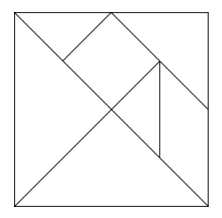
Question illustration

Arrange all seven pieces into a specific outline, such as an animal, object, letter or number. Pieces must fit without overlapping and must lie flat on a surface.

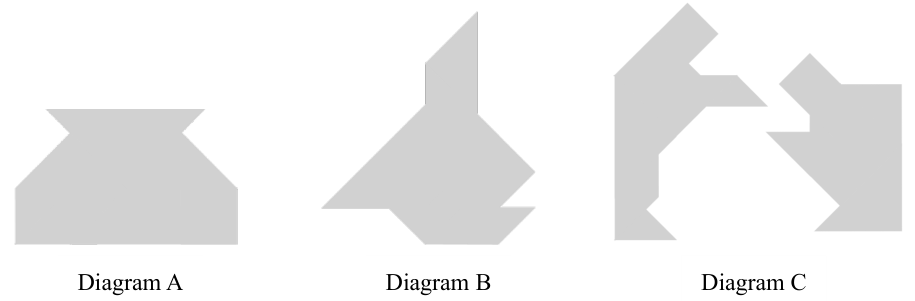
A. Use one tangram set to form Diagram A. (1 point)
B. Use one tangram set to form Diagram B. (2 points)
C. Use two tangram sets to form Diagram C. (3 points)
Question illustration

Question 2

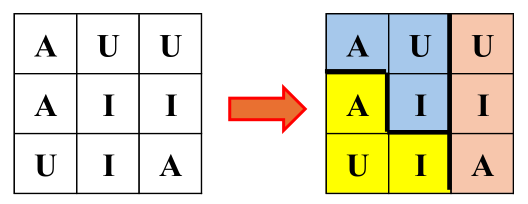
In a $3\times3$ grid with A,I,U, draw segments on grid lines to divide it into three pieces, shading them in different colors. Each piece must contain exactly three letters, all different. The completed example is shown.

Question illustration

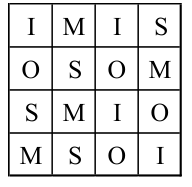
A. Divide the $4\times4$ grid into four pieces, using different colors. Each piece must contain exactly four letters, all different: I,M,S,O. (1 point)

Question illustration

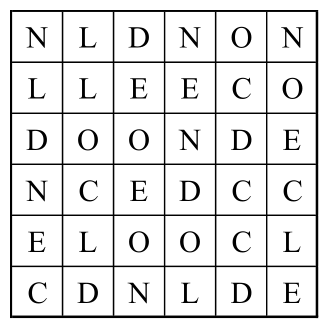
B. Divide the $6\times6$ grid into six pieces, using different colors. Each piece must contain exactly six letters, all different: C,E,N,D,O,L. (2 points)

Question illustration

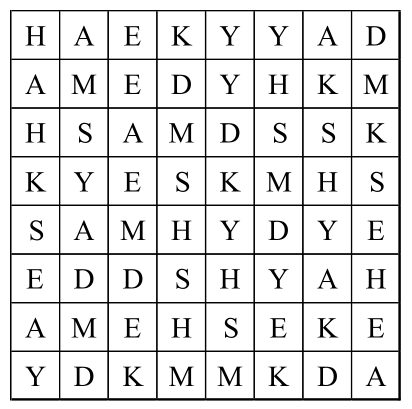
C. Divide the $8\times8$ grid into eight pieces, using different colors. Each piece must contain exactly eight letters, all different: K,E,D,A,H,M,Y,S. (3 points)

Question illustration

Question 3

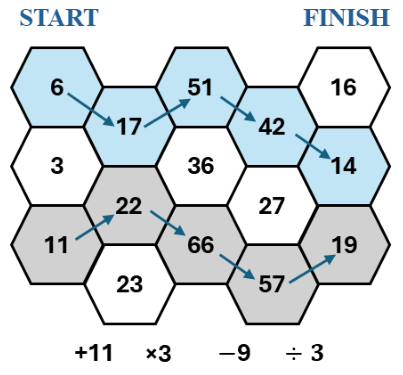
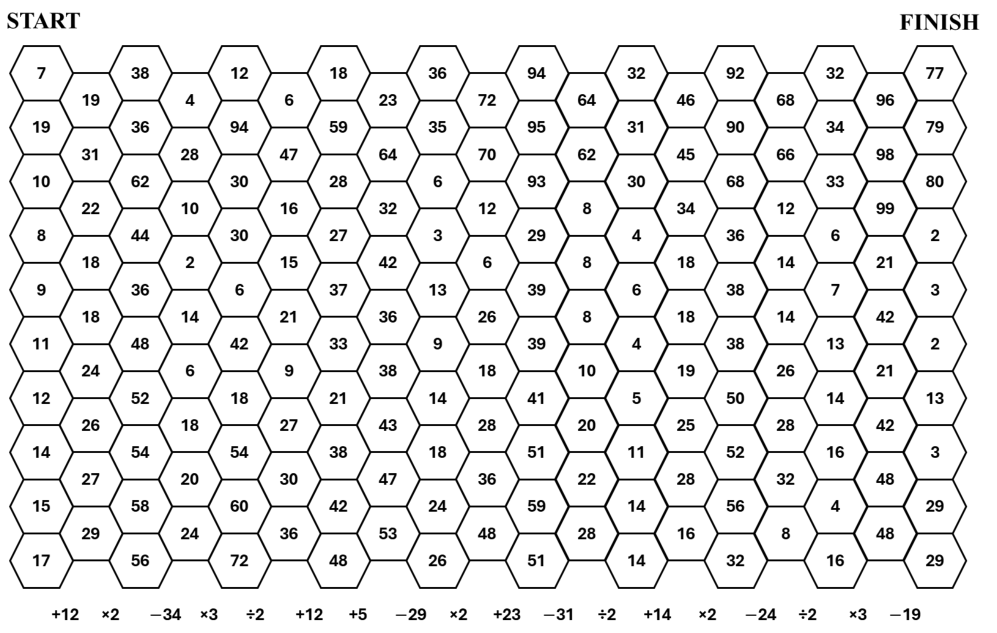
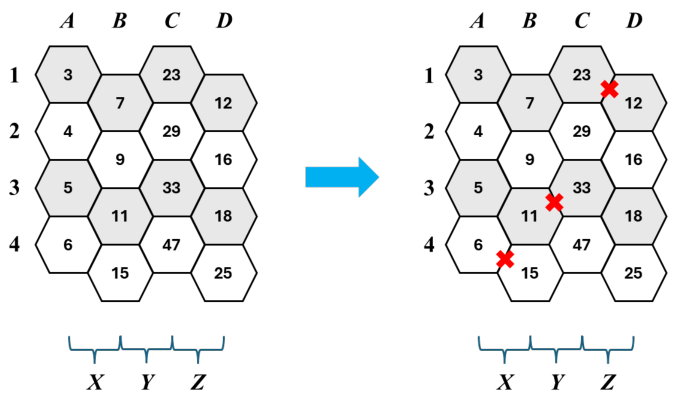
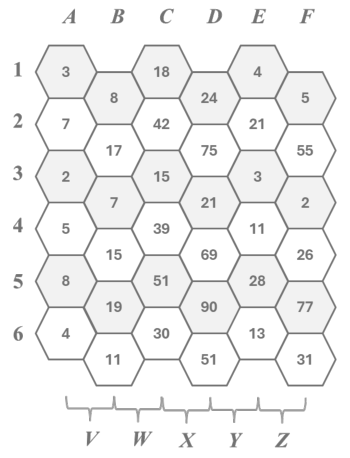
In every honeycomb grid begin in the leftmost START column and end in the rightmost FINISH column.

A. A path is correct when each operation gives the adjacent number in the next column. In the example there are two correct paths: $6\to17\to51\to42\to14$ (blue) and $11\to22\to66\to57\to19$ (gray).

Question illustration

Find and shade all correct paths in the following grid using a colored pencil.

Question illustration

B. A variant uses variables for operations. In the $4\times4$ example, rows are 1–4, columns A–D, and operations X,Y,Z. X maps column A to B; Y maps B to C; Z maps C to D. Each operation has exactly three correct calculations and one incorrect calculation. Put × on the incorrect segments. Writing a,b,c,d for the four numbers in a row, possible rules are: $b=2a+1$, correct in rows 1,2,3 and wrong in row 4; $c=3b+2$, correct in rows 1,2,4 and wrong in row 3; $d=(c+3)\div2$, correct in rows 2,3,4 and wrong in row 1.

Question illustration

Now, in this $6\times6$ grid, each operation has exactly four correct calculations and two incorrect calculations. Put × on every incorrect segment.

Question illustration

Question 4

A clear plastic sheet shaped like T covers five unit squares. Place it along grid lines, completely inside the grid. There are four possible orientations:

Question illustration

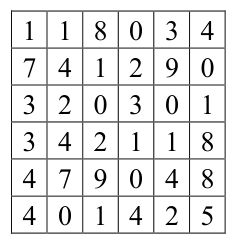
Consider this $6\times6$ number grid:

Question illustration

How many different placements cover numbers whose sum is 16? Show every solution by shading it on a separate grid using a colored pencil. Shade one T per grid.

Question 5

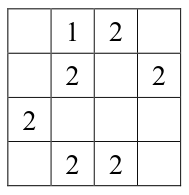
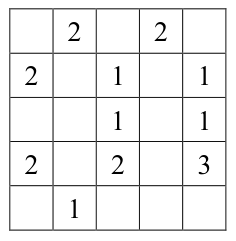
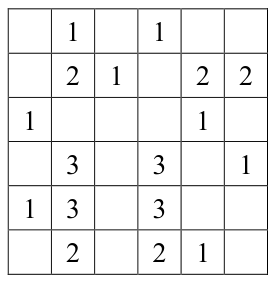
Find all hidden treasures. Each given number tells how many treasures touch its square in the eight surrounding side-or-corner neighboring squares; it does not count the square itself. Complete every empty square: write T if it contains a treasure, otherwise write the correct neighboring-treasure count.

A. (1 point)

Question illustration

B. (2 points)

Question illustration

C. (3 points)

Question illustration

Question 6

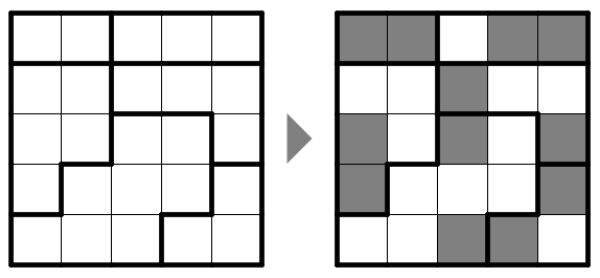
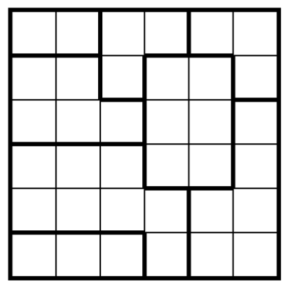
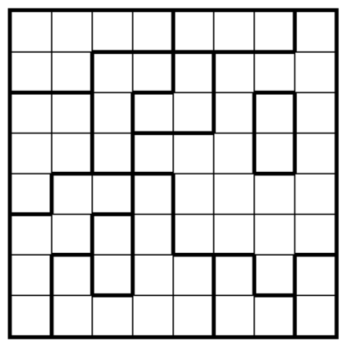
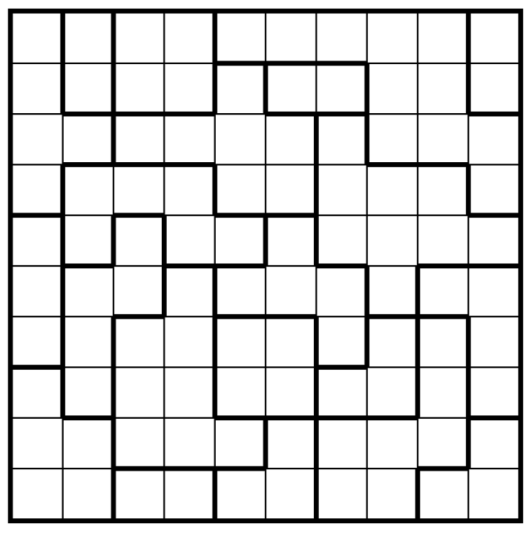
A grid is divided into regions; their shapes may be the same or different. Shade cells according to both rules:

- Every region contains exactly two shaded cells, which may or may not be adjacent.
- Every shaded cell shares a side with exactly one other shaded cell; its partner may be in the same region or a different region.

The original $5\times5$ example has six regions; its completed solution is shown at right.

Question illustration

A. $6\times6$, eight regions. (1 point)

Question illustration

B. $8\times8$, twelve regions. (2 points)

Question illustration

C. $10\times10$, twenty-one regions. (3 points)

Question illustration