Skip to content / Đến nội dung
ThichHocToan.com

IMSO 2024 — Mathematics Exploration

Question 1

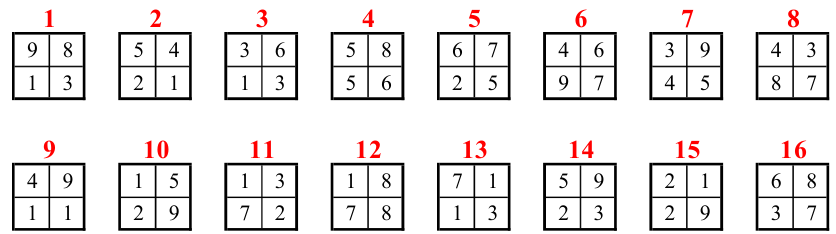
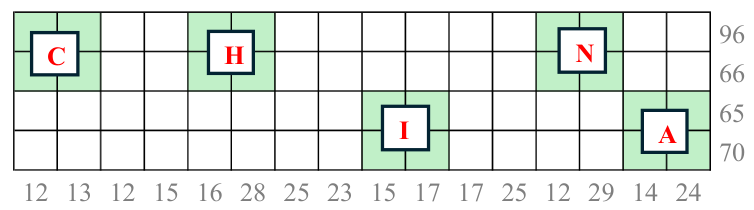
Fill the $4\times16$ grid using the sixteen $2\times2$ tiles below, each exactly once. Every column sum must equal the number below it; each row sum is given at its right. What are the tile numbers represented by [C], [H], [I], [N], [A]?

Question illustration

Question illustration

Question 2

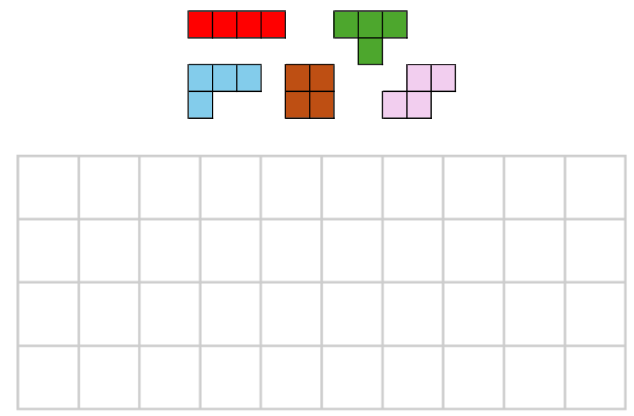
a. Use exactly 2 pieces of each of the following tetrominoes to cover the $4\times10$ grid without overlap.

Question illustration

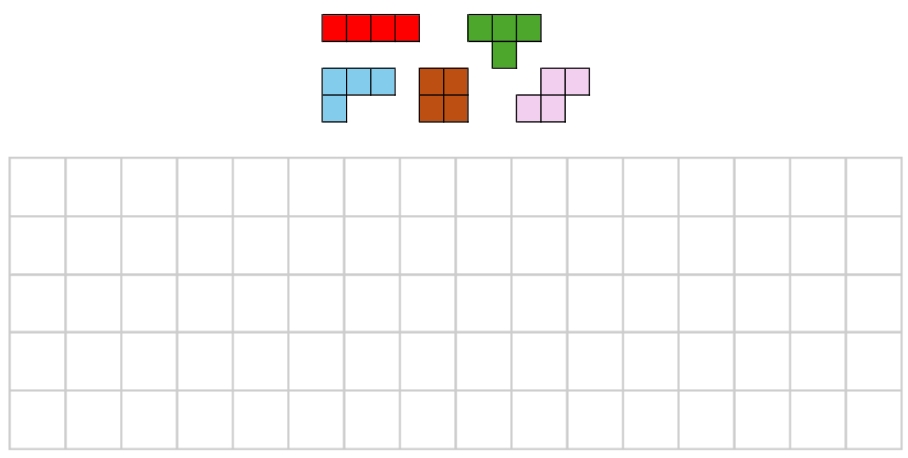
b. Use exactly 4 pieces of each of the following tetrominoes to cover the $5\times16$ grid without overlap.

Question illustration

Question 3

A standard domino set has 28 pieces: 6-6, 6-5, 6-4, 6-3, 6-2, 6-1, 6-0, 5-5, 5-4, 5-3, 5-2, 5-1, 5-0, 4-4, 4-3, 4-2, 4-1, 4-0, 3-3, 3-2, 3-1, 3-0, 2-2, 2-1, 2-0, 1-1, 1-0, 0-0.

a. In the left diagram, a standard set is laid out in an $8\times8$ grid. Mark the domino positions in pencil. The checklist at right may help: cross out each found domino. The 0-0 domino has already been marked.
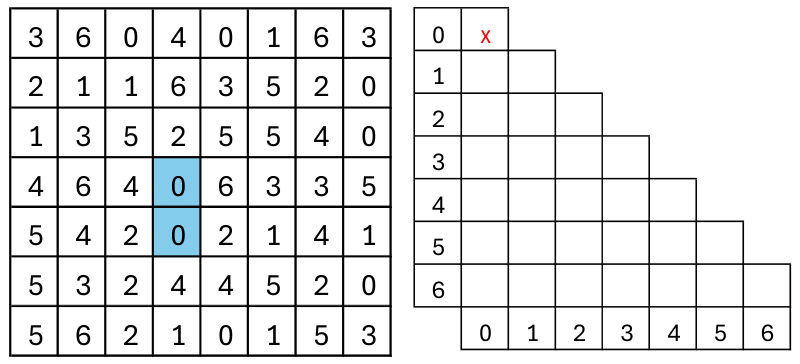
Question illustration

b. Bold lines show domino positions. Numbers beside each row and below each column must occur in that row or column, not necessarily in the given order. In a horizontal domino, the smaller number is on the right; in a vertical domino it is at the top. Each colored domino has equal numbers. Complete the $8\times8$ grid.
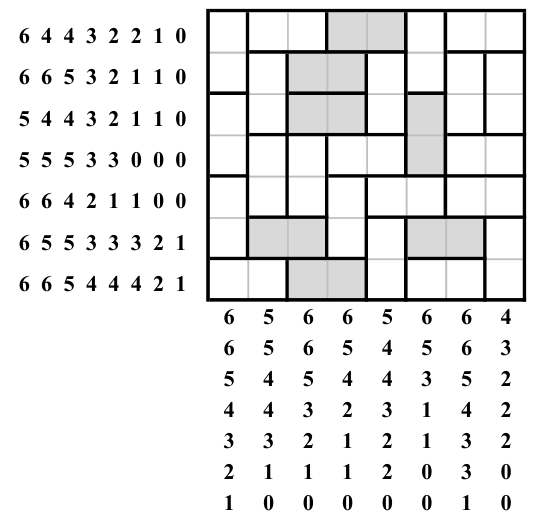
Question illustration

Editorial source note: both figures actually show 7 rows and 8 columns. The original wording and numbers are retained; see the solution for further contradictions.
Question 4

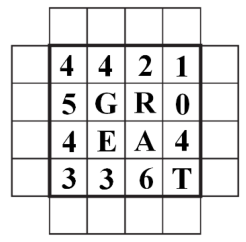
Place an arrow in each of the 16 outer squares, vertically, horizontally, or diagonally at 45 degrees, pointing into the bold-bordered grid. A number inside the bold border is the number of arrows pointing to that square. Draw all arrows correctly and find the five-digit number $\overline{GREAT}$, where G,R,E,A,T are the five missing numbers.

Question illustration

Question 5

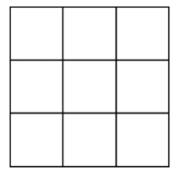
A $3\times3$ grid is shown.

Question illustration

Andy wants to shade some cells so that no two shaded cells share an edge. How many ways are there to shade (a) fewer than 3 cells, (b) 3 or 4 cells, (c) more than 4 cells?

Question 6

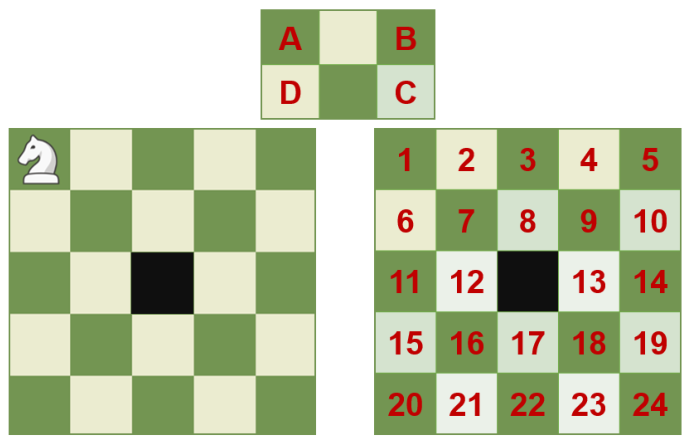
A $5\times5$ square board has its center square missing, marked black. A white knight moves in an L-shape: in the illustrated $3\times2$ rectangle it can move A to C, C to A, B to D, or D to B. Starting at the top-left square (Square 1), list every possible route by writing in order the numbers of the squares visited. A route passes through every available square exactly once.

Question illustration