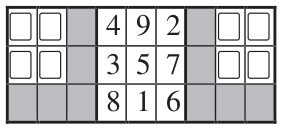
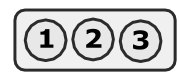
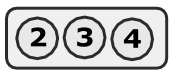
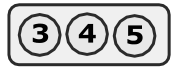
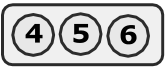
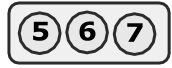
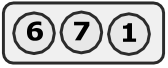
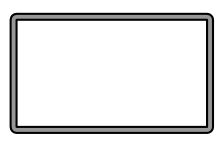
The left and right parts of a three-part brochure each contain four transparent windows. When both parts are folded onto the middle part, some of its numbers are visible through the windows. What is the sum of the visible numbers when the brochure is folded?
The base of a triangle is extended by 50% and its height is reduced by one third. What is the ratio of the area of the new triangle to the area of the original triangle?
Lisa has four wooden digits with which she can make the number 2025. How many different numbers greater than 2025 can she make using these four digits?
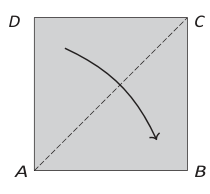
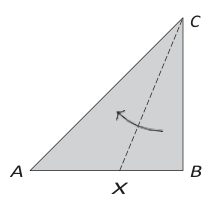
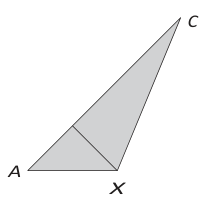
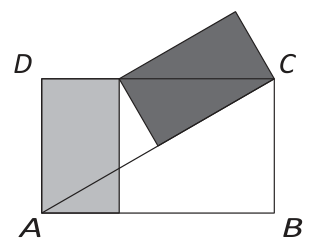
Alex folds a square sheet of paper along its diagonal to form a triangle. He then folds it again so that one shorter side lies on the longer side, producing the smaller triangle AXC shown. What is $\angle CXA$?
The four-digit number $\overline{80ab}$ is missing its last two digits. It is divisible by both 8 and 9. What is the product of the two missing digits?
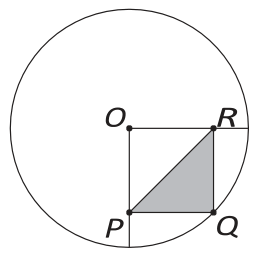
A circle has centre O and radius 10 cm. A square OPQR is drawn inside it so that Q lies on the circle, as shown. What is the area of the grey triangle PQR?
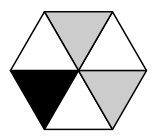
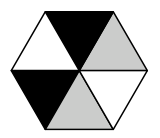
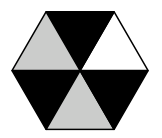
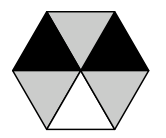
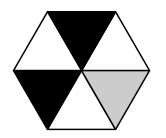
An athlete has 2 gold medals and 5 silver medals, numbered in some order from 1 to 7. Each of the six black-and-white photographs shows exactly one gold medal. What is the sum of the numbers on the two gold medals?
Anna is looking at a picture on her smartphone. Its format is 16:9 and it fills the entire screen. When she turns the phone, the picture becomes smaller, as shown. What proportion of the screen does the smaller picture occupy?
Kate and Tom both celebrate their birthday today. Tom notices that $1/19$ of Kate’s age equals $1/17$ of his age. Together they are older than 40 years and younger than 100 years. How old is Kate?
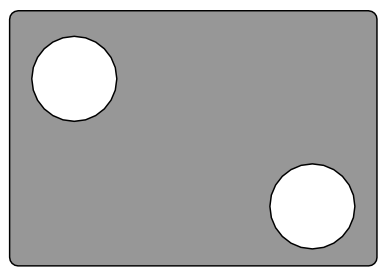
Paul shoots at the two targets shown a total of 27 times. He hits the upper-left target on 50% of the shots aimed at it and the bottom-right target on 80% of the shots aimed at it. Altogether 9 shots miss their target. How many times does he hit the upper-left target?
Sara has a bag of 18 balls numbered from 1 to 18. What is the smallest number of balls she must remove to be sure that at least three removed balls bear prime numbers?
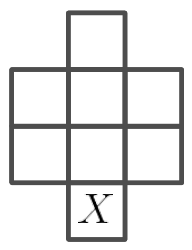
We place the numbers 1 through 8 in the eight squares shown, one per square, so that consecutive numbers are never in adjacent squares, including diagonal adjacency. Which numbers can be written in the square marked X?
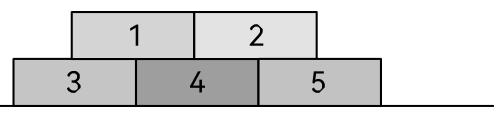
Five bricks form the wall shown. Peter may remove a brick only when no other brick is directly above it. At each turn he chooses uniformly at random among the currently removable bricks and removes one. What is the probability that brick 4 is the third brick removed?